The zone system
Eleven zones as one world. Seven variables each zone sets, a neighbour rule, a compass rule for glow, and the colour script.
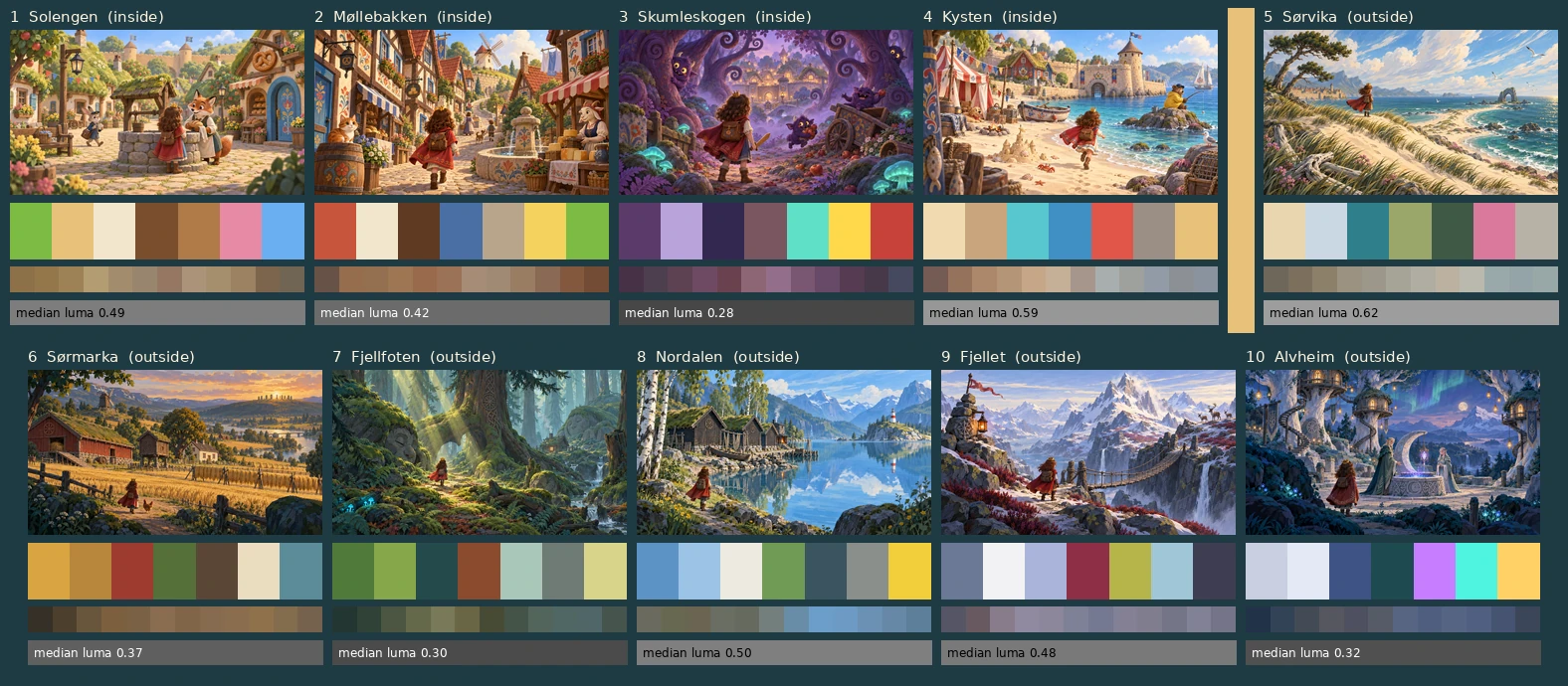
Eleven zones in two groups: four inside the wall, seven outside (Alvheim is one of them, and has a book of its own). Each has a card with the same fields, a page of its own, and numbers in tokens.json. A zone added later fills in zones/_template.md.
What keeps them one world
The eight family rules; the same sky and sun; the same princess; the same paper UI; one umber path colour outside (#5A4636) and one tan inside (#B07A48); one family of lantern posts, waystones and signposts on each side of the wall.
What makes each distinct: seven variables
| Variable | Rule |
|---|---|
| Key colours | 5 to 7 hex with roles; the first one or two take half to two thirds of a frame. |
| Value key | The allowed median luma of a daytime frame, a band 0.14 to 0.18 wide. |
| Shape motif | One shape that the land, the trees and the buildings all repeat. |
| Accent | One of the four glow colours, by the compass rule below. |
| Light and weather | An hour and a weather the zone leans toward. In the game this is a bias in the region grade and the haze while the clock keeps running. |
| Signature plant and ground | One flower or plant found nowhere else as a drift, and one ground. |
| Architecture | One roof, one wall material, one colour, one detail. |
The compass rule
North is fire against the cold: ember #FF8A3D. West is old magic: cyan #4FF3E0. South is the sun: gold #FFD166. High is the moon: violet #C77DFF, with cyan. Inside the wall nothing glows by day except Skumleskogen's mushrooms and eyes.
The neighbour rule
Two zones that meet differ in at least two of: key hue (40 degrees or more apart), value key (0.10 or more apart), temperature (warm or cool). The closest pairs:
- Solengen and Møllebakken: both warm, both about 0.45. Hue and motif carry it: turf green against tile red, a low dome against a tall gable. The ground carries the rest: lawn and turf in Solengen (green at least 40 % of a frame), cobbles and red tile on Møllebakken.
- Nordalen and Fjellet: both cool and light. Nordalen keeps its birch green as the larger share, and the border runs through red heather.
- Sørmarka and Fronten: Fronten's only border. Key hues 75 degrees apart (olive and grey-violet haze against barley ochre) and cool against warm; the value keys overlap (middles 0.36 and 0.38), so the step south is a change of colour and temperature, not a drop into the dark.
- Fronten and Fjellfoten: next to each other in travel order, but they do not meet on the map. Both are mid-low and green-grey (hues 29 degrees apart, value keys 0.05 apart), so a border between them would pass at most one of the three tests (temperature).
The eleven cards
| Zone | Side | Value key | Shape motif | Glow |
|---|---|---|---|---|
| Solengen | inside | 0.38 to 0.55 | the bread loaf: a low dome on a round foot | none that glows by day; butter-yellow windows and lanterns |
| Møllebakken | inside | 0.35 to 0.52 | the tall gable and the turning wheel | none that glows by day; striped awnings |
| Skumleskogen | inside | 0.22 to 0.36 | the spiral | mushroom teal and the skumlinger's yellow eyes |
| Kysten | inside | 0.50 to 0.68 | the scallop and the wave arc | none that glows by day; coral stripes |
| Sørvika | outside, look 0.85 | 0.52 to 0.70 | the wind-leaning crescent | gold: sparkle on the sea, the lamp at Havporten |
| Sørmarka | outside | 0.30 to 0.46 | the long low line and the row | gold: the sun stones, lamplight in the barn |
| Fronten | outside | 0.30 to 0.42 | the long line and the leaning post | gold: the line's lanterns, beacons and muzzle flash; ember for fire; violet only south of the moat |
| Fjellfoten | outside | 0.24 to 0.38 | the huge trunk and the hunched round back | cyan: glowing mushrooms, the trolls' tarn |
| Nordalen | outside | 0.40 to 0.58 | the slender upright and its mirror image | ember: the smokehouse, the kiln, the brazier, the lighthouse lamp |
| Fjellet | outside | 0.40 to 0.58 | the triangle and the diagonal | ember by day (a lantern, a campfire); the northern lights at night |
| Alvheim | outside, look 0.6 | 0.26 to 0.42 | the crescent and the pointed leaf | violet and cyan: the moonwell, the runes, the flowers |
Open a zone for its palette, motif, light, plants, buildings, creatures and its one "never".
The colour script, painted
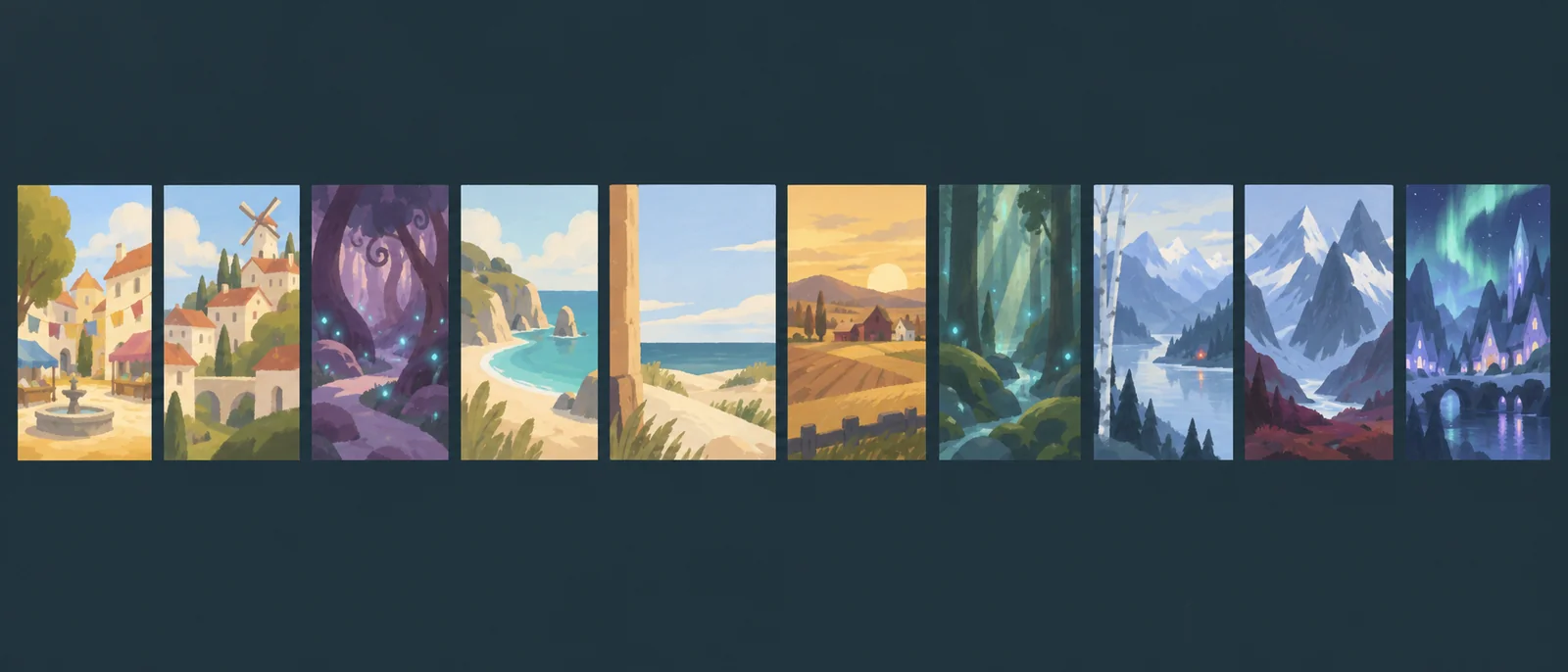
What the strip must keep doing, and what a new zone must not break:
- Inside is one warm chord with one low, violet dip.
- The wall is the biggest step; the first zone outside (Sørvika) is the lightest and most open, so the step out feels like air.
- Outside swings: light and pale (Sørvika), warm and mid (Sørmarka), cool and mid (Fronten), low and green (Fjellfoten), light and blue (Nordalen), light and cold (Fjellet), low and glowing (Alvheim). No two zones that meet share a value key and a hue; Fronten and Fjellfoten are close in both and never meet.
- Saturation falls and glow rises along the way.
- The strip's own fault: Solengen and Møllebakken average to nearly the same tan. In the game the ground must carry the difference.
Adding a zone
Fill in zones/_template.md, add the card to tokens.json, and run the six checks at the end of making and judging. The accent follows the compass rule or the card says why not.