Folk and creatures
One design for human folk, with numbers. Eyes first. The bigger, the kinder.
Folk
One design for human folk in the whole game (Petter, 2026-10-01): the outside design, shown by the bottom row of the line-up. It is used inside the town wall too. The 3-head chibi folk of the top row are retired as a target.
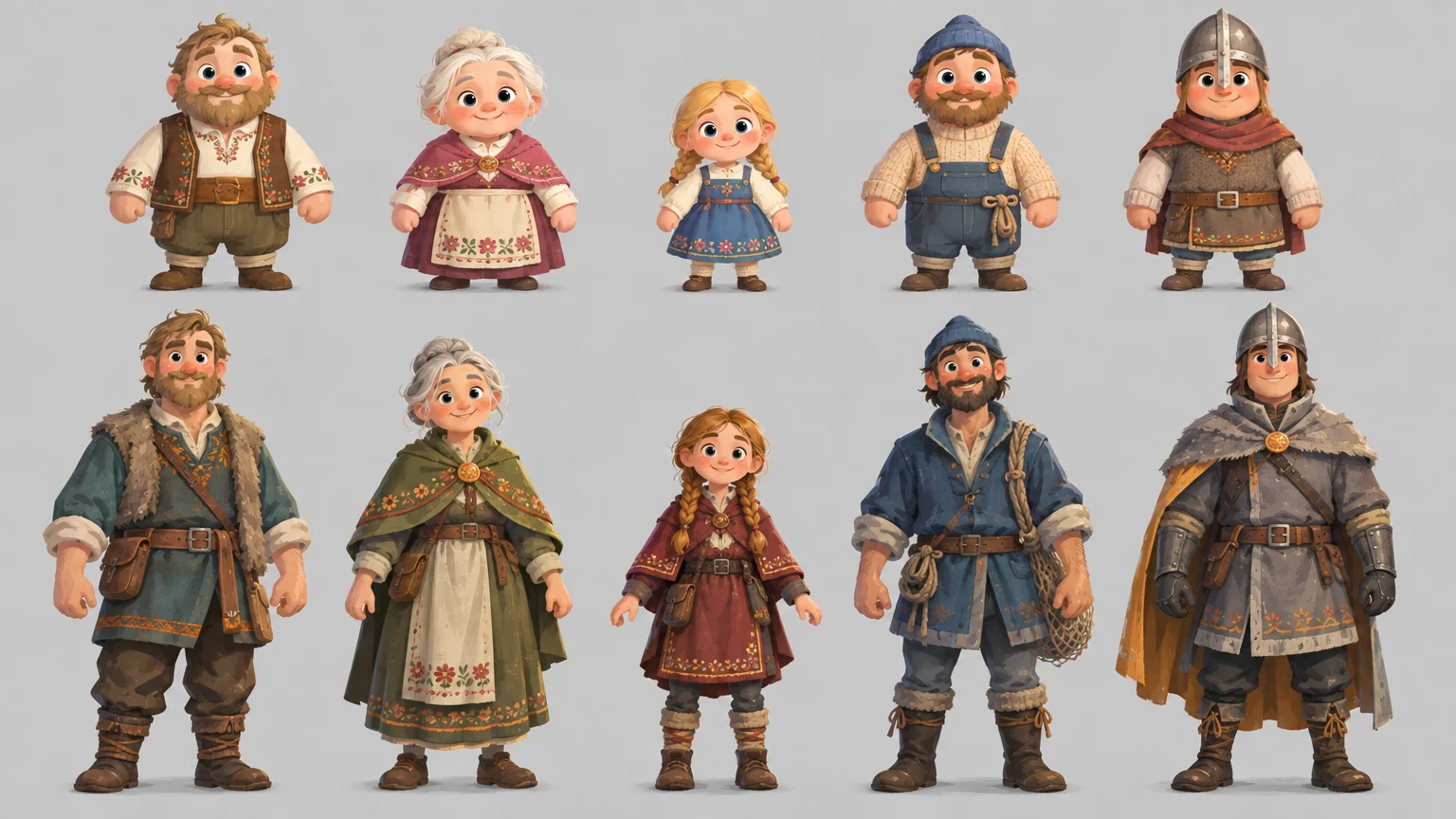
| Human folk, inside and outside | Elves of Alvheim (own book) | |
|---|---|---|
| Grown-up | 4.5 heads tall (4 to 5), stocky: a large head, a short neck, a long body, short strong legs | 5 heads; the queen 5.5 |
| Child | 3.5 heads | 3.5 heads |
| Height in the game | 1.45 to 1.8 m | 1.75 to 1.9 m; the queen 1.95 m |
| Each eye | at least 1/5 of the face's width, with strong expressive brows | a quarter of the face's width, whites visible |
| Face | a nose with a shape, a smile, brows that act | star-freckles, leaf-shaped ears |
| Paint | three flat tones with hard edges, brush planes visible, thin coloured line; painted light from above and in front | the same brush; the book's own glow rules |
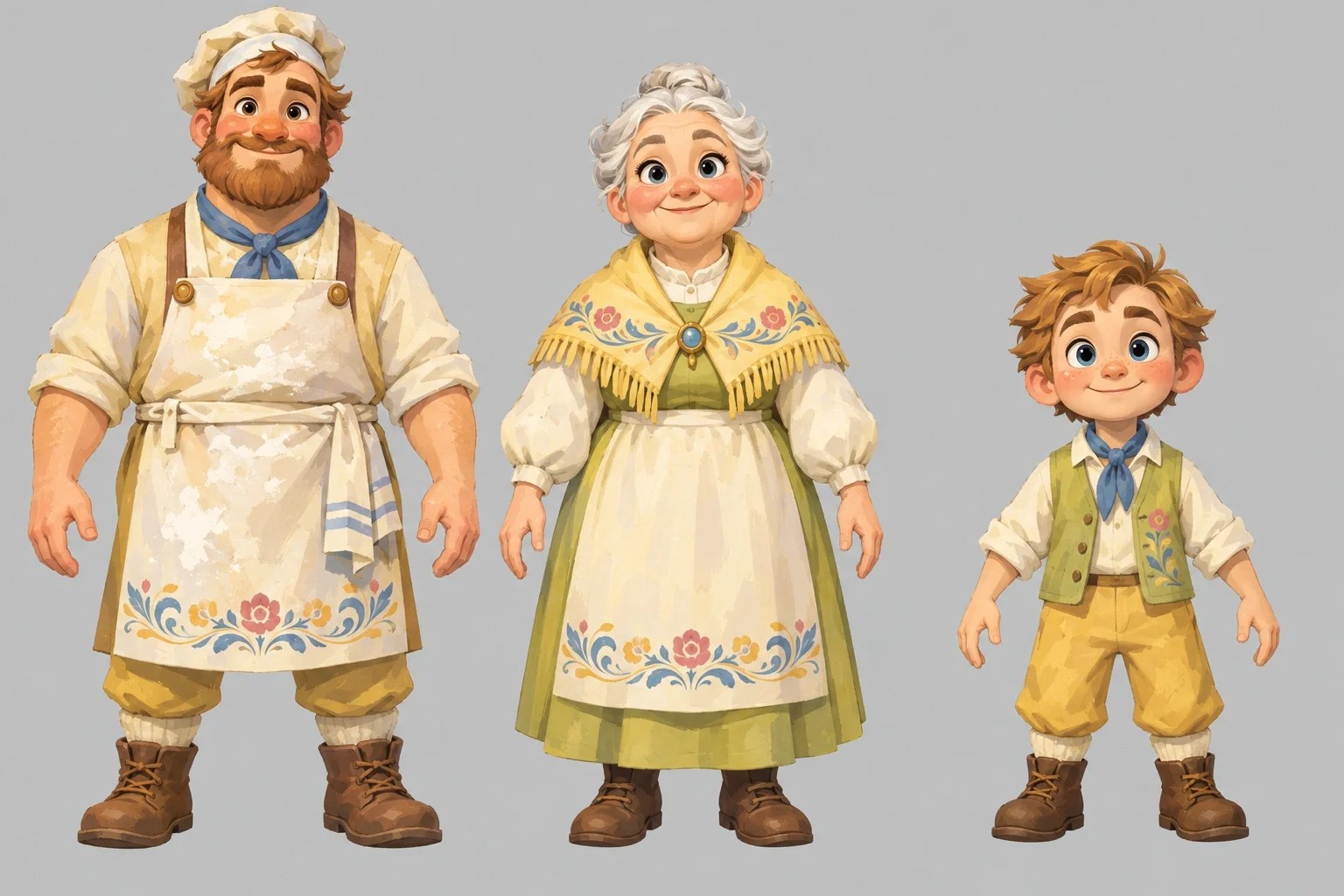
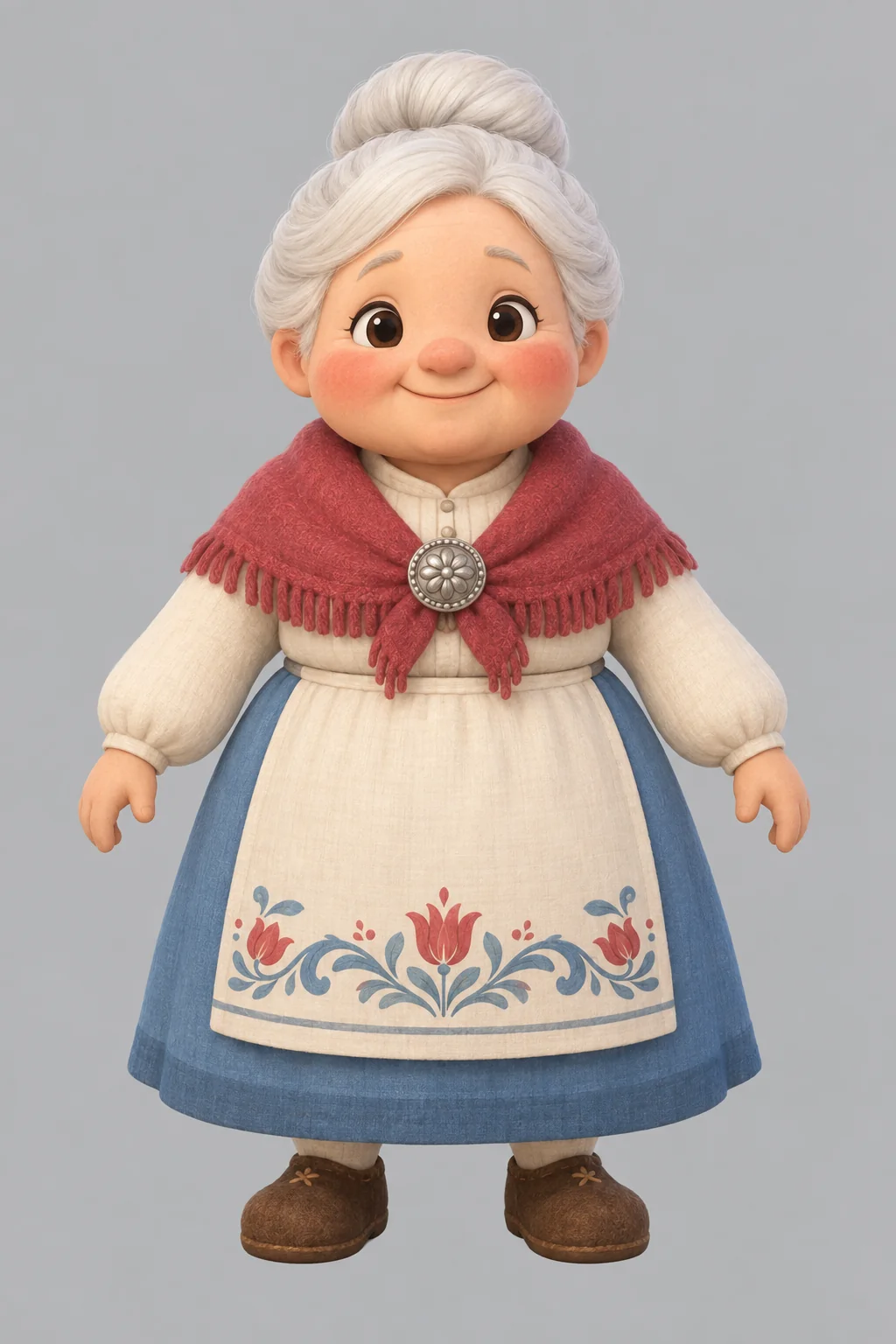
| Colour inside the wall | lighter and warmer: the zone's palette (cream, honey, butter, yellow-green, rose, sky blue), one small accent | |
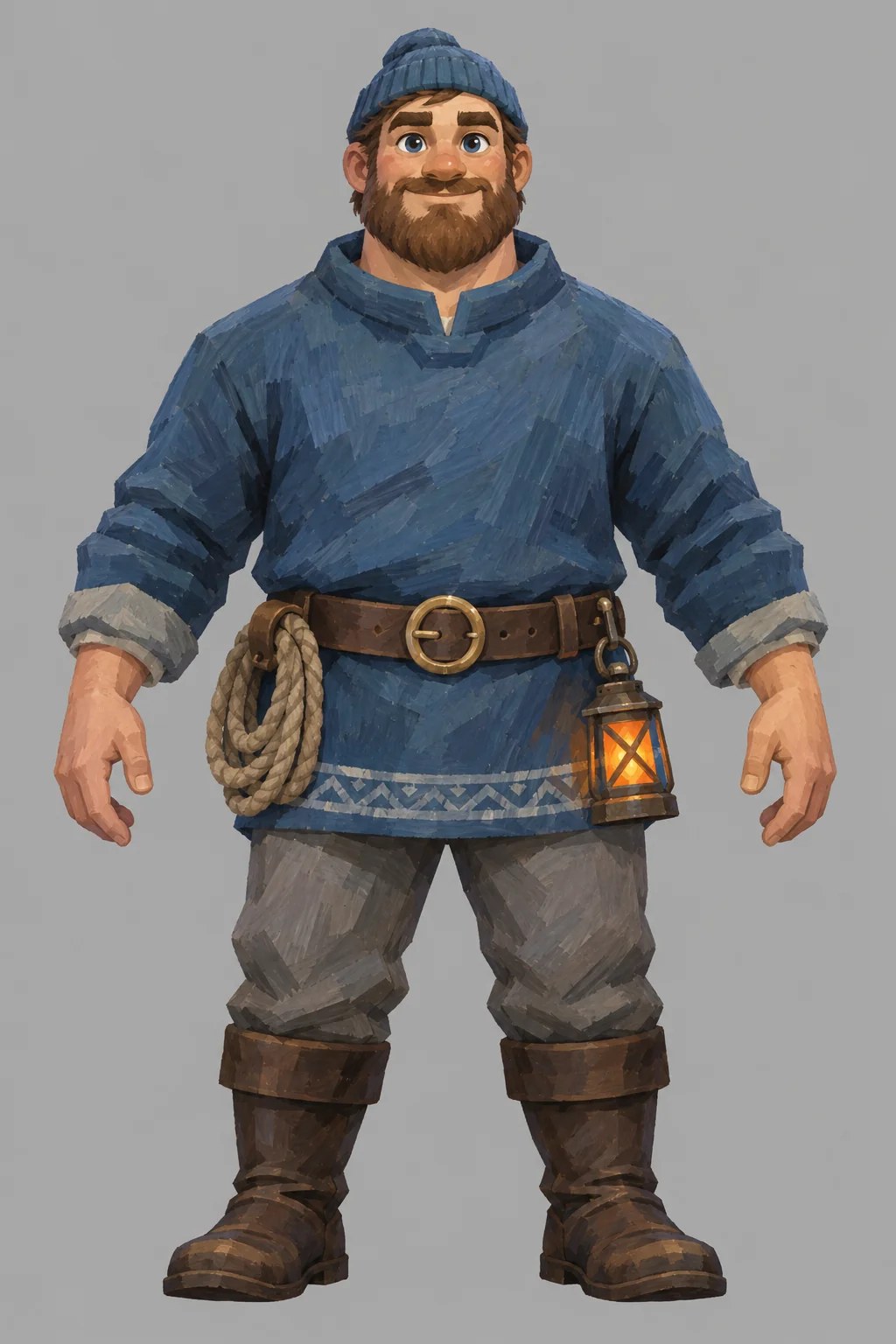
| Colour outside the wall | one colour of their own per figure from the zone's palette and one small glowing accent (a lantern, a buckle) | |
| Ornament on clothes | inside: one painted rosemaling band; outside: one woven or carved geometric band | one woven rose band in the elf's glow colour |
| The princess | 1.2 m, 3 heads: the game's own model, not redesigned | not redesigned |
The wall's difference is carried by the place (shape, palette and paint of buildings and land, enclosure). On a figure it is carried only by what the zone sets:
- Clothing colours from the zone's palette. Inside, lighter and warmer: cream, honey, butter, fresh yellow-green, with a clear rose or sky-blue accent; brown only for boots and belts. Outside, one colour of their own and one small glowing accent.
- The ornament rule: inside, one band of painted rosemaling flower scrolls in rose, butter and blue; outside, one woven or carved geometric band.
Same body, same face, same brush. The princess, the animal villagers already in the game (the Tripo cast inside the wall), animals and creatures, and Alvheim's elves are not changed by this.
Do
- Say the head count as a number and a fraction: "exactly four and a half heads tall"; a child "exactly three and a half".
- Give the eyes their own sentence: "as big and bright as an animated-film hero, strong expressive eyebrows".
- Inside, put the zone's light warm colours and one rosemaling band on the clothes.
Never
- Folk at 5.5 heads with small eyes (a grown-up fantasy game).
- Folk at 2 or 3 heads (gnomes, chibi) for new human figures.
- Weapons held up, shields, or black clothes.
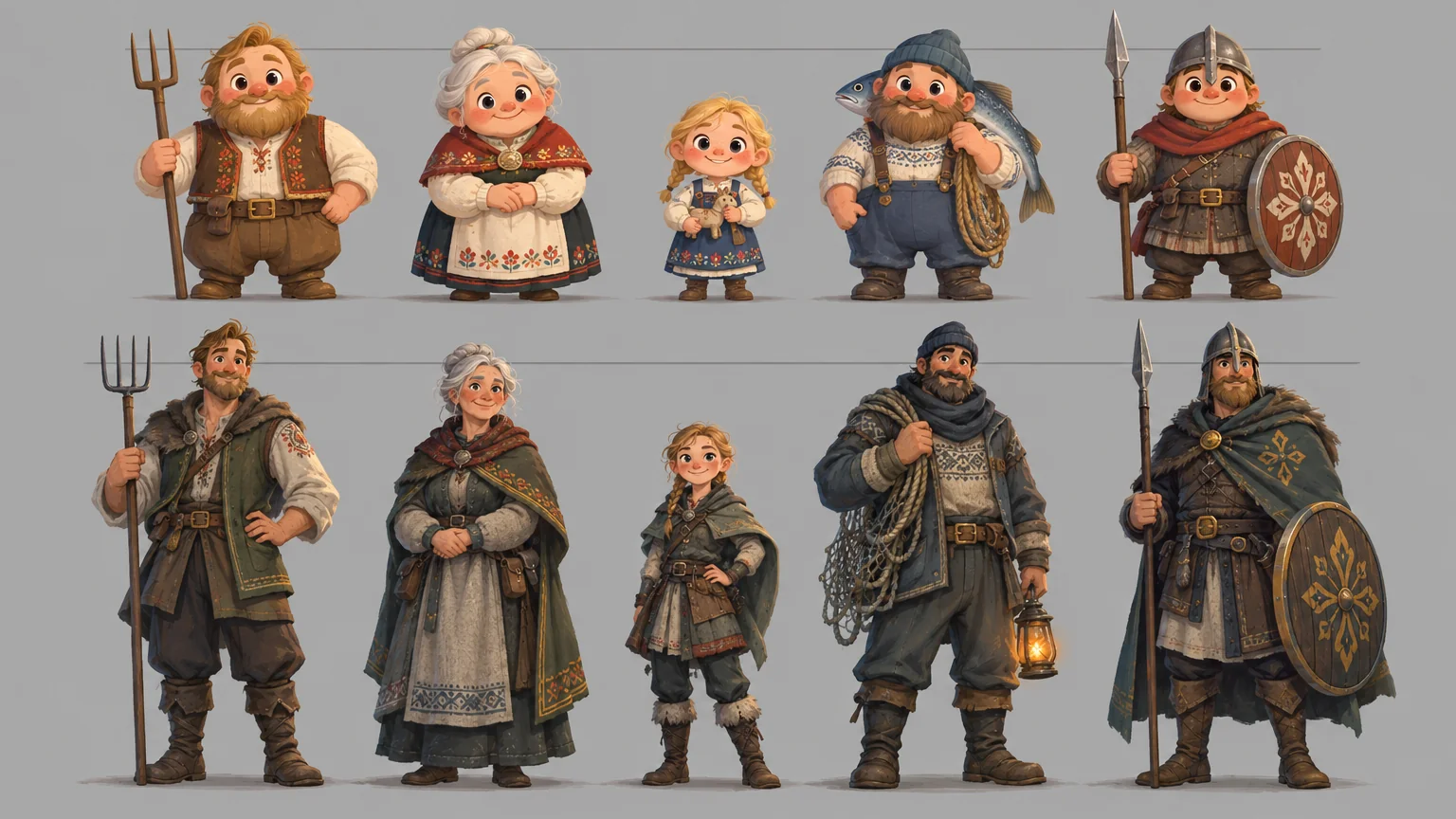
Do not draw gákti, the four-winds hat or Sami band patterns for mountain folk, elves or herders. Use generic Norse carving and woven bands. See open questions.
Creatures
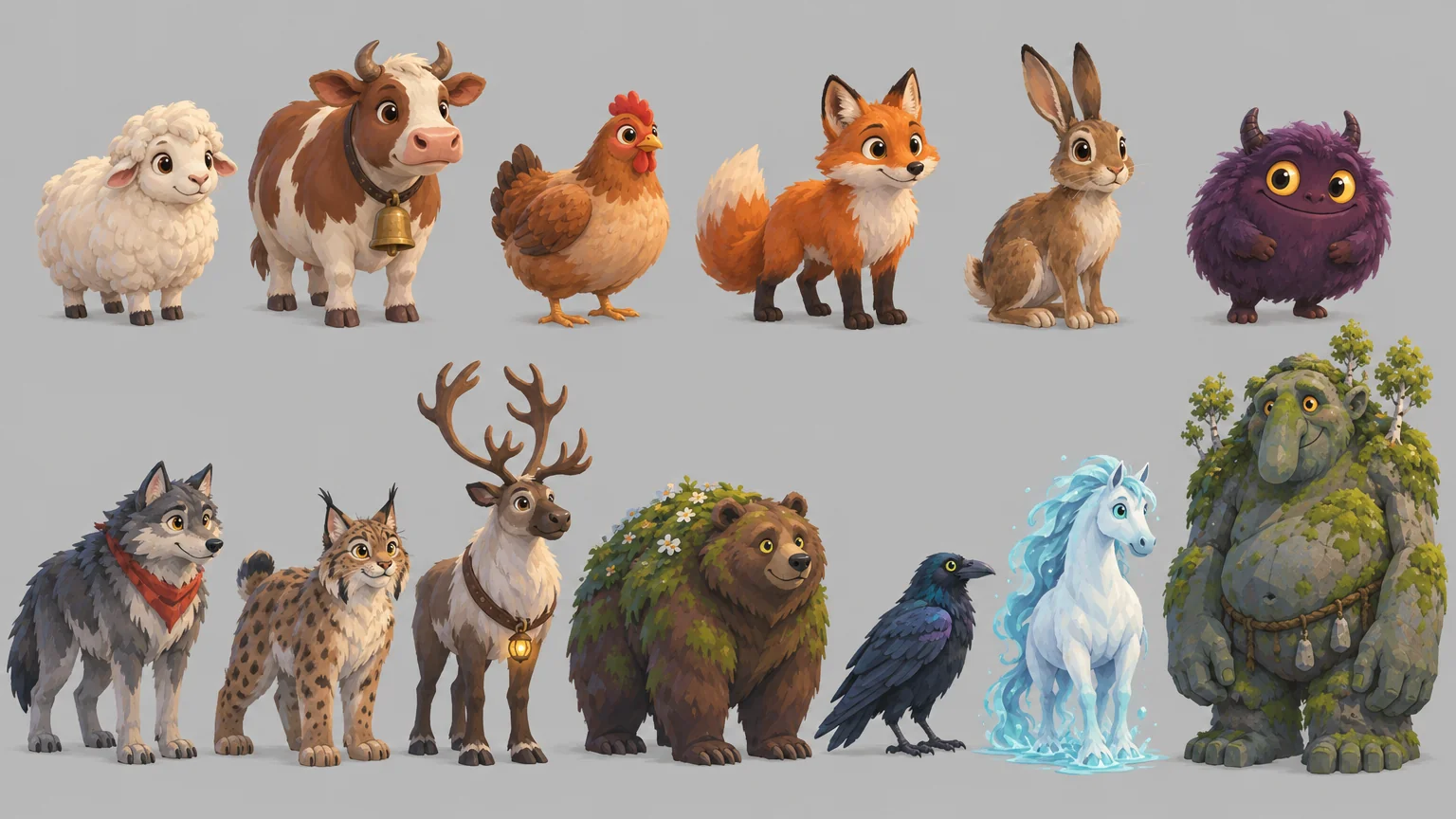
| Inside the wall | Outside the wall | |
|---|---|---|
| Head | half the body's size | a third |
| Legs | short; at most 1/4 of the height | longer, real joints, still thick |
| Anything over 3 m | not inside | round back, half-closed warm eyes, closed mouth |
| Inside | Outside | |
|---|---|---|
| Eyes | big, round, dark with a highlight | big, coloured, bright; a magic creature's eyes glow in its zone's accent |
| Silhouette | round rump, no neck | tapered, one asymmetry (a bent ear, a neckerchief, moss on one shoulder) |
| Surface | soft masses, no strands | three tones, fur and feathers as brush planes |
| Worn or grown | a bell, a bow | a neckerchief, flowers or moss growing on it, a lantern |
Rules for all:
- The bigger, the kinder. Anything over 3 m has a round back, half-closed warm eyes and a closed mouth.
- A dangerous thing differs from a friendly one by silhouette and accent before it is close.
- Skumlinger are deep violet plum
#3B2A4F(proposed), never black, with big yellow eyes and tiny horns. - A creature belongs to one zone and wears something of it: Fjellfoten's bear grows moss and anemones, Nordalen's water-horse has a cyan sheen, Fjellet's reindeer carries a lantern.