Grass and flowers
Painted masses, not blades. Thirteen art rules, two hands on either side of the wall, and the rules for a flower card.
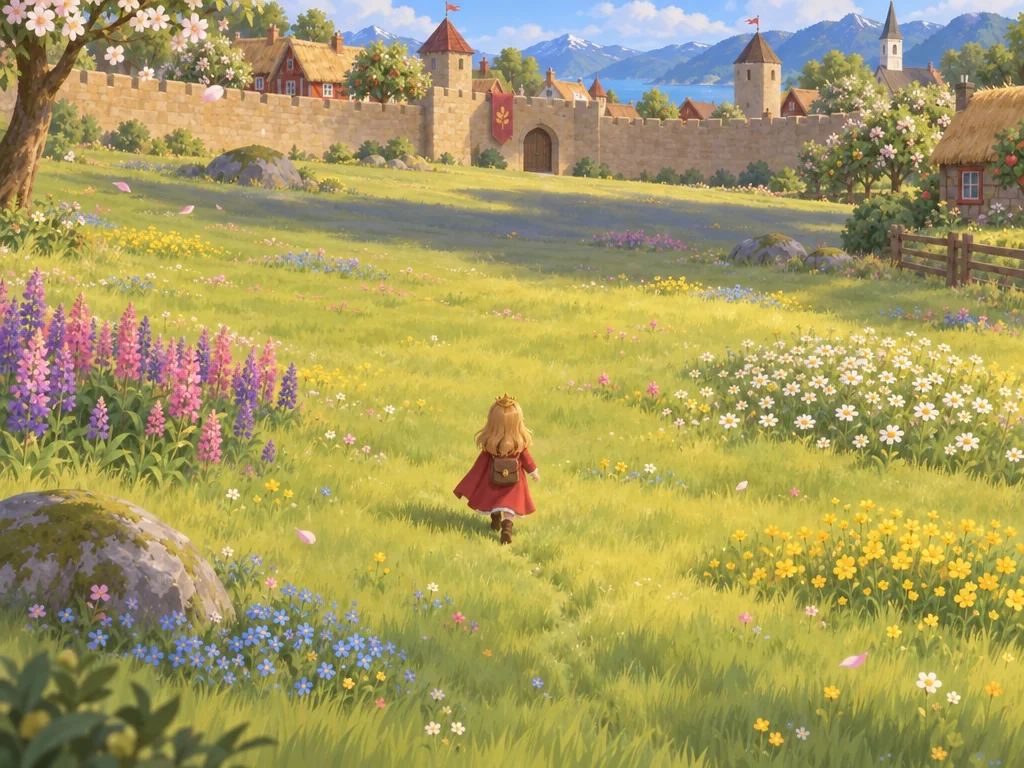
Grass and flowers are the ground of every frame, so they carry a lot of the look. The rule in one line: a meadow is two or three colour shapes; blades are drawn only where the grass has an edge.
This chapter holds the art rules. The technique (washes, tufts, dab flowers, the gust texture, budgets, build order) is a design in the grass portfolio and is being built in the game on its own branch; the game's docs/flora.md will describe what was built. Where the build changed a number, that number replaces the one here.
The thirteen rules
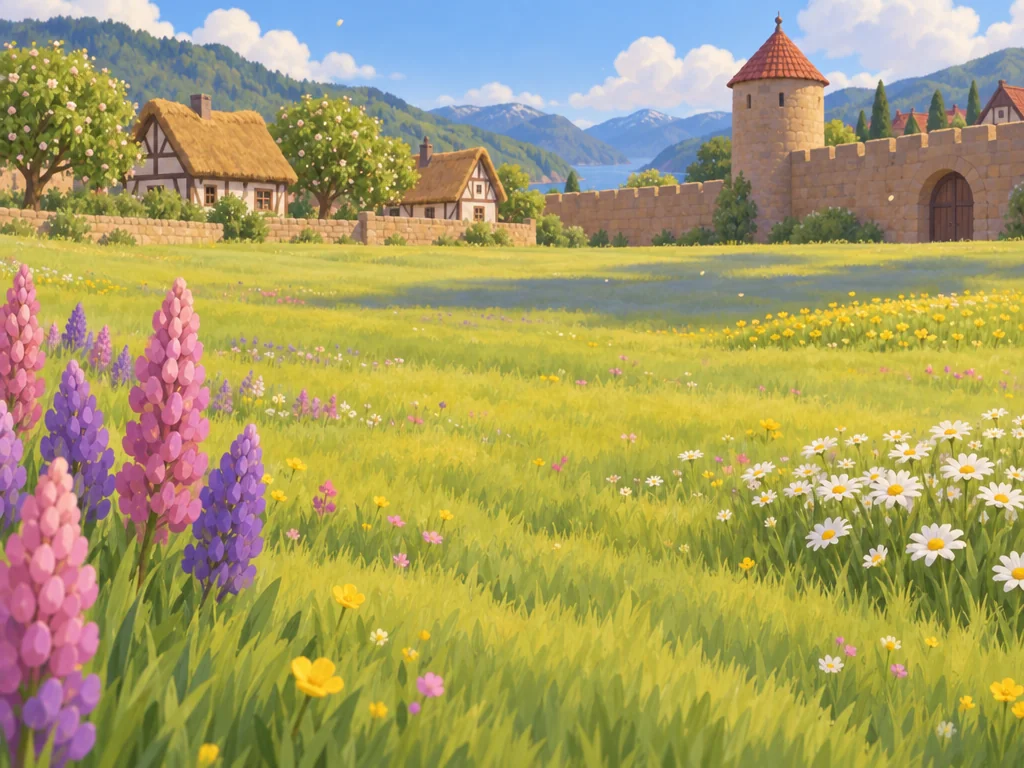
R1. Masses before blades. A meadow is two or three colour shapes. Blades are drawn only where the grass has an edge against something else: the nearest 3 to 4 m, the crest of a rise, the rim of a path or a stone. In the middle of a field there is colour and a few brush marks, no blades. Check: in a lit patch 8 to 20 m away, the standard deviation of display luma in a 64 by 64 px window is under 0.035.
R2. A blade's foot is the ground's colour. The darkest thing in a tuft is its foot, and it is only a little darker and cooler than the ground beside it: times 0.86 inside, 0.78 outside, never 0.5. Light sits at the outer and upper edges.
R3. Vary hue, hold value. Across a lit field the value stays within 0.05 luma; the hue wanders between a warm and a cool version of the zone's green in patches 10 to 40 m across, with dry, yellowed patches 5 to 15 m across. Check: hue spreads at least 6 degrees inside and 4 outside, sampled every 4 m.
R4. Four values in a meadow frame. Sky lightest, the lit ground next, slopes and cloud shade next, upright things (trees, the wall, her) darkest. A lit meadow is lighter than any tree beside it.
R5. Light crosses the field as shapes. A cloud shadow is one flat shape with a soft edge, cool, never dark (luma about 0.24 outside). Use one of two schemes: shade near with a patch of light in the middle distance, or a fringe of light near with the shade behind.
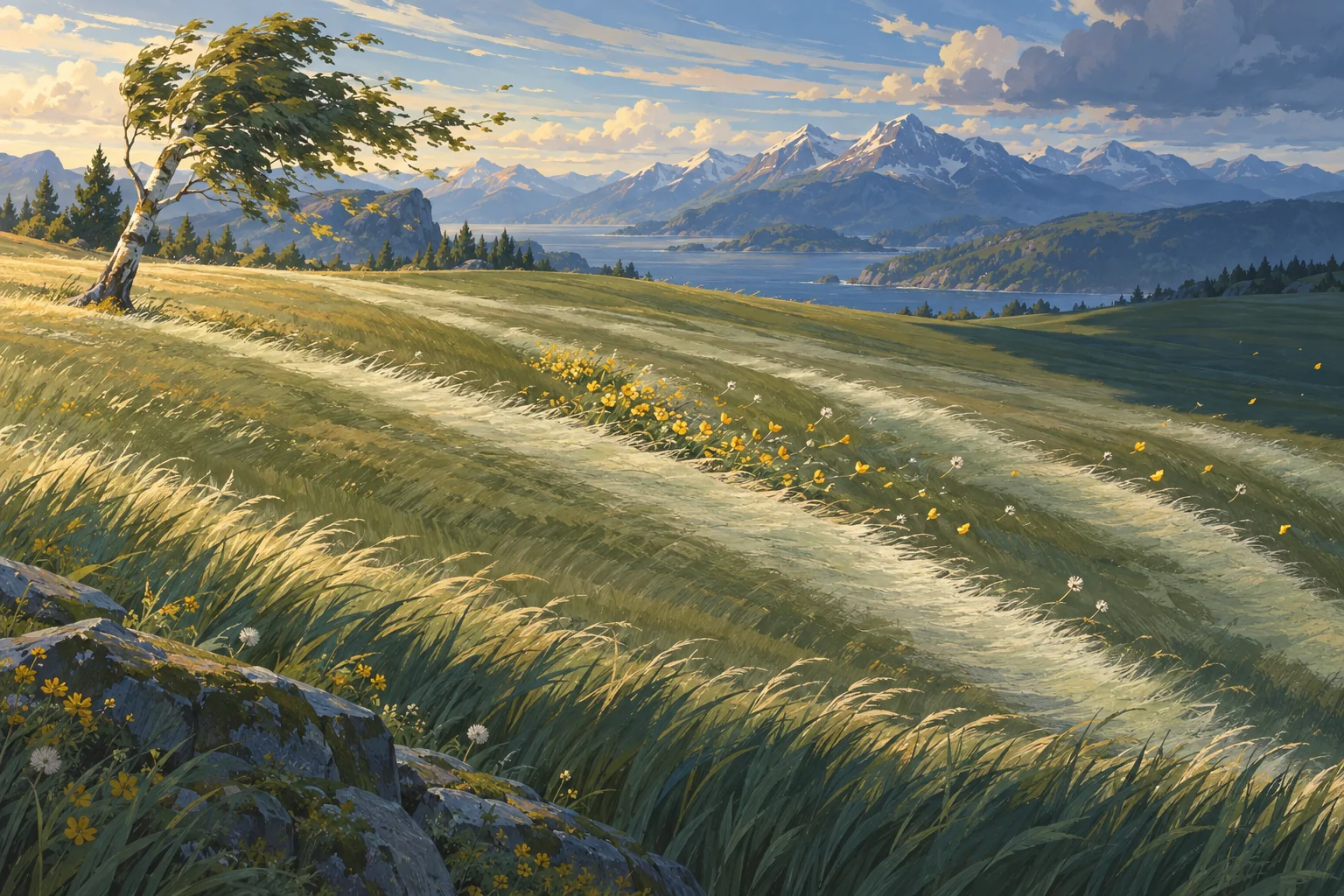
R6. A gust is a band of pale grass with a front. The leading edge is sharp (1 to 2 m), the tail fades over 15 to 35 m, bands lie 20 to 40 m apart and bend with the ground. In the band the grass is lighter by about 0.15 luma and less saturated (#9B9771 against #777141), because the blades show their pale sides. Flowers in the band lean, and seeds and petals travel with it.
R7. Flowers are masses too. A drift is one kind and one colour, with a ragged edge and a thick middle. Inside, drifts are small (3 to 6 m across) and many; outside, few and big (10 to 30 m). At least two thirds of a meadow is open grass on both sides of the wall. Check: no flower kind is spread evenly over a field; the share of ground under flowers is at most a third.
R8. Three sizes of flower. Near (to 8 m): a few big simple shapes, in groups of three, one large and two small. Middle (8 to 40 m): dabs, a hand's width each. Far: a patch of colour with a soft edge, no dots. The same drift is all three as she walks up to it.
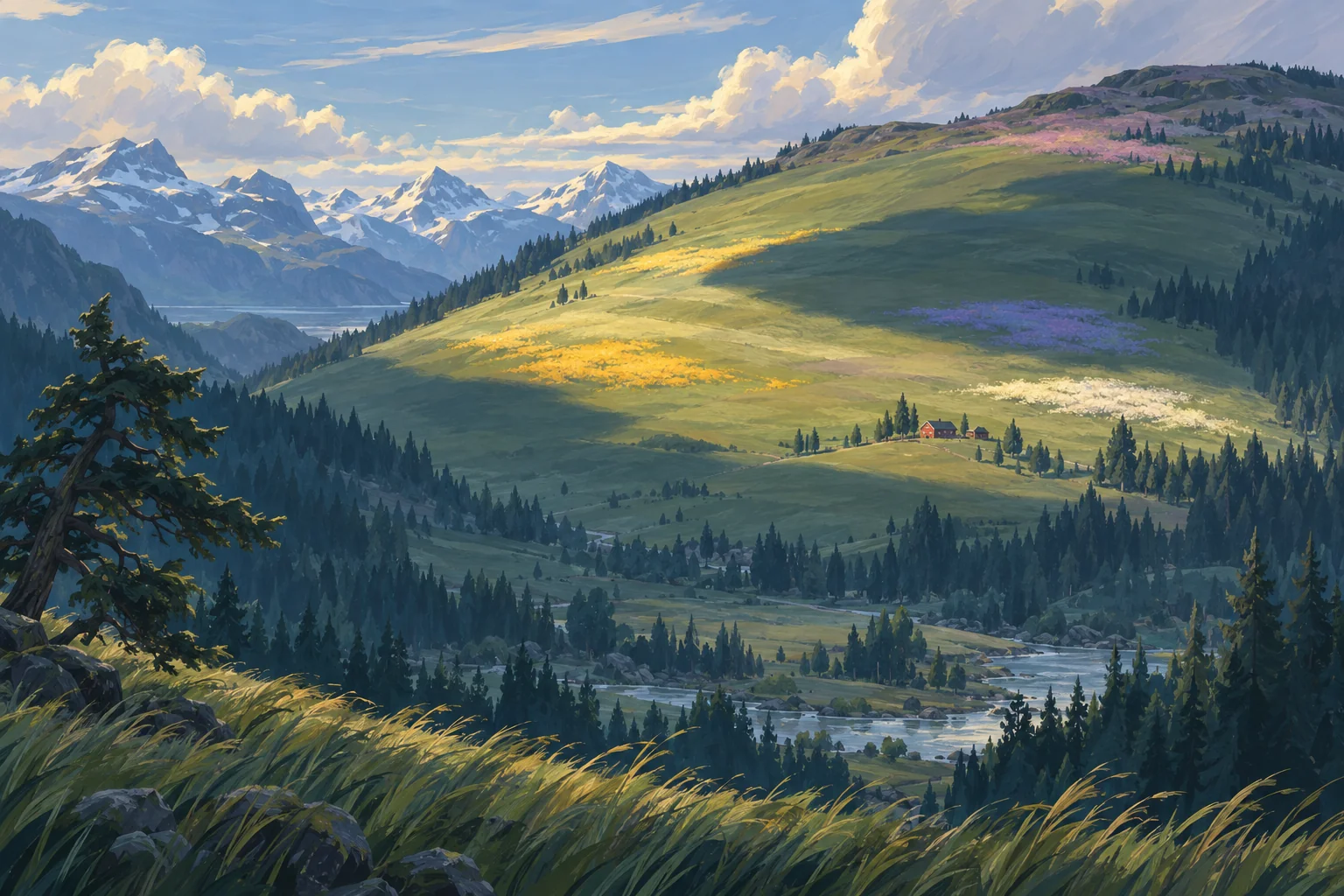
R9. Detail is spent at her feet and on the skyline. The fringe of drawn blades is the nearest 4 m and the crests. Flower cards are hero shapes within 8 m. Nothing else gets detail.
R10. The far field is a wash. Beyond the blades: flat colour shapes that follow the land, cooler and lighter with distance, the warm colours dropping out first.
R11. No line on grass. Line belongs to figures and silhouettes; grass and flowers are paint.
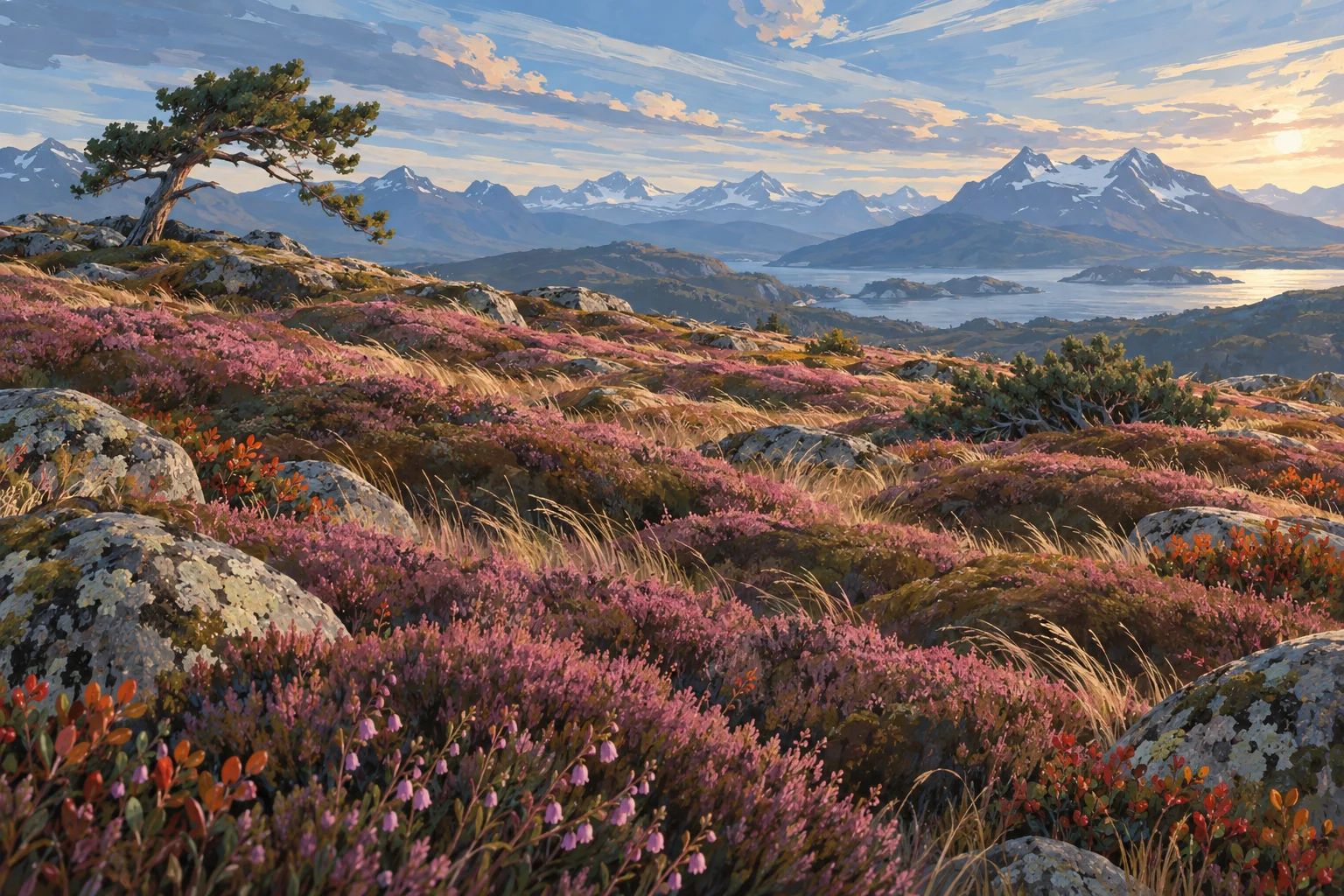
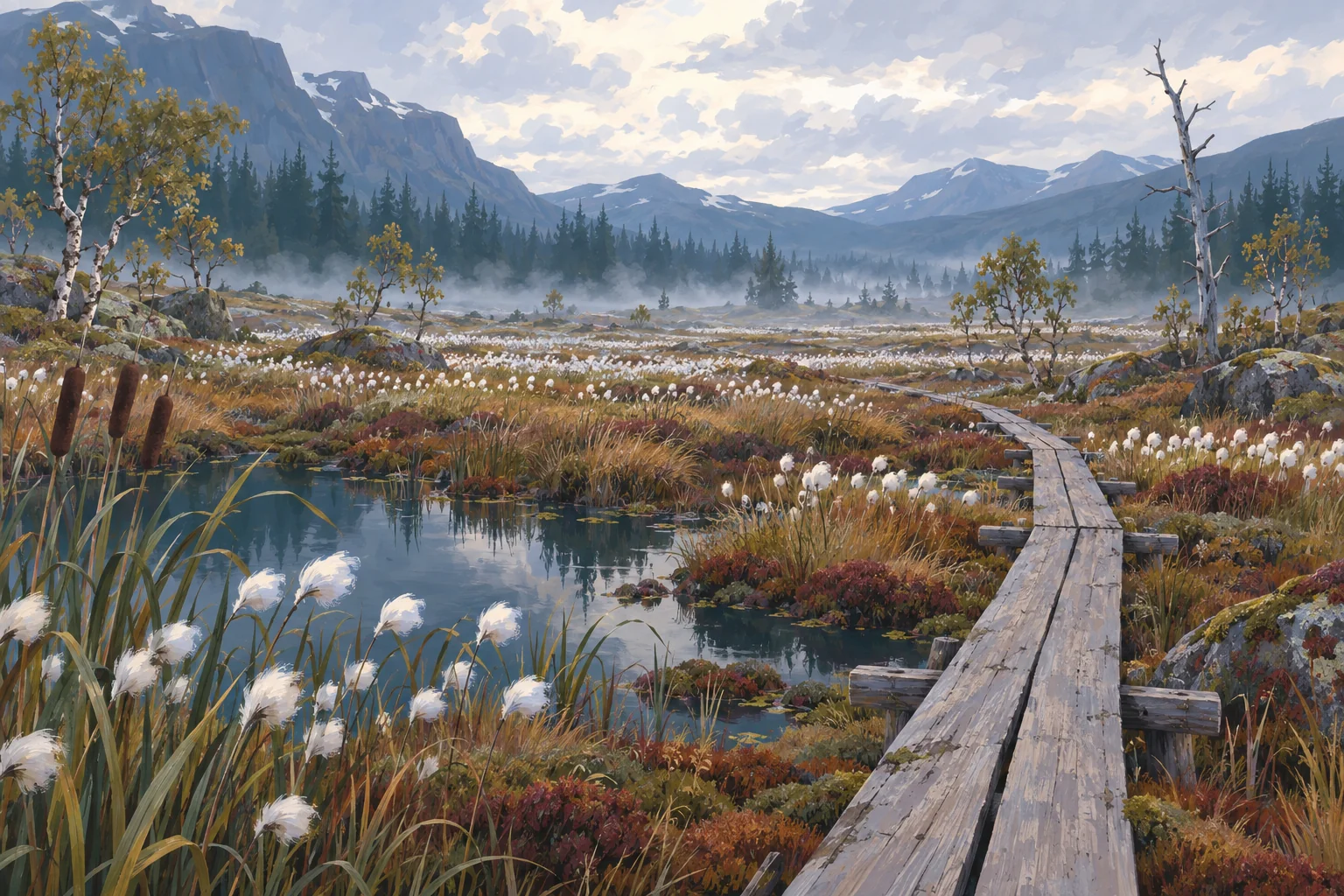
R12. The wall is the change of hand. Inside: soft, blended, round, bright, tidy. Outside: visible strokes, combed by the wind, muted, with flowers as the glow. Near the gates the two meet over a band.
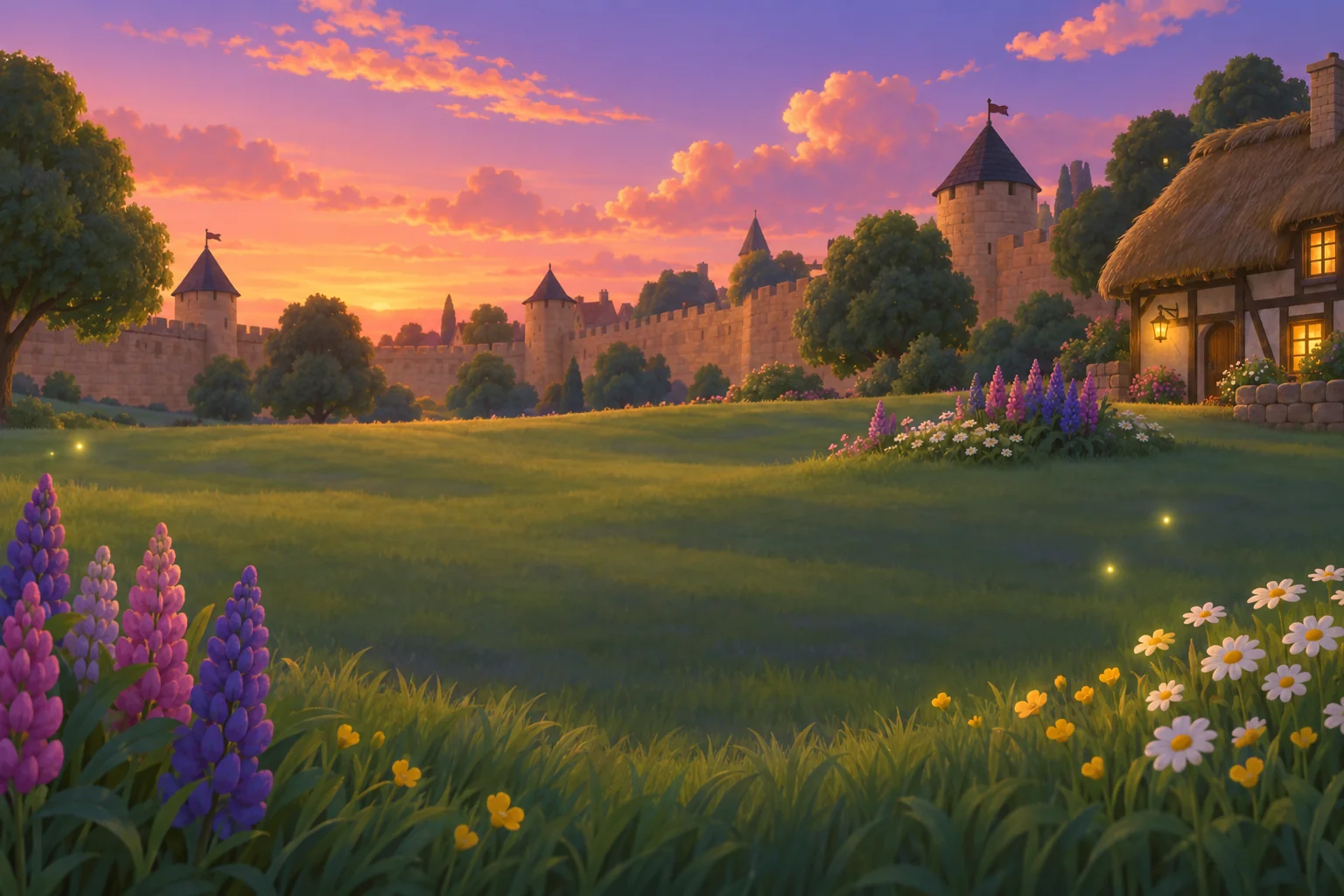
R13. Dusk keeps the colour. At dusk the meadow is three greens (a glow-facing olive, the body, blue-violet hollows), the fringe takes a peach rim, the flowers go a little deeper and the white ones glow. The game's rule stands: ground luma at least 0.2, hue green.
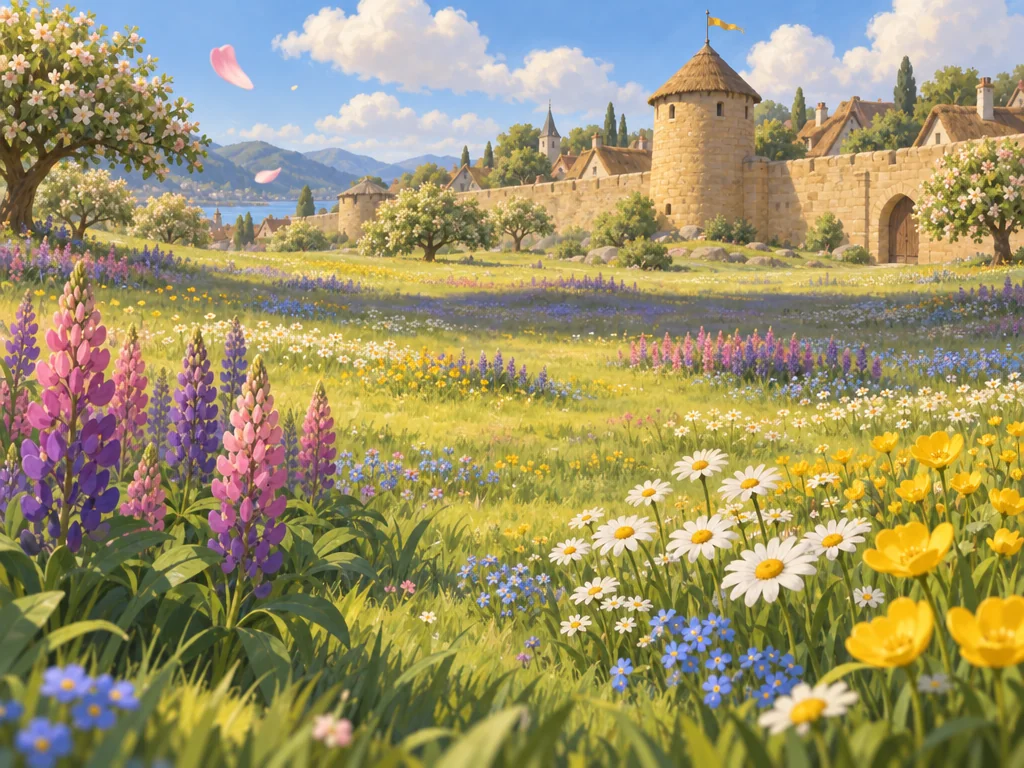
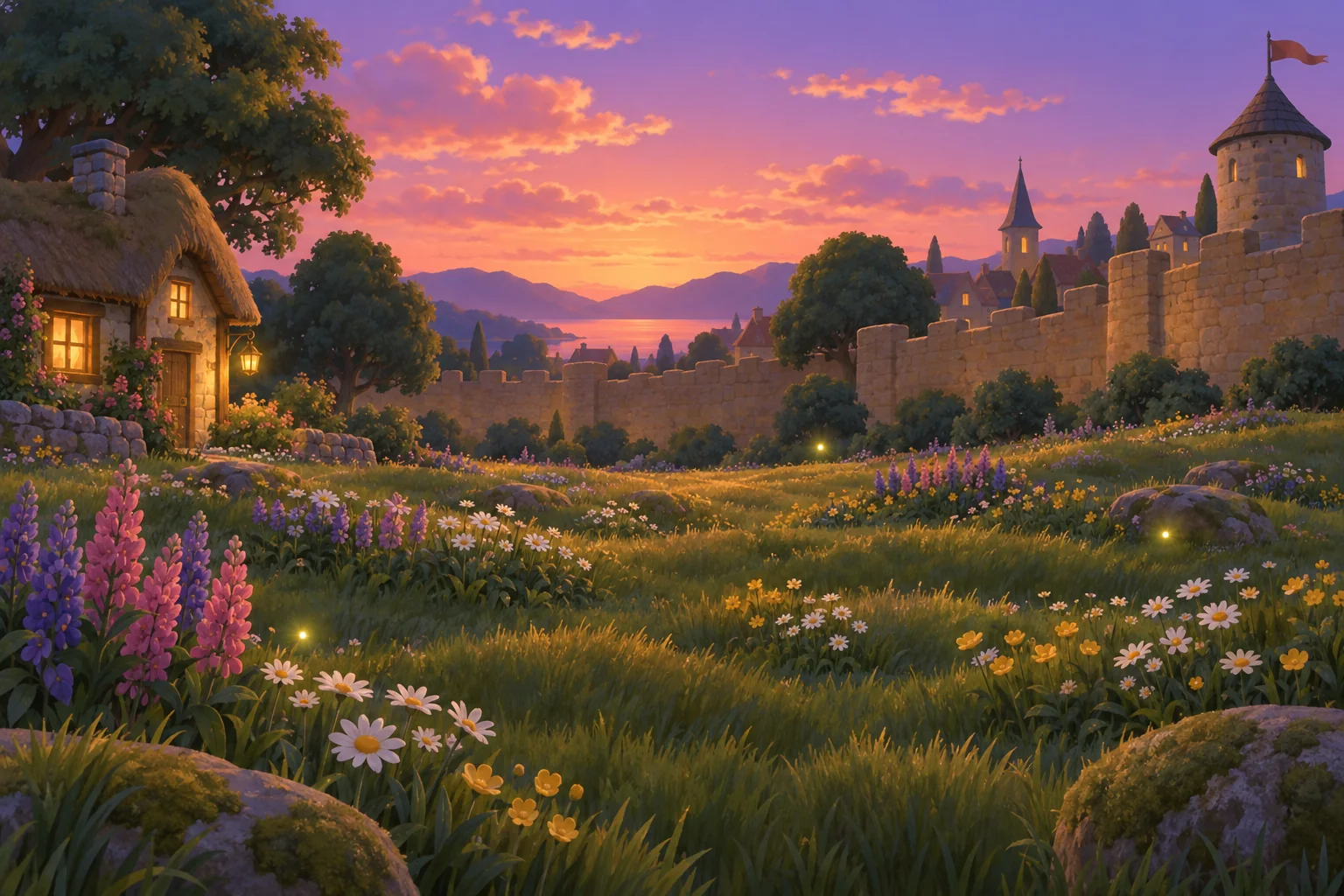
The two sides of the wall
| Inside the wall | Outside | |
|---|---|---|
| Grass as paint | soft masses in two or three close tones; blades only as a fringe at the near edge and on crests | long level strokes in three tones leaning with the zone's wind; blades only within about 8 m |
| Tuft | short, broad, upright | longer, narrower, leaning downwind |
| Hue | yellow-green #6DB33F to #8CC84B; painted sunlight is yellower than the game's, so tips #A4CF52, dry patches #B9BE4E | the zone's own green; muted |
| Gust | a soft warm lightening (#D6E88F) | a pale greyed band with a hard front (#C2C89A) |
| Flowers | in tubs, boxes and beds near houses; in meadows, drifts of one kind 2 to 3 m across | one signature flower per zone as its only big drift; other flowers as single dabs |
| Flower share of a meadow | up to a third | up to a sixth |
| Cards | the cute set: chunky, big heads, thick stems | the painterly set: flat strokes, leaning, blossoms in accent colours |
| Height | seed grass at most 0.6 m (a child sees over it) | 0.9 to 0.95 m; marram 1.2 m (she wades through) |
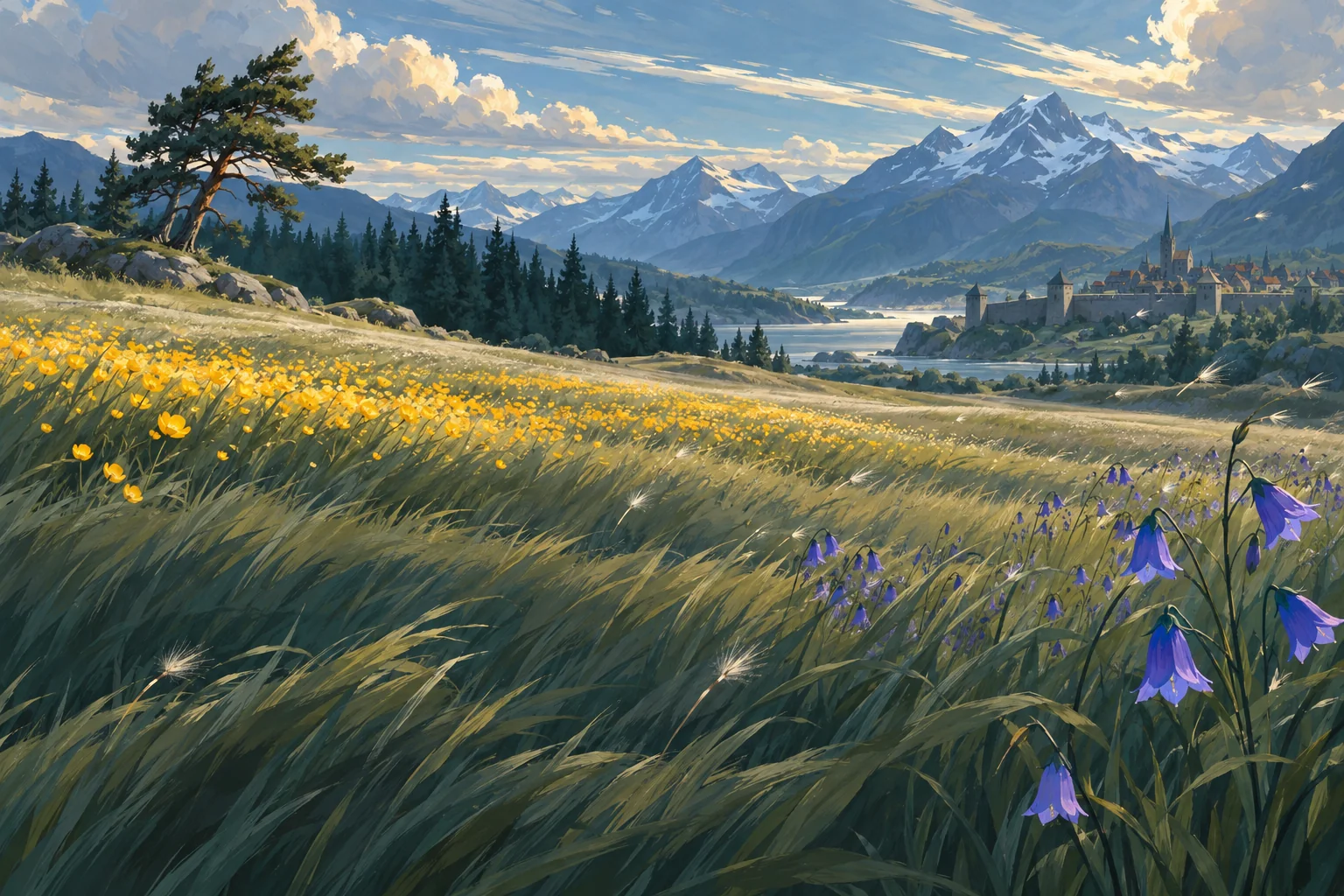
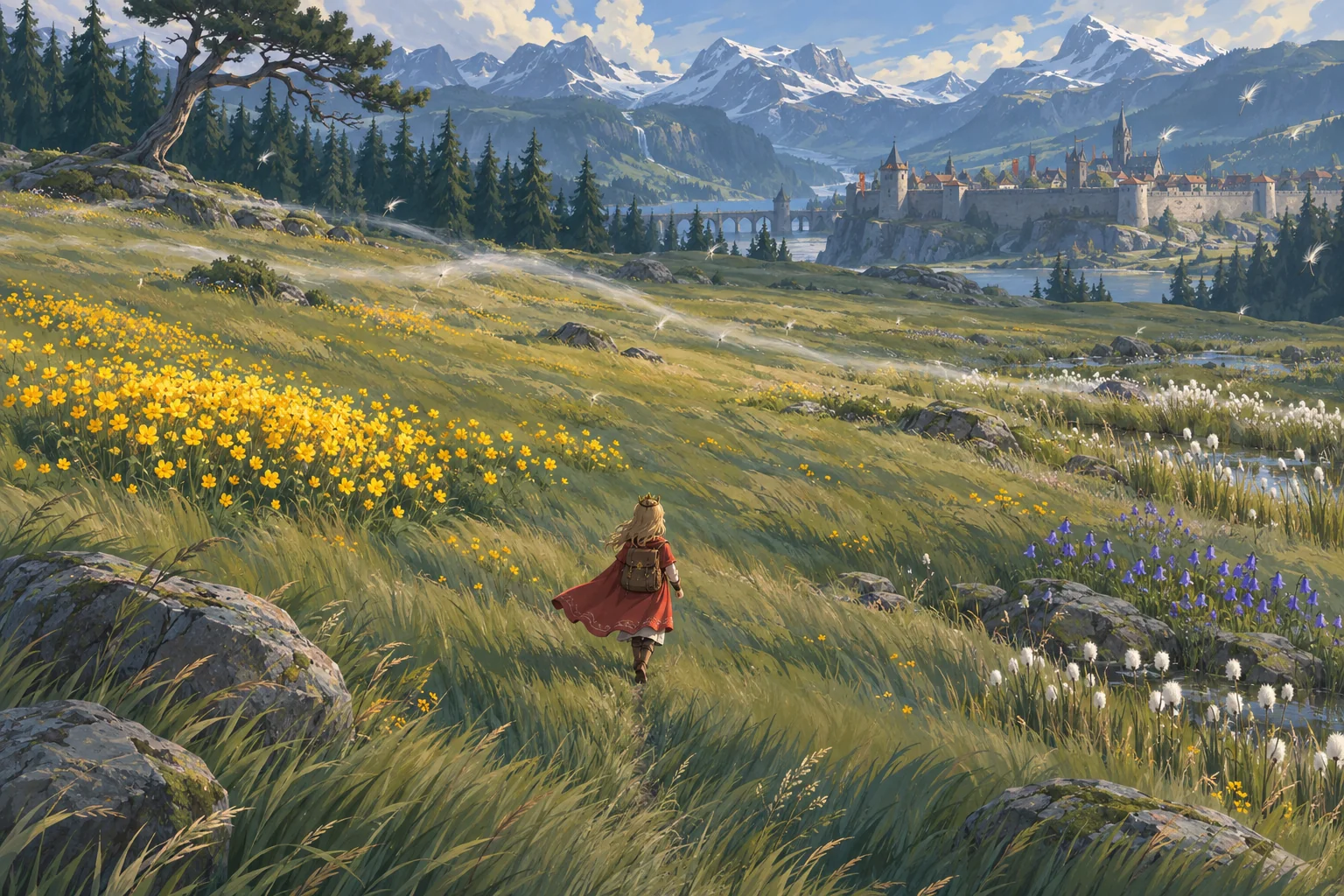
Grass by zone
The zones' own greens come from the zone cards. Where the grass portfolio's table (built on the earlier two palettes) differs, the cards win. Tips, heights, density and lean are the portfolio's; check the tips on a still.
| Zone | Body | Tip | Height (m) | Density | Lean | Drifts of flowers | Signature |
|---|---|---|---|---|---|---|---|
| Inside the wall (Hjemdalen) | #6DB33F | #A4CF52 | 0.20 to 0.38 | 4.0 | 0 | 1.4 to 3 m radius, on a 6 m grid, 80 % of cells | daisies, lupin, buttercup, harebell, red clover |
| Nordalen | #6F9A55 | #8C9A52 | 0.35 to 0.60 | 4.0 | 0.15 | 5 to 12 m on a 24 m grid, 45 % | globeflower (gold), harebell; cotton grass at the shore |
| Fjellfoten | #4F7A3A | #7E9060 | 0.25 to 0.45 | 3.2 | 0.08 | 3 to 7 m on a 20 m grid, 35 % | harebell in the sun, wood sorrel, foxglove in threes; ferns and moss carry the old wood |
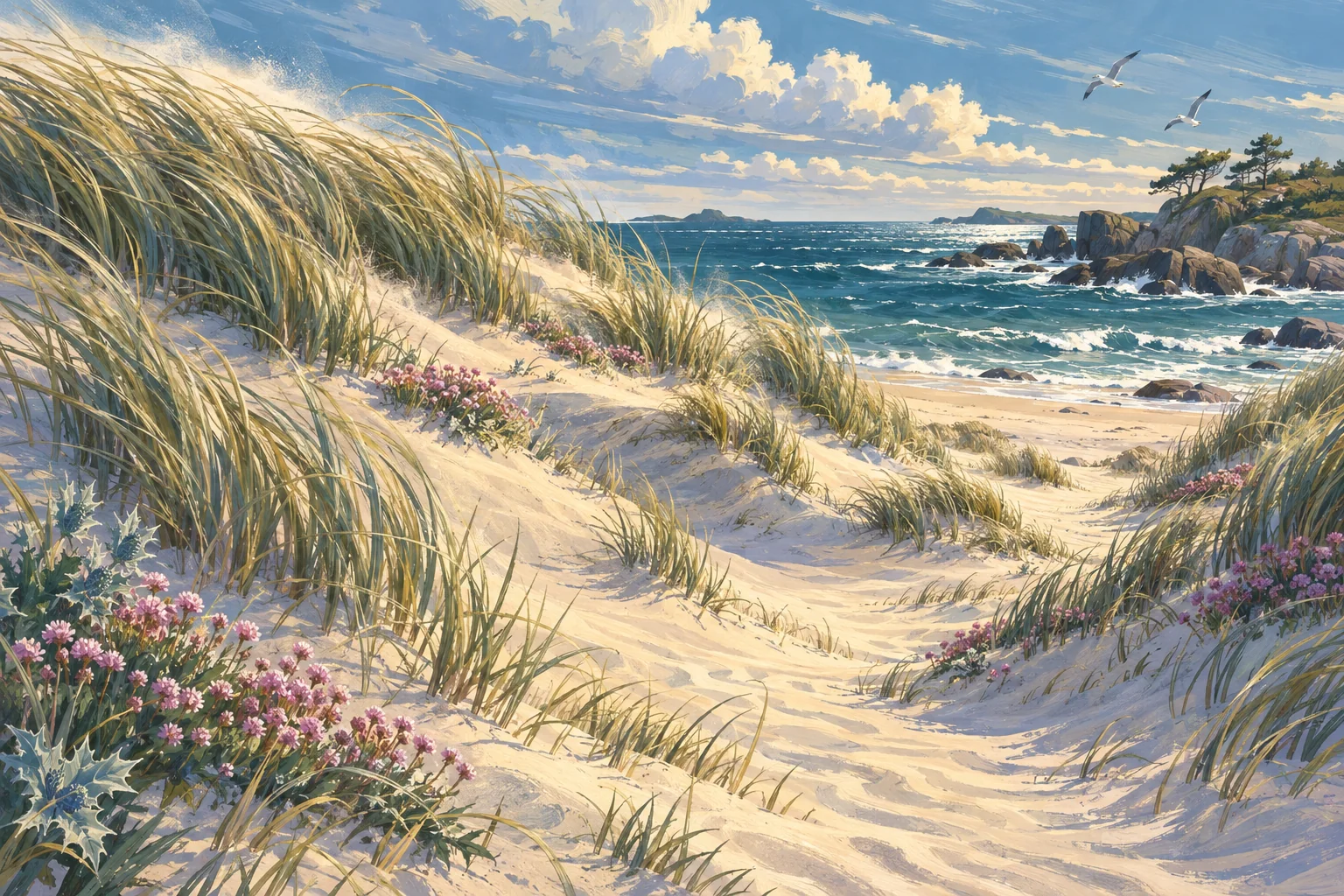
| Sørvika | #9AA66A | #A3AD78 | 0.30 to 0.50; marram 0.75 to 1.20 | 3.0 | 0.30 | 6 to 14 m on a 20 m grid, 70 % (Blomsterenga) | marram on the crests, thrift in the lee |
| Sørmarka | #55703A | #B09A4A | 0.45 to 0.70; pasture 0.12 to 0.20 | 4.4 | 0.12 | 4 to 10 m on a 22 m grid, 40 % | buttercup and clover as dabs; poppy and cornflower within 4 m of a wall or a way |
| Fjellet | #6E7448 | #A39258 | 0.10 to 0.22 | 1.6 | 0.40 | 0.8 to 2 m on an 8 m grid, 30 %, only on gentle slopes | moss campion, mountain avens, cotton grass |
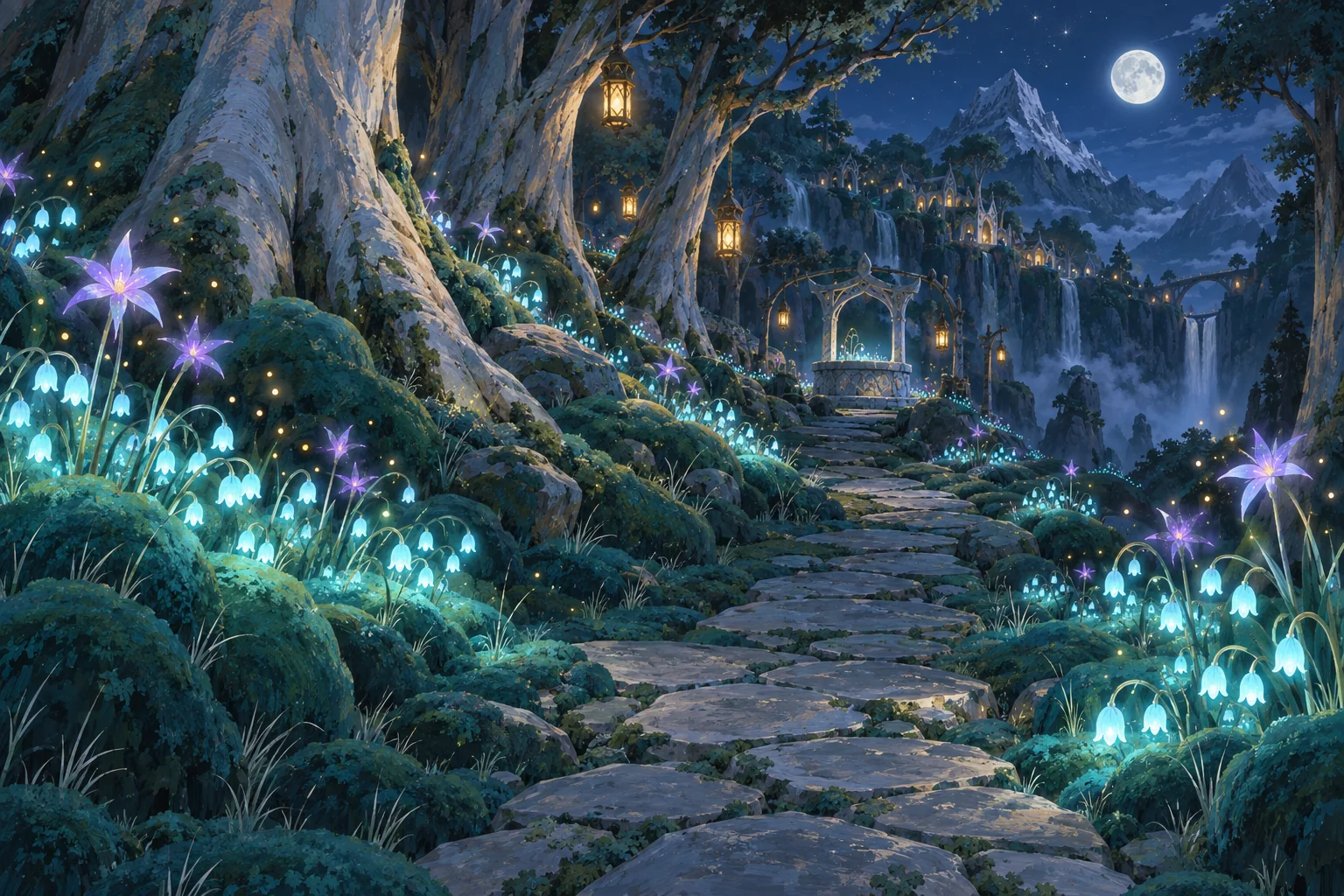
| Alvheim | #2F5D58 | #7FCDB6 | 0.20 to 0.35, width x 0.6 | 2.0 | 0 | ribbons 1.3 to 5 m from a way, rings 2 to 4 m round the old trees and the well | elf bell (cyan), elf star (violet), glowing |
Kinds of ground
| Ground | Look |
|---|---|
| Meadow | the zone's row above |
| Pasture | height about 0.45 of the meadow's; buttercup, clover and daisy as dabs, no cards |
| Moor | half the tufts, low, straw-coloured (tip #B59A5C), heather as a carpet that lies in drifts |
| Bog | tall sedge, wine red #7A3A34 in clumps, cotton grass in bands |
| Dune | marram 0.75 to 1.20 m, leaning hard, #8EA078 to #C9C08A; thrift cushions in the lee |
| Birch wood | height times 0.8; wood anemone and forget-me-not as dabs |
| Old wood | a third of the grass; moss, the map's own colour |
Flower cards
The painted clump card is replaced by a spray: stems and blossoms, with the grass as its leaves. A clump with a leaf rosette brings its own green and its own shade into a field that already has grass, and repeated at one size it is a sticker. Rules for a card, each checkable on the cut-out:
- Blossoms cover more of the card's solid pixels than stems and leaves do.
- A stem is at least 4 px wide in the 256 px cell (1.6 % of the cell). Thinner stems vanish in the mips.
- Three to six stems of uneven height from one point at the bottom middle; one leans out.
- No leaf rosette, no dark leaves. Any leaf is in the zone's tip colour and sits in the lower 42 %.
- Three values on a blossom: light, middle and a coloured shade (violet-blue inside, teal outside). Nothing under luma 0.2.
- Outside, blossoms are at least luma 0.55 and lean right (the game mirrors half and the wind does the rest).
- Lit from above, no cast shadow, plain light grey behind.
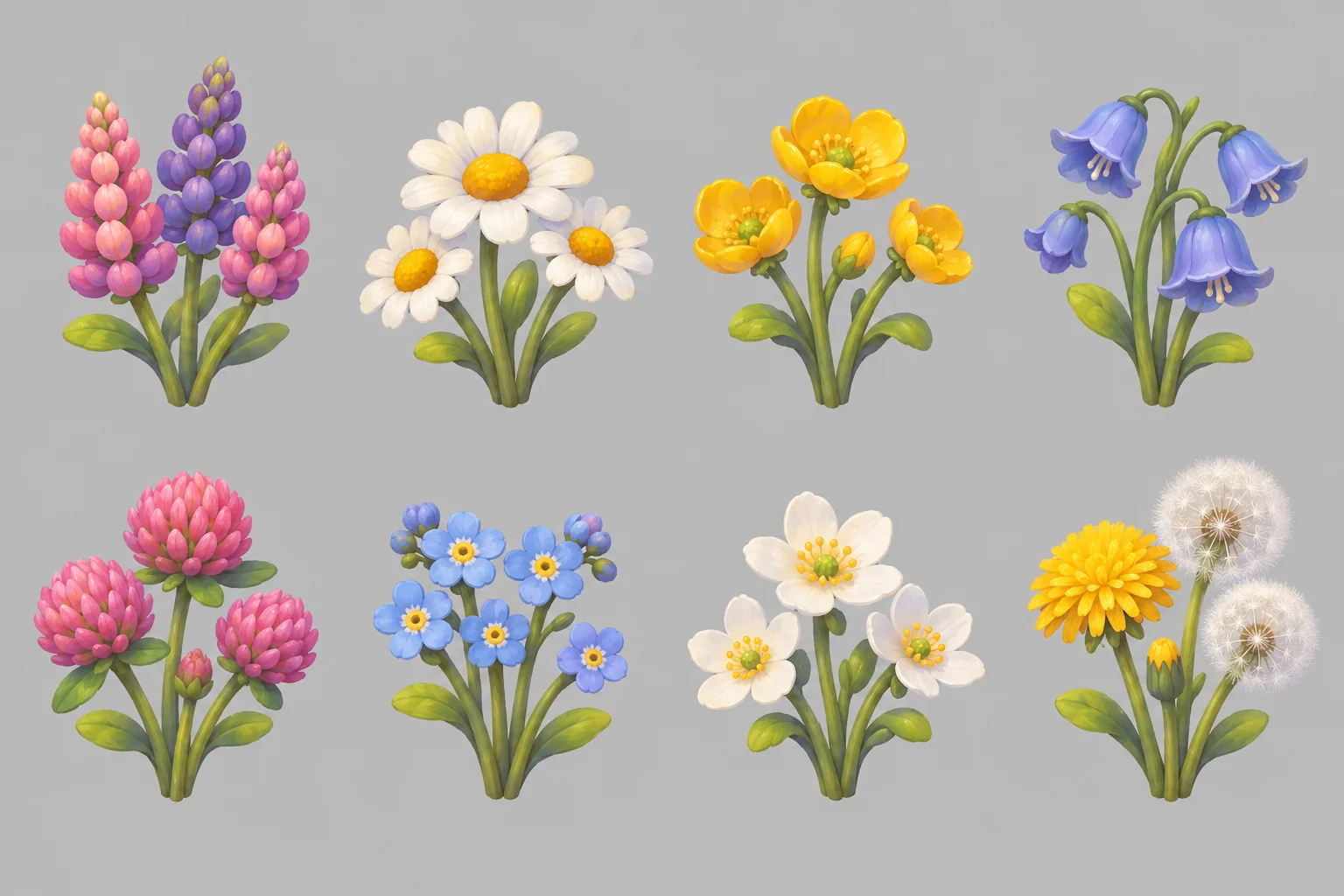
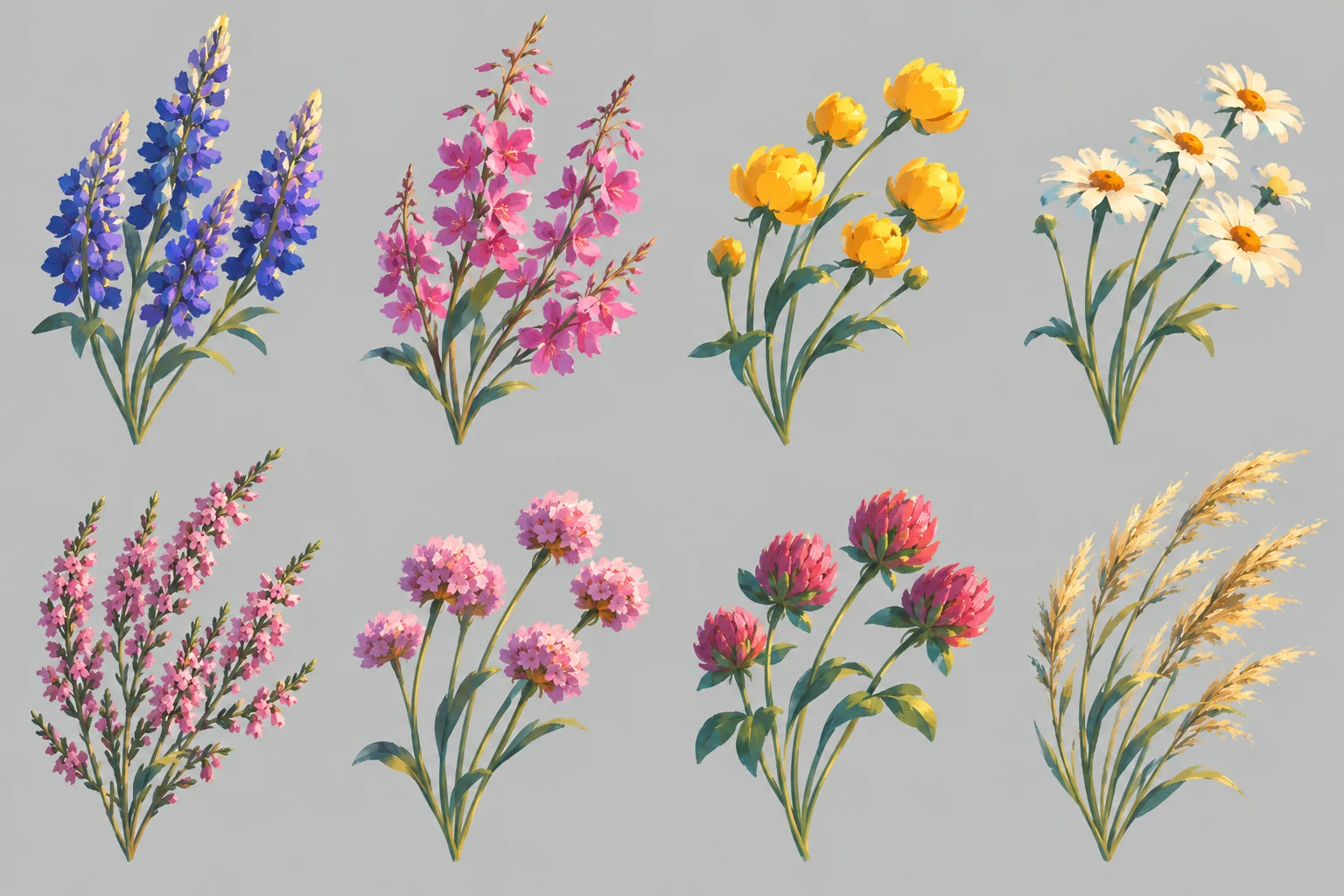
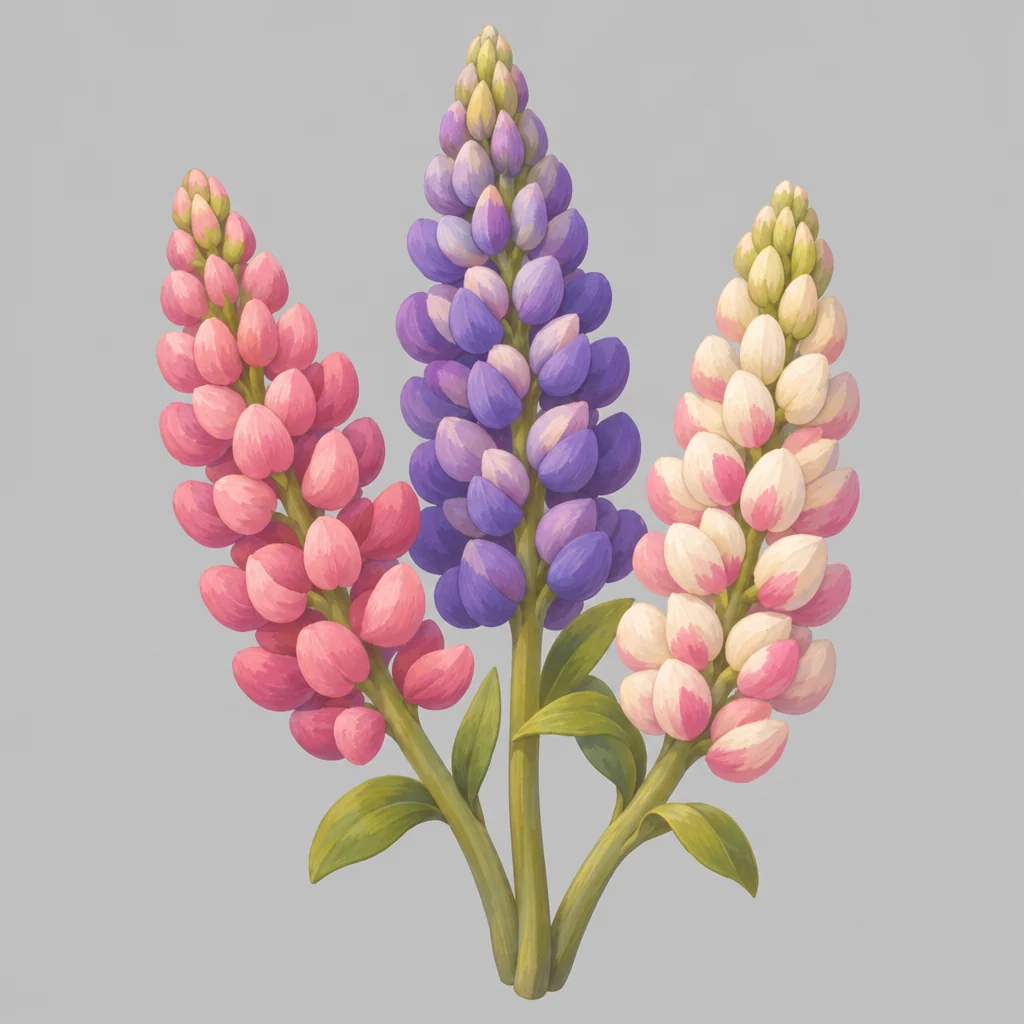
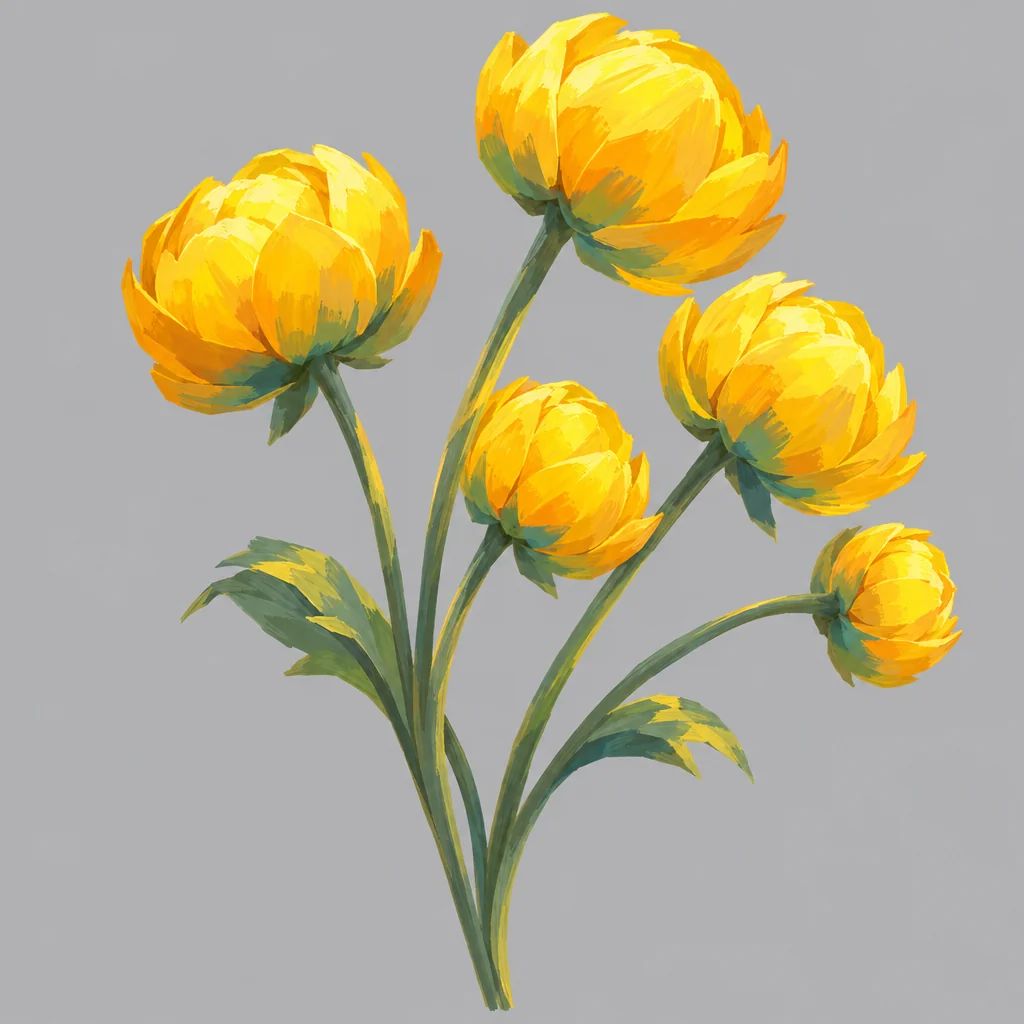
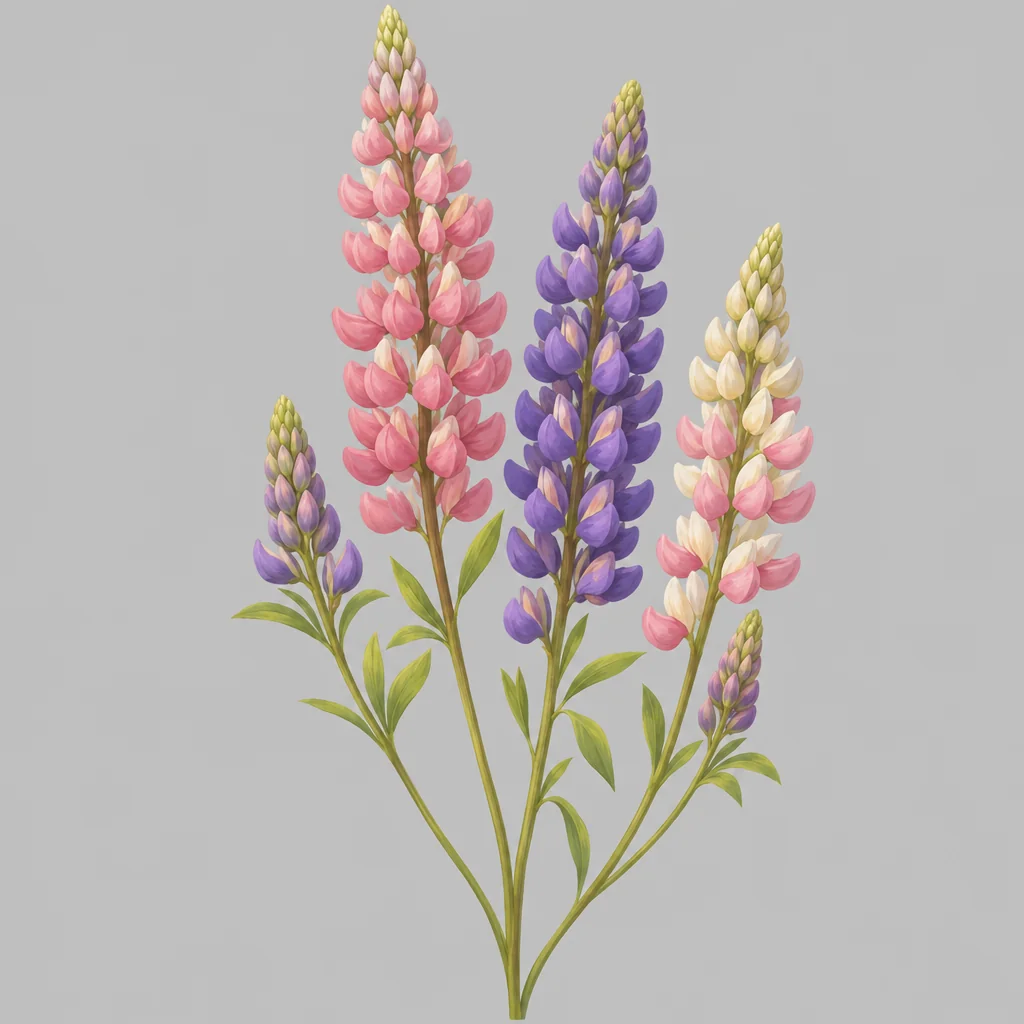
The prompt blocks for cards are on the prompt blocks page. In Krea prompts write without similes: "like stacked beads" came back as bubbles.
The small stuff
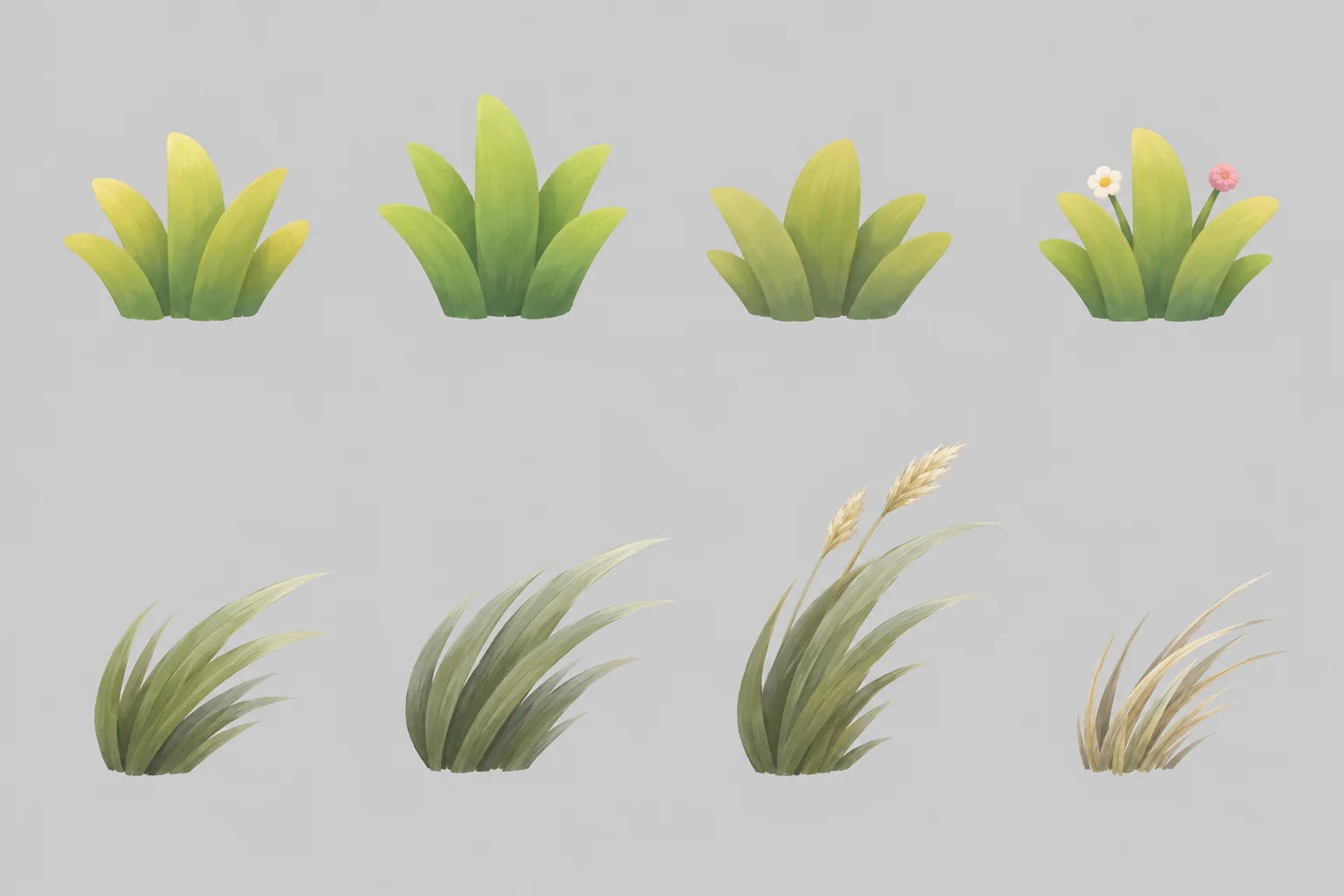
Open questions on grass (the card's turn to the camera, how yellow the inside may be, tall flowers outside) are in open questions.