Eventyrland: the family look, the two sides of the wall, and the zone system
Research portfolio, 2026-10-01. It refines a local file (the rulebook) and adds the
zone system the rulebook lacks. Two sister portfolios go deep where this one stays short: ../alvheim/ (the elf
village) and ../flora/ (grass and flowers). Both must fit the frame set here.
Not finished: the four 3D models are queued on zap and had not come back when this was written
(models/README.md). How the look survives meshing is therefore unjudged.
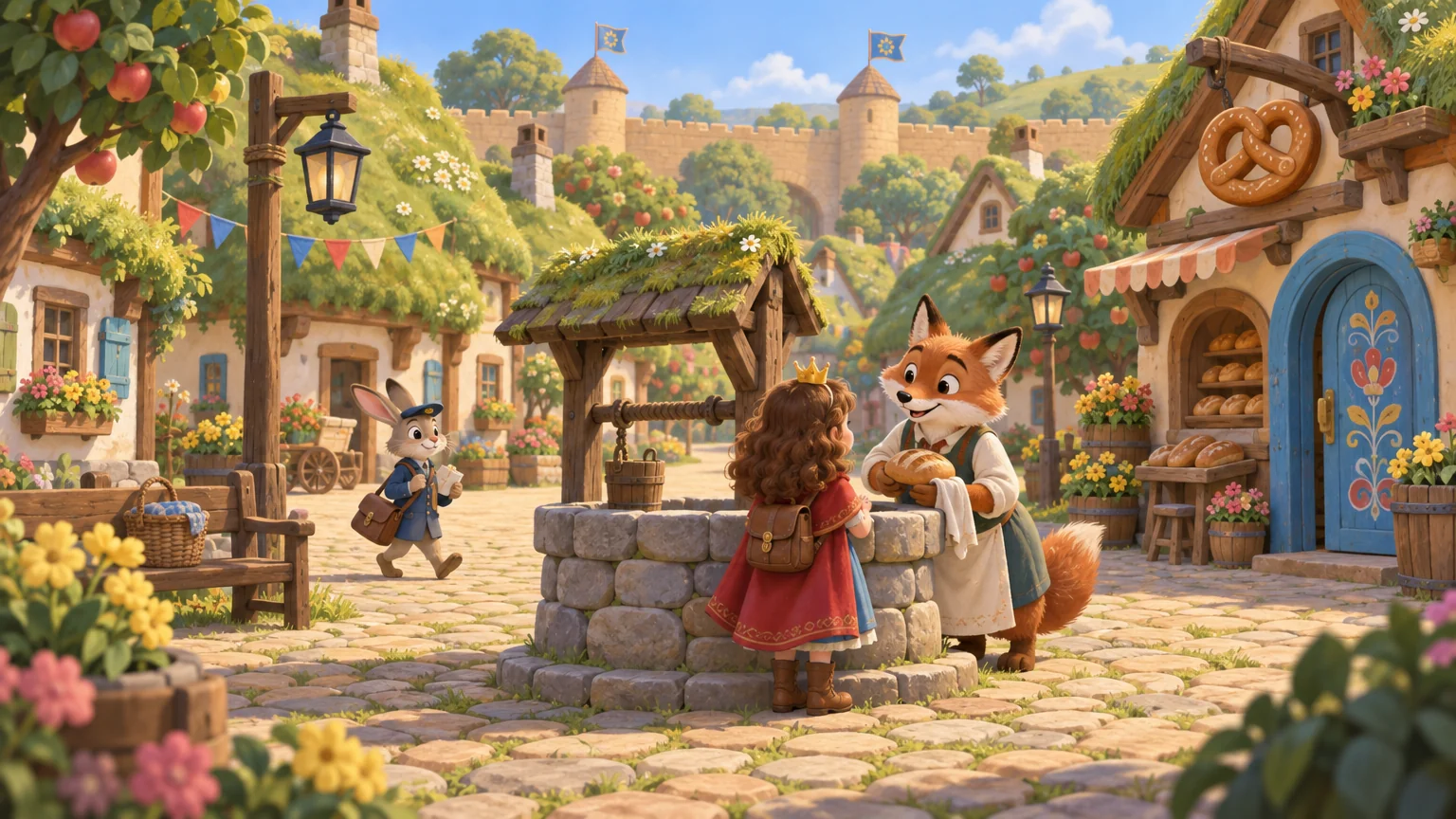
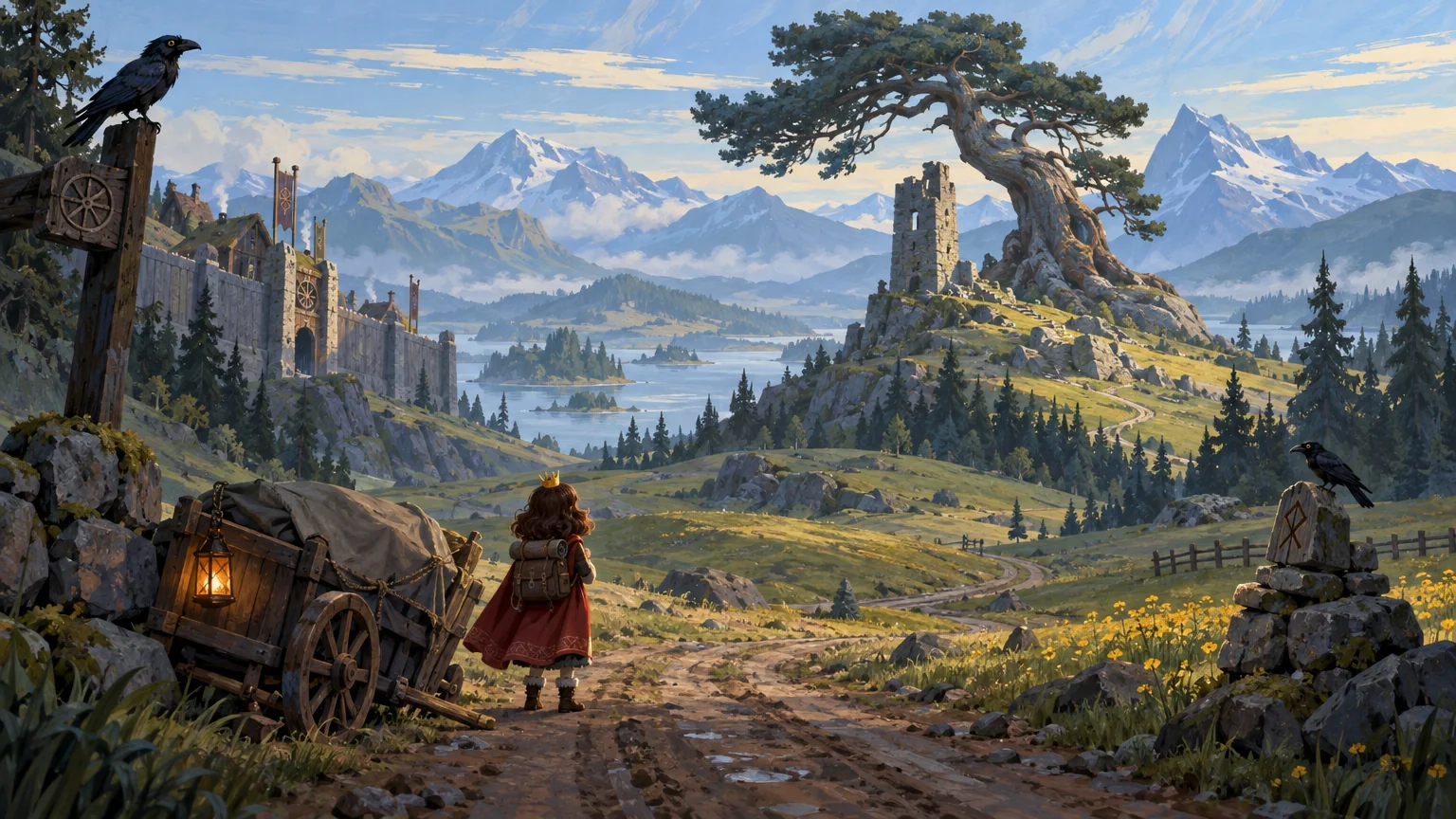
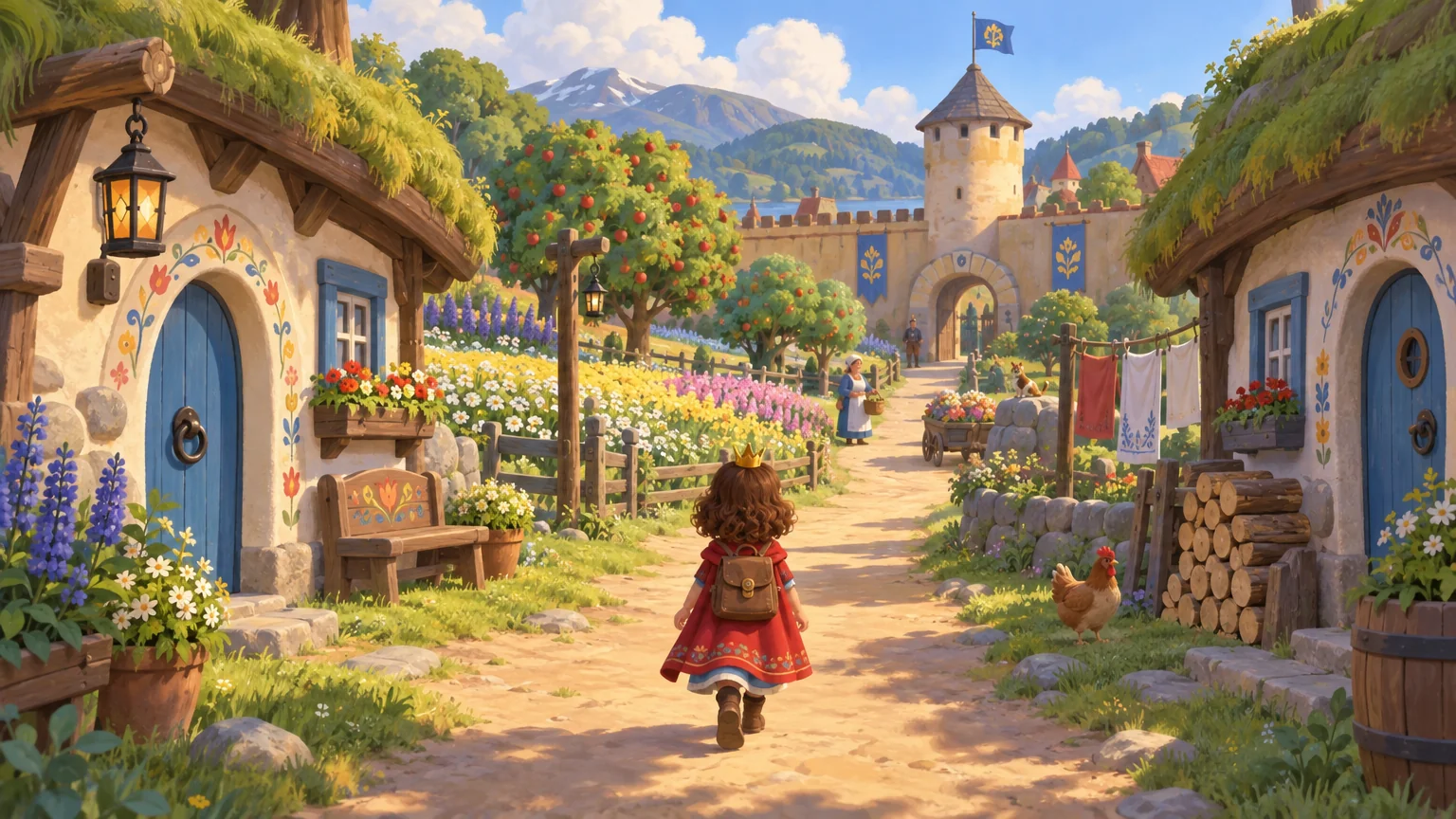
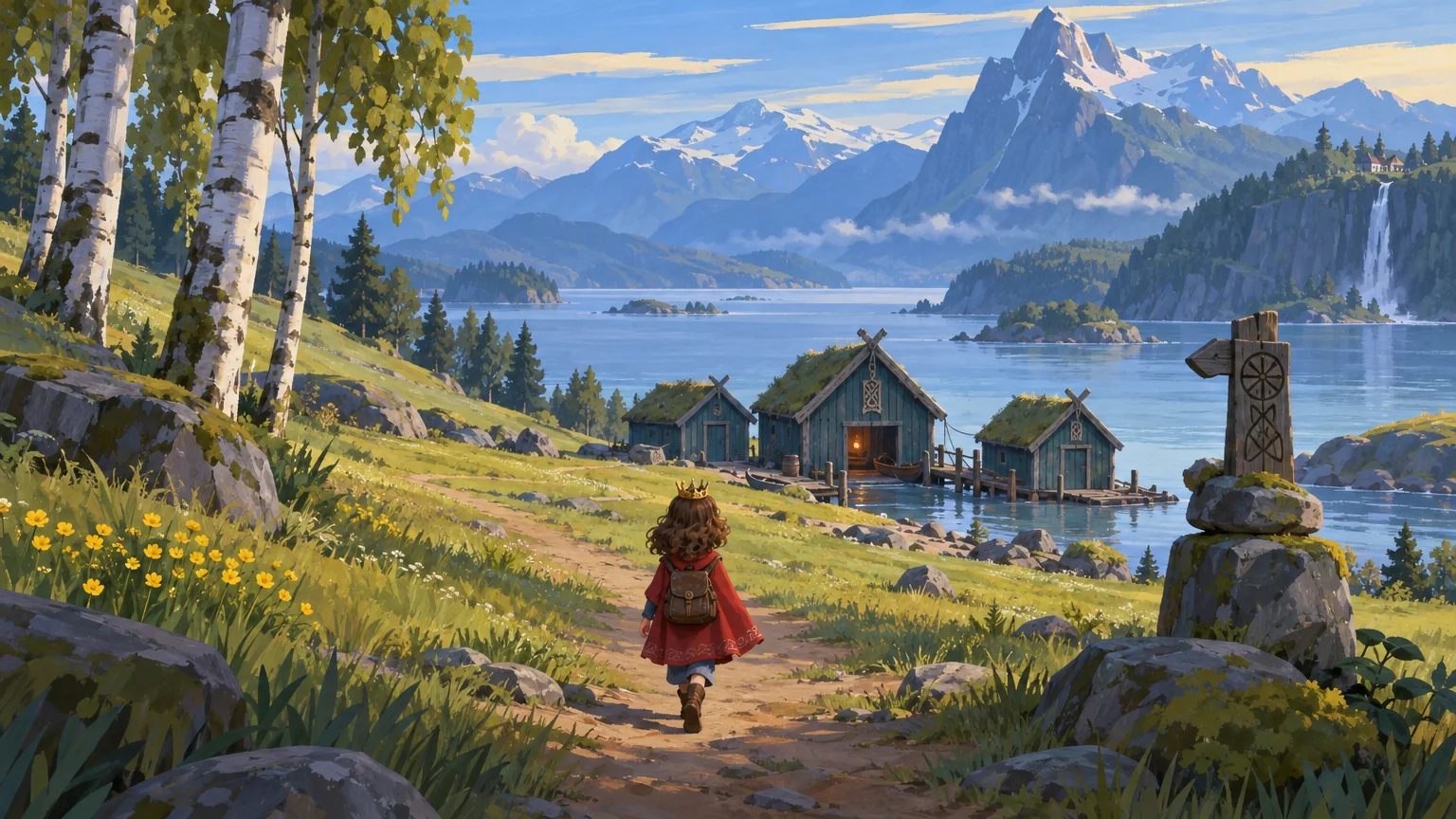
About the pictures: 47 images were generated, 31 are kept in art/ and 8 in art/rejected/. They are concept
paintings: more detail than the game can draw. Read them for shape, colour, value and staging. The girl in the red
cape is a stand-in for the princess; the game's own model is not in these images. art/gamecam-inside.webp and
art/gamecam-outside.webp are the two frames closest to what the game's camera should show.
Files: prompt-blocks.md (the reusable prompts), prompts.json (every kept image with prompt, seed and verdict),
zones.json (the zone cards as data), zone-template.md (for a zone added later), tools/frame-stats.py (measures
a frame against the numbers below), sources.md, open-questions.md, models/.
1. Findings
1.1 What we take from each reference, and what we leave
Sources and their status are in sources.md. Points marked (our reading) come from looking at the published work
and have no source in the artist's words.
Amulet (Kazu Kibuishi)
| Take | Leave |
|---|---|
| Simple figures in a rich world. Thin single-weight line and flat local colour on the figures, a fully painted world behind them. Kibuishi: a detailed world "you can access very easily" through simple faces. For us: figures carry fewer tones and less detail than the place they stand in. | The page as a film strip: panel cuts, camera moves, blur. The game has one camera. |
| The palette follows the mood of the place, chosen before anything is painted ("finding a suitable color palette takes more time than anything else"; start from a mid-tone and work away from it). For us: one key colour per zone, set as a mid-tone, light and shade built from it. | Soft airbrushed gradients as the surface. Outside, Fortiche's hard-edged brush is the surface. |
| Depth by layers of air (our reading): each layer back is paler and closer to the sky's colour; light falls in shafts. For us: three depth layers in every outside frame. | Book 1's heavy dark palette (a reference entry notes it; the later books lighten). |
| Scale (our reading): a tiny figure against one huge thing (the walking house, the city in the clouds). For us: one thing at least ten times her height in every outside vista. | The machines and robots. Eventyrland builds in wood, stone, turf and wool. |
| Glow means magic (our reading): the stone's pink light is small, saturated and lights the face beside it. For us: four glow colours, at most 10 % of a frame. |
Nordlys (Malin Falch)
| Take | Leave |
|---|---|
| Norwegian nature drawn from life. Falch photographs the forest she draws; reviewers single out the landscapes and "drømmende og stemningsfulle farger". For us: each zone is a real Norwegian landscape type with its own plants, not one meadow recoloured. | Film-like panel cutting (a reviewer's criticism of book 1). |
| Fire against a cold night (our reading): green-teal and violet sky, deep blue land, one warm fire with faces lit by it. For us: the night rule, and ember as the north's accent. | The meaner trolls (she cites Trolljegeren, glowing eyes, thick outlines in later books). Ours are huge, odd and kind. |
| Expressive faces on simple figures. She credits manga for the stylised expressions and Disney and Ghibli for the rest. For us: eyebrows and mouths that act, also outside, where faces otherwise go small and stern. | The drift toward manga figure proportions. Our outside folk stay stocky. |
Kittelsen, Bauer and Asbjørnsen and Moe as the stock of creatures (her stated sources; the rulebook's STYLE_INSIDE already names the first two). | Borrowing Sami dress for a "mountain folk". One reviewer reads her mountain people that way; Disney made a formal agreement with Sami bodies for Frozen 2. See open-questions.md. |
| Shape tells character (a reviewer: long noses for the mean, round forms for the kind). For us: round is safe, tapered is brave; nothing in the game is pointed and mean. |
Feature and series CGI
| Work | Take | Leave |
|---|---|---|
| Arcane (Fortiche) | Two cities drawn as two dialects of one style (Piltover geometric and symmetric, Zaun asymmetric with flourish): the model for our wall. "Everything is painted": light and brush live in the textures. Smoke and fire as 2D shapes. | The grit, the grown-up faces, the dark. Run alone, the Fortiche block drifts there (art/test-outside-A-block-only.webp). |
| Wolfwalkers (Cartoon Saloon) | The closest precedent: a walled town in stiff uniform line, a forest in loose line, and at the forest's edge a blended zone where trees are still angular. A character's own line changes as she crosses. | 2D line as the carrier. Ours is shape, colour and brush. |
| Klaus (SPA) | Shape sets mood: "tall and pointy, lots of triangles" reads hostile; an inverted triangle is unstable. Light is "an integral part of storytelling". We use it in reverse: taper and lean make outside brave, rounded corners keep it kind. | A desaturated, decayed town. Nothing in Eventyrland is hostile. |
| Frozen, Frozen 2 (Disney) | Norway as the source: rosemaling "can be very cursive and flowery, but it can also be very geometric and lineal" (Giaimo): flowery inside the wall, geometric outside. The horizontal building "amongst the vertical" land. A narrow palette per place ("yellow to deep maroon. That's your range"). | Glamour bunads and ice palaces. |
| Raya and the Last Dragon, Zootopia (Disney) | One world, several lands, each with its own form and colour logic (flowing and cool-green, geometric, purple-pink, earth tones); districts parted by material, palette and axis (the rain forest "a vertical environment"). This is the zone card. | |
| Encanto (Disney) | A written guide that tracks colour and shape per character. Ours is zones.json. | |
| Tangled (Disney) | Lanterns as the picture of safety and home (our reading; the Fragonard link is not confirmed). | |
| Puss in Boots: The Last Wish, Spider-Verse | Paint strokes that belong to the 3D, "not a Photoshop filter"; detail abstracted away in the background. Backs the rulebook's "the assets are the paint, the pass is the glue". | Stepped animation, halftone, line on fur. |
| Wish (Disney) | Atmosphere as a flat coloured wash laid over the distance: cheap, and what our haze does. | The watercolour paper look. It flattens the cute look inside. |
| The Sea Beast | Colour themes set in the colour script (red against green; tame garden against wild sea). | Its near-real materials. |
| The Dragon Prince, Nimona | Legibility by silhouette. | Cel shading and flat graphic fills: the rulebook rules out flat vector. |
| Colour scripts (Pixar) | A strip that maps "color, lighting, emotion and moods", abstract shapes only. Ours: art/colour-script.webp. | |
| Games: Breath of the Wild, Firewatch, Sable | Triangles of three sizes as landmark, view-blocker and tempo; "bold colours in very distinct layers", the sky deciding the biggest patch of colour; fog set per biome "had the biggest impact overall". |
What does not transfer to three.js on an iPad, whatever the source: per-shot lighting, hand-drawn 2D effects on every frame, strokes generated per object, soft volumetric shafts (ours are painted cards or the haze), and any detail smaller than about 1 % of the screen height. Each rule below is one the game can meet with painted textures, the paint pass, haze, the region grade and placement.
1.2 How the three pull apart, and the decision
Amulet's surface is soft and blended. Nordlys is a line-drawn comic. Fortiche paints hard-edged strokes. They cannot all be the surface outside the wall, so each gets one job:
- Fortiche is the surface: brush, three tones with hard edges, thin coloured line. Petter's block stays.
- Amulet is the space: layers of air, scale, simple figures, glow as magic.
- Nordlys is the place and the night: Norwegian landscape types, the northern palette, fire in the cold, faces that act.
Inside the wall none of the three leads. It stays the feature-film storybook look of the rulebook and
docs/concept/03-village.jpg.
The test, same scene three ways:
| Frame | Result | |
|---|---|---|
| A | art/test-outside-A-block-only.webp: Petter's block and the old rule line | Brown, stormy, gritty, median luma 0.29. Good painting, a grown-up's game. |
| B | art/key-outside.webp: plus the space rules and a stated palette | Cooler, cleaner, flatter far shapes, a tiny figure against the pine, median luma 0.36. |
| C | art/test-outside-C-night.webp: plus the northern night | The strongest frame of the set: sky green-teal and violet, land blue, one fire. |
The alternatives are in open-questions.md (question 1).
1.3 What the image rounds showed
- A shared light colour kills the zones. With "warm amber sunlight" in the shared block, Nordalen, Gammelskogen
and the key art all came back orange (
art/rejected/key-outside-v1.webp). The zone must state its hour and the share of the frame its key colour takes. The same will be true of the game's grade. - Ornament spreads. Asked for a folk ornament, the model put the same red scroll on cairns, boathouses and tree trunks. Hence rule 8: painted and flowery inside, carved and geometric outside, on built things only, with a budget.
- Outside folk lose their eyes. The first line-up (
art/rejected/lineup-folk-v1.webp) and the game's own Krea picks (a local file) both have small eyes and flat faces. The rulebook says "still big readable eyes"; it needs a number. - Outside buildings go black and grim unless the darkest tone is named (
art/rejected/mesh-ref-fiskerstue-v1.webp). - An old forest goes too dark unless told to stay mid-value (
art/rejected/zone-fjellfoten-v2.webp, median 0.18). - Krea 2 Turbo keeps the look and drops a long scene; with the subject first and under 900 characters it draws
the scene, flatter than gpt-image does (
art/krea-short-scene.webp). Details inprompt-blocks.md.
1.4 Where this contradicts the rulebook
| Rulebook | Here | Why |
|---|---|---|
| Outside value is "lower and even: most between 0.25 and 0.7" | Value is a property of the zone. Sørvika, Nordalen and Fjellet are light (median 0.48–0.62); Gammelskogen and Alvheim are low (0.30–0.32). The lifted shade floor and the 2–3 bands stay everywhere outside. | One value key for everything outside makes the zones alike; the colour script needs the swing. |
| Outside palette "muted, cooler bases (55–70 % of inside's saturation)" | Muted holds only on average: mean saturation 0.36 over the six outside frames against 0.43 over the four inside ones, about 85 %, with overlap (Sørmarka 0.44, Alvheim 0.45, Kysten 0.36). Cooler does not hold: Sørmarka and Sørvika are warm zones. | The south is the sun's side (the compass rule, section 6.1). |
| Outside folk "1/4–1/5 of the height … still big readable eyes" | 4.5 heads, stocky, each eye at least 1/5 of the face's width. | Without numbers they come back as 5.5-head adults with small eyes. |
STYLE_OUTSIDE for figures: Petter's block and one rule line | The same, plus OUTSIDE_ADD (prompt-blocks.md): head count, eyes, three tones, where the painted light comes from. | Test A; the huldra pick. |
| No rule on ornament | Rule 8. | Section 1.3. |
docs/design.md: skumlinger are "round, black" | Deep violet plum #3B2A4F, as the rulebook's "no black" already implies. | art/zone-skumleskogen.webp shows they read as well and funnier. Open question 3. |
Everything else in the rulebook stands: the paint pass, the linework numbers, the density table, "places where things happened", the budget.
2. The family look: eight rules that hold everywhere
A frame that keeps these is recognisably Eventyrland on either side of the wall.
- Painted by hand, three or four tones. Every surface is three or four close tones of its own colour in clear shapes. No photo texture, no flat single-colour fill nearer than 20 m to a path, no detail finer than 1 % of the screen's height except at the frame's one focal point.
- No black, no white. At most 3 % of a daytime frame under display luma 0.08, at most 8 % at night; nothing
pure white. The darkest tones are deep teal
#1F3A44or deep violet#2B2447; the lightest is cream#FFF4DC. - Light is warmer than shade, and shade has a colour. Inside, sun
#FFE2A8and blue-violet shade#5A5C9A. Outside, light#F2C28Aand teal shade#2E4A55. Never grey shade. The zone sets the hour; no block, grade or prompt shared by all zones may set a light colour. - Round where she can touch. Every edge within reach is bevelled by at least 8 % of the part's smallest dimension, on both sides of the wall. Taper, lean and points belong to silhouettes above 2 m.
- Eyes first. Every living thing has bright eyes with a highlight, readable at 15 m. Each eye is at least 1/4 of the face's width inside and 1/5 outside. Mouths smile or are goofy; no bared teeth.
- A warm light where folk are. Every place people use has a lit window or a lantern, on by day in the art and
glowing at night in the game. Lantern light is butter
#F4D35Einside and ember#FF8A3Doutside. A warm light seen from far means safety and somebody home. - Glow means magic or fire. Four glow colours only: cyan
#4FF3E0, ember#FF8A3D, violet#C77DFF, gold#FFD166. Together at most 10 % of a frame, and each zone owns one (section 6.1). - Handmade, with one ornament. Built things are wood, stone, turf and wool; no plastic, no sheet metal. Each building or prop cluster carries one ornament: inside, painted rosemaling (flower scrolls in rose, butter and blue); outside, carving, unpainted (a sun wheel, knotwork, a woven band). Never on rocks, trees or animals. Ornament covers at most 5 % of a frame.
Shown by: art/key-inside.webp (1, 3, 4, 5, 8: one painted door), art/key-outside.webp (1, 2, 7),
art/sheet-props-two-looks.webp (4, 8), art/rule-night-inside.webp and art/test-outside-C-night.webp (2, 3, 6).
Broken on purpose to learn: art/zone-mollebakken.webp (ornament on every wall), art/zone-fjellfoten.webp (a
carving on a living tree), art/zone-alvheim.webp (6.8 % under luma 0.08).
3. Inside the town wall: the fairy tale
The feeling: a storybook village on a sunny day; safe, warm, busy with small lives. The rulebook's inside palette and density table stand. Refinements:
| Item | Rule |
|---|---|
| Shape | Circles and soft squares. Seen in outline, at least 70 % of a thing's edge is curved. Roofs sag (ridge 3–8 % of its length lower in the middle), walls bulge, nothing leans, nothing is broken; wear is moss and a polished step. |
| Scale | Chunky and a little oversized (bench 1.2×, lantern 1.3×, door handle 1.5×). Nothing over 12 m tall but the wall's towers and the windmill. |
| Composition | Enclosed. Something frames both sides of a street or square view, and the far view is closed within 150 m by trees, a hill or the wall. Sky at most 30 % of an eye-height frame. |
| Palette | The rulebook's table. Shares in a Solengen frame: about half greens (grass, turf, trees), a third honey, cream and timber, the rest sky; accents (rose, butter, lilac, sky blue) under 10 %. |
| Value and saturation | Median luma 0.38–0.55 in the villages (measured 0.42–0.49), mean saturation 0.40–0.50 (measured 0.44 and 0.50; Kysten's pale sand gives 0.36). |
| Light | Late morning to afternoon in the art. Blue-violet shade. At dusk the ground keeps its colour (the rulebook's rule; art/rule-night-inside.webp). |
| Brush | Soft, blended, strokes barely visible. No drawn line. |
| Materials | Honey sandstone in round blocks with warm mortar, cream plaster, warm timber, turf with daisies, red tile, wool and linen. |
| Faces and proportions | Section 7.1. |
| Architecture | Section 7.3. |
| Props | Section 7.4 and art/sheet-props-two-looks.webp, top row. |
| Density | The rulebook's table. Flowers in boxes, tubs and beds along walls; in meadows, drifts of one kind (../flora/). |
| Never | A lean, a ruin, a spike, a cold colour as a base, a far horizon, a thing she cannot guess the use of. |
Target at the game's camera: art/gamecam-inside.webp.
4. Outside the wall: the art
The feeling: a big world with weather and history; brave, a bit wild, still friendly. Petter's Fortiche block is the surface. The rulebook's outside palette, linework, bands and "readable and not scary" list stand. Refinements:
| Item | Rule |
|---|---|
| Shape | Tall rectangles and triangles with rounded corners. Silhouettes taper, lean 2–8° and are asymmetric. A building is tall-and-narrow or long-and-low, never square. |
| Scale | Every vista holds one thing at least ten times her height (a tree, a tower, a peak, a giant) and one small sign of folk (a hut, a cairn, a boat). |
| Composition | Open. One side of the frame runs to a horizon at least 300 m off. Three depth layers: a near frame in the zone's darkest tone, a lit middle ground, a far layer within 15 % luma of the sky and shifted toward its hue. Sky 25–50 % of an eye-height frame (Gammelskogen: none). |
| Palette | The zone's (section 6). Bases muted: mean saturation of a frame at most 0.38, except Sørmarka's evening and Alvheim's glow (at most 0.46). One key colour takes half to two thirds of the frame. |
| Value | Set by the zone's value key. The shade floor stays lifted (darkest band at luma 0.19, as the pass does). |
| Light | The zone's hour and weather. Light falls as shapes: a shaft, a pool, a lit slope against a shaded one, in two or three bands. |
| Brush | Visible strokes following the form, a stroke 1–3 % of a texture's width (the rulebook's number); three tones with hard edges. On an asset the painted light comes from above and in front only, so it never fights the game's sun. |
| Line | The rulebook's: thin, coloured, never black. |
| Materials | Tarred or silvered wood, cold grey stone, turf and moss, wool, rope. Things are weathered and mended. |
| Faces and proportions | Section 7.1. |
| Architecture | Section 7.3. |
| Props | Section 7.4 and art/sheet-props-two-looks.webp, bottom row. |
| Density | The rulebook's table: fewer things, each bigger. |
| Night | Land in deep blue and teal with every shape readable, sky green-teal and violet when clear, one fire or lit window per place and nothing else warm (art/test-outside-C-night.webp). |
| Never | Black, gloom, a grave, a skull, a weapon raised, a face without eyes, a storm with no shelter in sight. |
Target at the game's camera: art/gamecam-outside.webp. Compare today's game at the same place:
a local file.
5. The seam at the gates
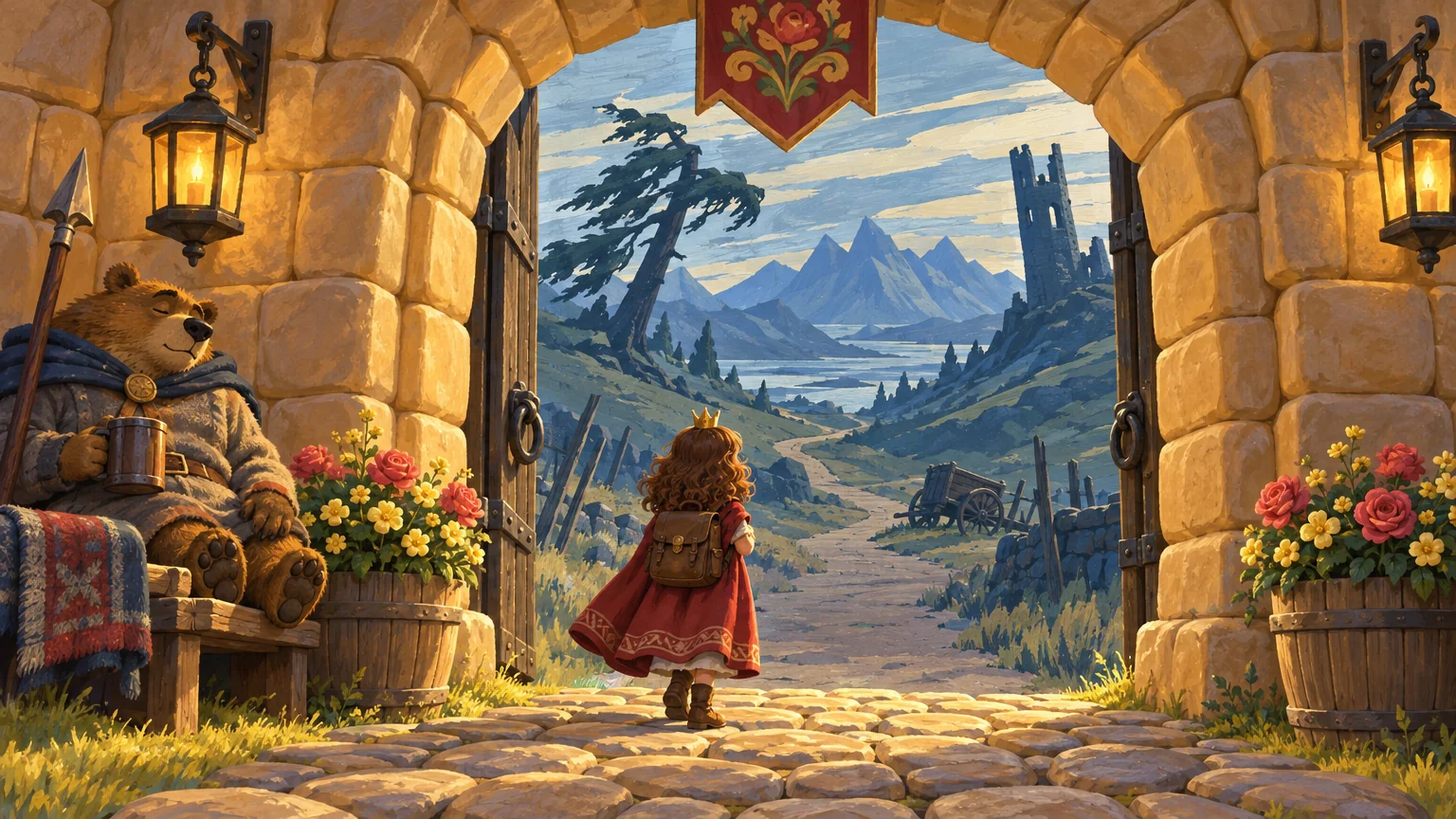
From inside, the arch is a picture frame and the land outside is a painting hung in it. A player feels the change because five things flip at once:
| Inside the arch | Through the arch | |
|---|---|---|
| Temperature | honey, cream, butter light | olive, slate teal, pale straw light |
| Shape | round, chunky, upright | tall, tapered, leaning |
| Paint | blended, no line | strokes, three hard tones, thin coloured line |
| Distance | everything within 30 m | the first thing 30 m off, the last 2 km off |
| Enclosure | framed on both sides | a horizon |
Rules, measured from the wall's outside face (they sit inside the rulebook's blend of 4 m inside to 36 m outside):
- Each gate frames one landmark of its zone, at least ten times her height, visible from 20 m inside the gate through the arch (Nordporten: the old pine and the watchtower in the key art).
- 0–10 m out: the cobbles stop at the arch's outer edge; the road turns umber; the last cute thing stands here (the rulebook's 10 m rule).
- 10–25 m: the flowers of the gate's two tubs come back as wild drifts of the same colours, in the outside brush. This is the one thread she can follow across.
- 15–30 m: the first leaning or tapered silhouette (a wind-bent tree, a tilted way-marker).
- Within 40 m: the first painterly story (the rulebook's list: the tipped cart at Nordporten and so on).
- Coming home: from 60 m out, the arch shows a warm, round, lit picture in a cold grey-green wall. Both gate lanterns are butter-yellow, the only butter light outside.
- Nothing is half-and-half. No prop mixes the two looks except the gate itself.
art/key-seam.webp breaks two of our own rules: the guard's spear is sharp, and the ruin outside is gloomier than
"friendly".
6. The zone system
Ten zones in two groups. Each has a card with the same fields, so they stay one world and each is distinct. The
cards are also in zones.json. A zone added later fills in zone-template.md.
6.1 What keeps them one world and makes each distinct
One world: the eight family rules, the same sky and sun, the same princess, the same paper UI, one umber path
colour outside (#5A4636) and one tan inside (#B07A48), and one family of lantern posts, waystones and signposts
on each side of the wall.
Distinct, by seven variables a zone must set:
| Variable | Rule |
|---|---|
| Key colours | 5–7 hex with roles; the first one or two take half to two thirds of a frame. |
| Value key | The allowed median luma of a daytime frame, a band 0.14–0.18 wide. |
| Shape motif | One shape that the land, the trees and the buildings all repeat. |
| Accent | One of the four glow colours, by the compass rule: north is fire against the cold (ember); west is old magic (cyan); south is the sun (gold); high is the moon (violet, with cyan). Inside the wall nothing glows by day except Skumleskogen's mushrooms and eyes. |
| Light and weather | An hour and a weather the zone leans toward. In the game this is a bias in the region grade and the haze, while the clock keeps running (open question 5). |
| Signature plant and ground | One flower or plant found nowhere else as a drift, and one ground. ../flora/ owns how they are painted. |
| Architecture | One roof, one wall material, one colour, one detail (section 7.3). |
Neighbour rule: two zones that meet differ in at least two of key hue (40° or more apart), value key (0.10 or more apart) and temperature (warm or cool). The closest pairs today: Solengen and Møllebakken (both warm, both about 0.45; hue and motif carry it: turf green against tile red, low dome against tall gable), and Nordalen and Fjellet (both cool and light; Nordalen must keep its birch green as the larger share, and the border runs through red heather).
6.2 The colour script
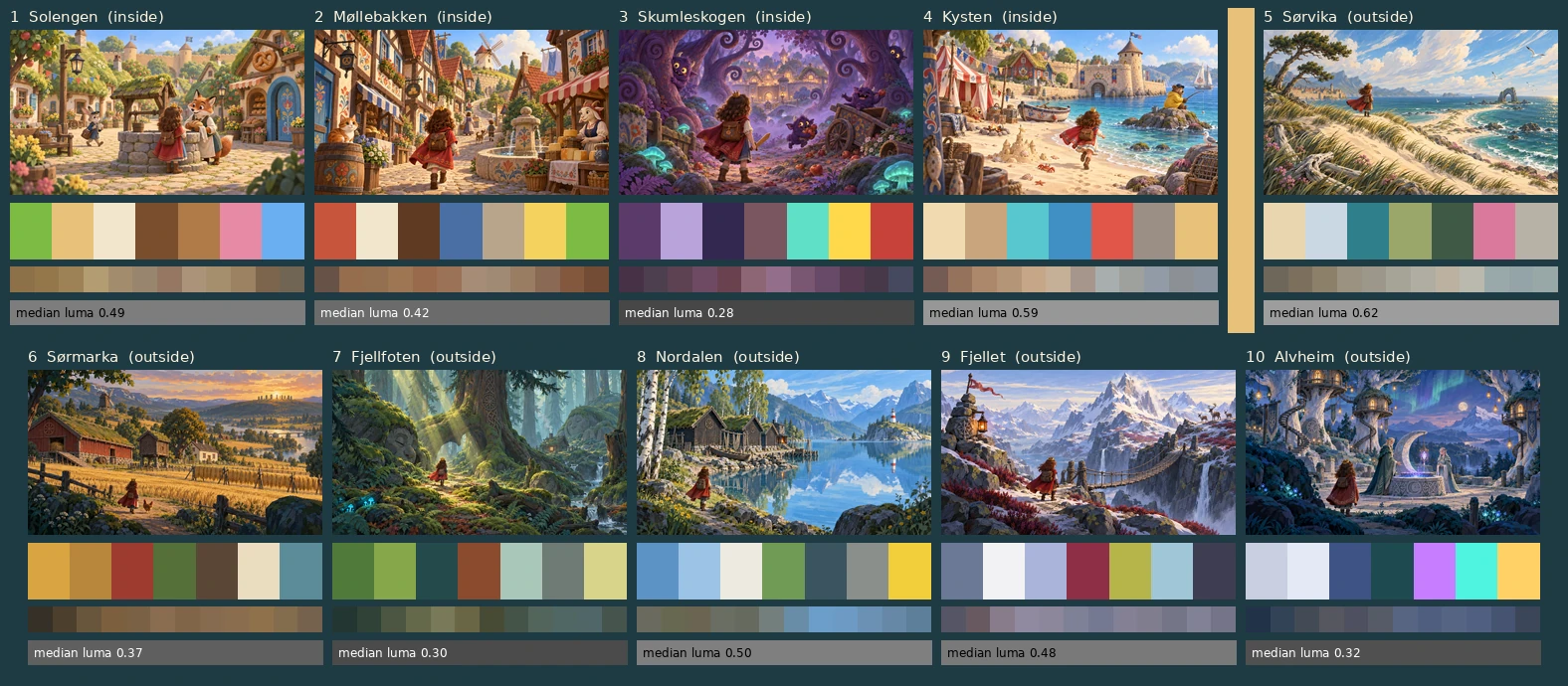
Travel order: the four places inside, the wall (the honey bar), then south and round by the west and north, and up.
Under each frame: the zone's designed palette, the frame boiled down to twelve columns of its own average colour,
and its median luma. art/colour-script-painted.webp is the same journey painted as abstract thumbnails.
What the strip must keep doing:
- Inside is one warm chord with one dip: three light, warm places and Skumleskogen as the low, violet one.
- The wall is the biggest step, and the first zone outside (Sørvika) is the lightest and the most open, so the step out feels like air.
- Outside swings: light and pale (Sørvika), warm and mid (Sørmarka), low and green (Fjellfoten), light and blue (Nordalen), light and cold (Fjellet), low and glowing (Alvheim). No two neighbours share a value key and a hue.
- Saturation falls and glow rises along the way: the most glow is at the end of the climb.
- The strip's own fault: Solengen and Møllebakken average to nearly the same tan. In the game the ground must carry the difference (lawn and turf against cobbles).
6.3 The ten cards
Each card: feeling, key reference, palette, motif, light and weather, plant and ground, architecture and materials, creatures, one never. Value keys are measured from the frame shown, ± 0.08.
1. Solengen (inside, Hjemdalen)
- Feeling: a sunny morning in a village where everyone knows your name.
- Key reference: the storybook village of feature animation;
docs/concept/03-village.jpg. - Palette:
#7DBB45grass and turf roofs ·#E8C27Ahoney sandstone ·#F3E6CCcream plaster ·#7A4E2Dtimber ·#B07A48path and cobbles ·#E88AA6rose (accent) ·#6AAEF0sky blue (accent: doors, bunting). - Motif: the bread loaf: a low dome on a round foot (turf roofs, the well's cap, haystacks, round apple trees).
- Light and weather: late morning, clear, puffy clouds. Value key 0.38–0.55.
- Plant and ground: daisies in the turf and flower tubs at every door; lawn with big rounded tan cobbles set in it.
- Architecture: low turf-roofed cottages, cream plaster, round sky-blue doors with rosemaling.
- Creatures: animal villagers in clothes, hens, a kitten; the classic round skumling never comes in.
- Never: a straight roof ridge.
2. Møllebakken (inside, Hjemdalen)
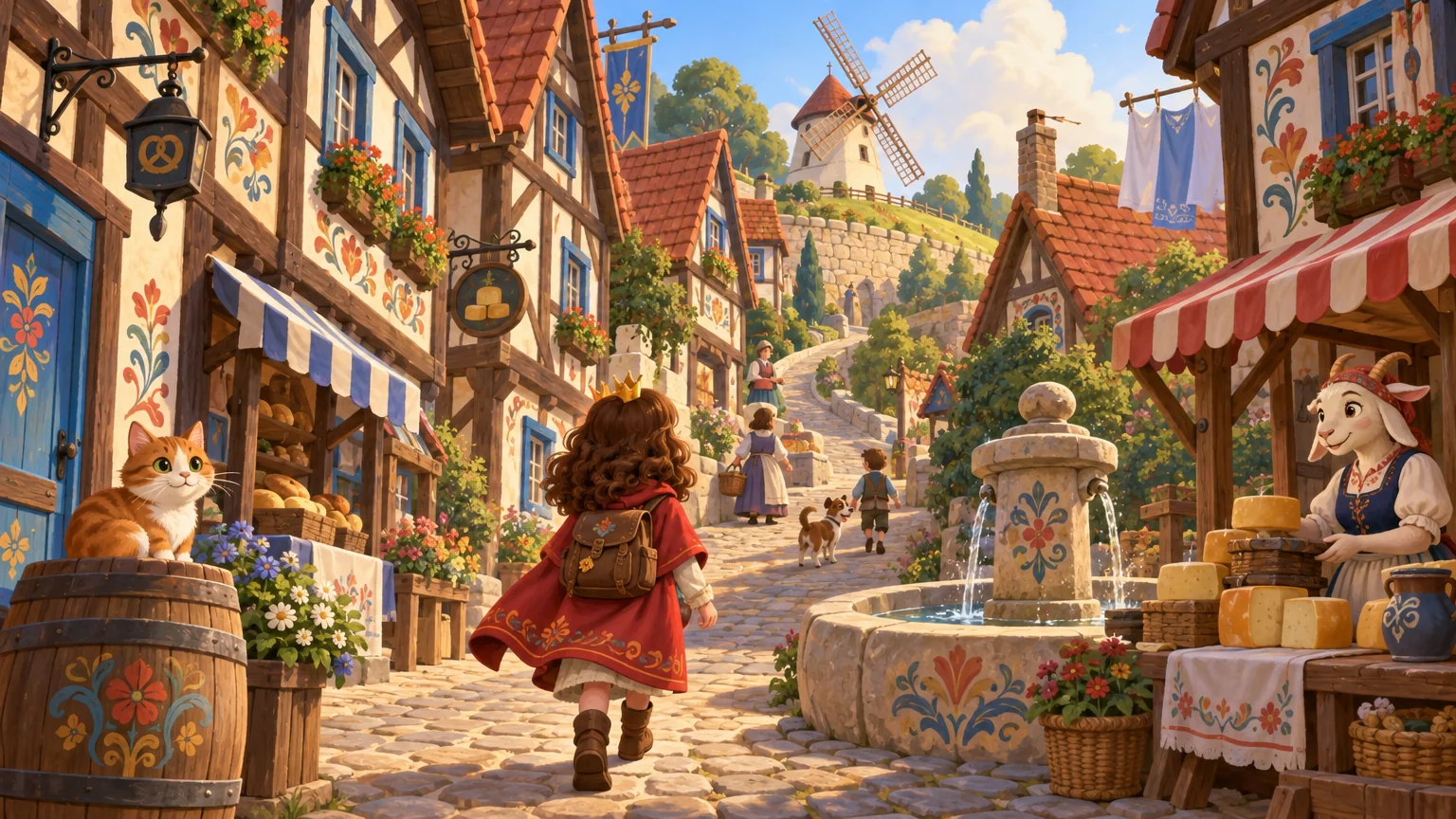
- Feeling: market day on the hill, with the mill turning.
- Key reference: a half-timbered market town; the rulebook's "Møllebakken's houses, windmill and market".
- Palette:
#C8553Dtile roofs ·#F3E6CCplaster ·#5E3A22dark timber ·#4A6FA5window frames and shutters ·#B9A58Ccobbles and fountain stone ·#F4D35Ebutter (accent: awnings, cheese, signs) ·#7DBB45vines. - Motif: the tall gable and the turning wheel (sails, the fountain's rim, cart wheels, cheeses).
- Light and weather: breezy afternoon; washing and bunting move. Value key 0.35–0.52.
- Plant and ground: geraniums in window boxes and vines up the walls; cobbled street with a worn middle.
- Architecture: two-storey half-timber, steep red tile, blue frames, striped awnings. Taller and tidier than Solengen, still round at every corner.
- Creatures: the mill folk (goat, goose, heron, squirrel, martens), cats on barrels.
- Never: a turf roof (that is Solengen's).
3. Skumleskogen (inside, Hjemdalen)
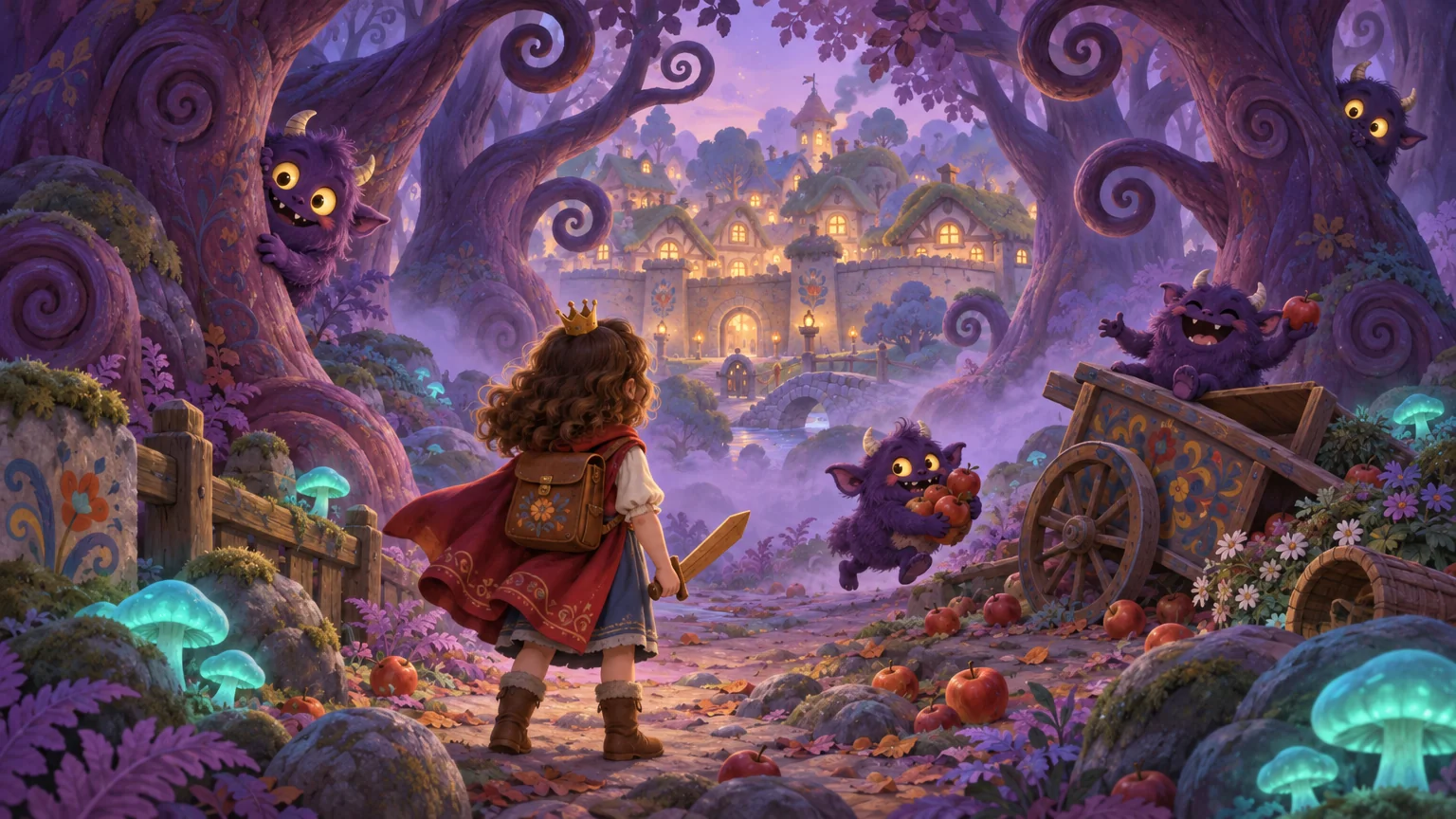
- Feeling: a wood that tries to be spooky and keeps giggling.
- Key reference:
docs/concept/05-creatures.jpg, with its black lifted to plum. - Palette:
#5B3A6Bplum trunks ·#B9A3D9lilac mist and far trees ·#33284Fdeep violet shade (the darkest) ·#7A5560mauve floor and path ·#5FE0C8mushroom glow (accent) ·#FFD84Askumling eyes (accent) ·#C8423Aapples and petals. - Motif: the spiral (branch ends, fern heads, roots, the skumlinger's tails).
- Light and weather: lilac twilight under the canopy at any hour, ground mist, fireflies. Value key 0.22–0.36.
- Plant and ground: glowing round-capped mushrooms and curled ferns; a mauve leaf floor with stolen apples.
- Architecture: none; one tipped cart, a lost lantern, the village's lit windows seen between the trunks.
- Creatures: the classic skumling, plum
#3B2A4F, yellow eyes, tiny horns, goofy grin. - Never: a straight branch, or anything black.
4. Kysten (inside, Hjemdalen)
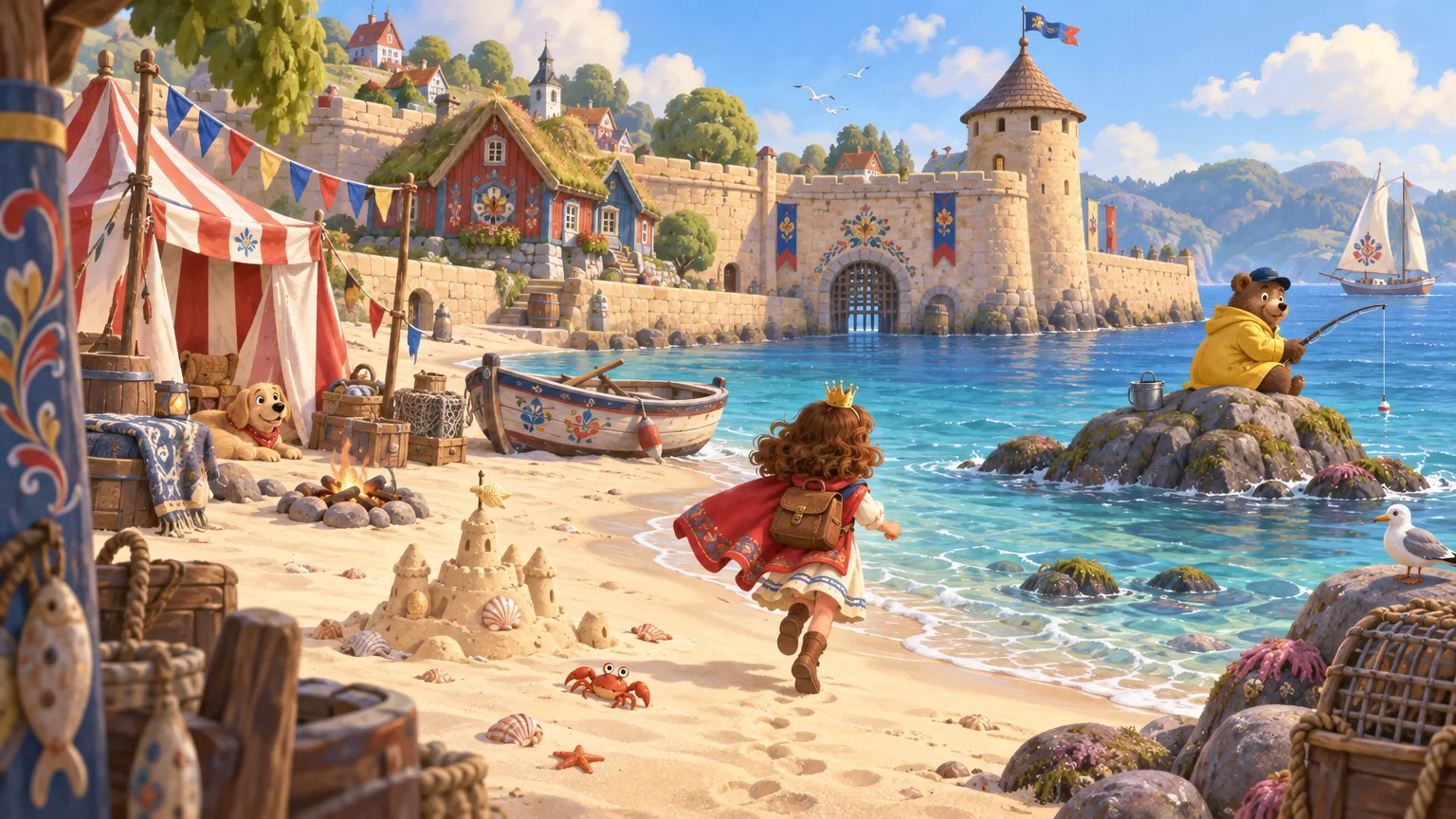
- Feeling: a day at the beach with the wall at your back.
- Key reference: the beach camp, the best-staged place in the audit.
- Palette:
#F1D9B0dry sand ·#C9A57Ewet sand ·#58C6D0aqua shallows ·#3F8FC4the sea's body ·#E0564Acoral stripes (accent: tent, boat, buoys) ·#9A8F86driftwood and rock ·#E8C27Athe wall and its water gate. - Motif: the scallop and the wave arc (shells, ripples, the cove's curve, the tent's edge).
- Light and weather: bright noon, a light sea haze, small waves. Value key 0.50–0.68.
- Plant and ground: sea rocket and beach peas at the sand's top edge; rippled sand with a wet line and a strandline of shells.
- Architecture: a striped tent, a shed, a pulled-up boat; the wall running out into the sea.
- Creatures: crabs, gulls, the bear in the yellow raincoat.
- Never: grey sand or a milky sea.
5. Sørvika (outside, look 0.85)
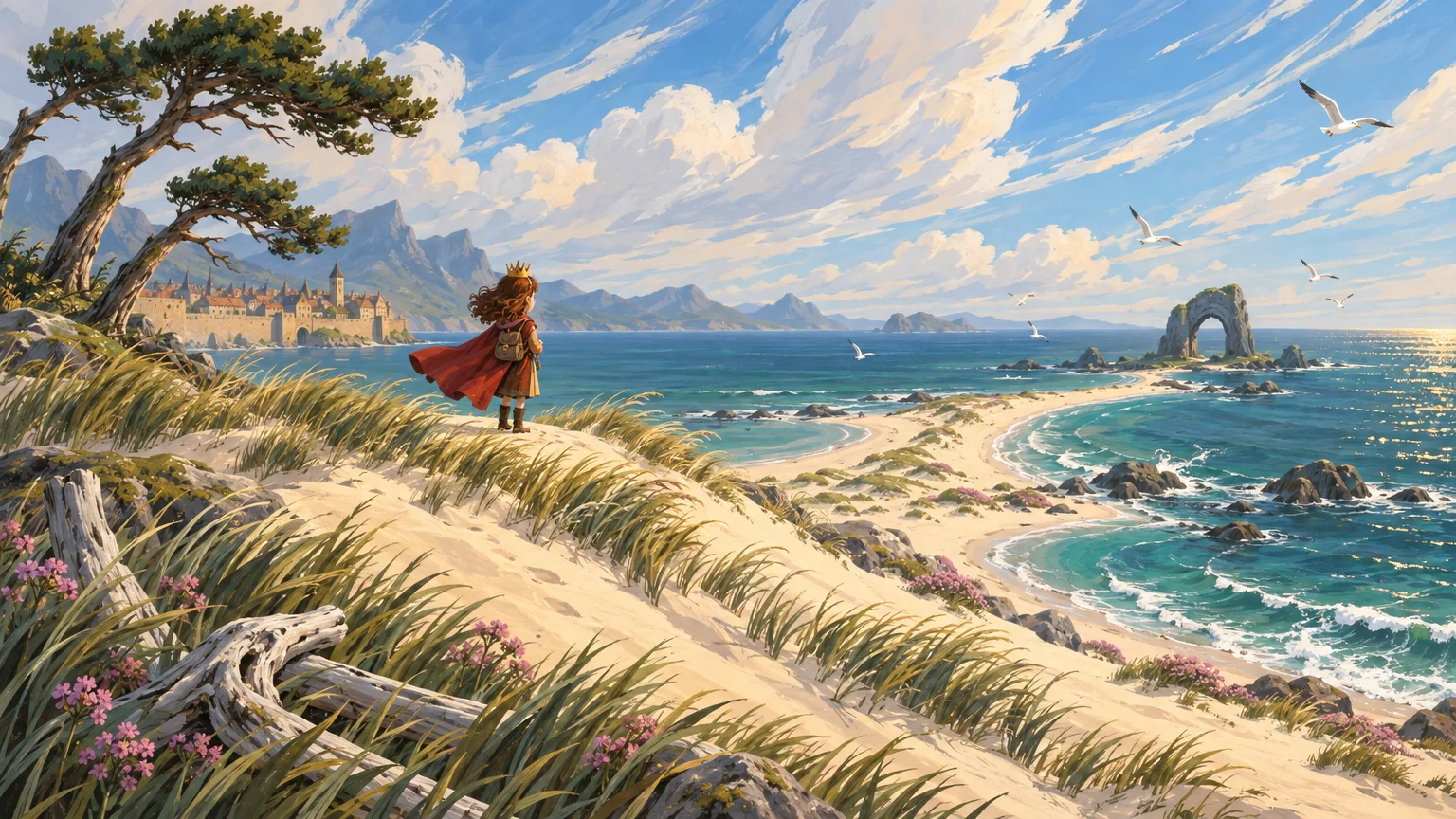
- Feeling: wind in your cape and the whole sky to yourself.
- Key reference: the Jæren and Lista dune coasts; Firewatch's rule that the sky sets the biggest patch of colour.
- Palette:
#E9D6AEdune sand ·#C9D8E2the pale sky ·#2F7F8Asea teal ·#9AA66Amarram ·#3F5A45wind-bent pines ·#D9799Bsea thrift ·#B8B2A6driftwood and gate stone. Accent: gold, as sparkle on the sea and the lamp at Havporten. - Motif: the wind-leaning crescent (dune crests, bent pines, the spit's curve, marram tufts, all leaning the same way).
- Light and weather: windy bright midday, fast streaked clouds, salt haze. Sky about half the frame. Value key 0.52–0.70.
- Plant and ground: sea thrift in pink cushions; pale sand with marram combed one way.
- Architecture: almost none: Havporten's stone arch at the spit's tip, a driftwood shelter, a stockfish rack.
- Creatures: gulls, terns, a seal on the skerry, a hare in the dunes.
- Never: anything standing straight up.
6. Sørmarka (outside)
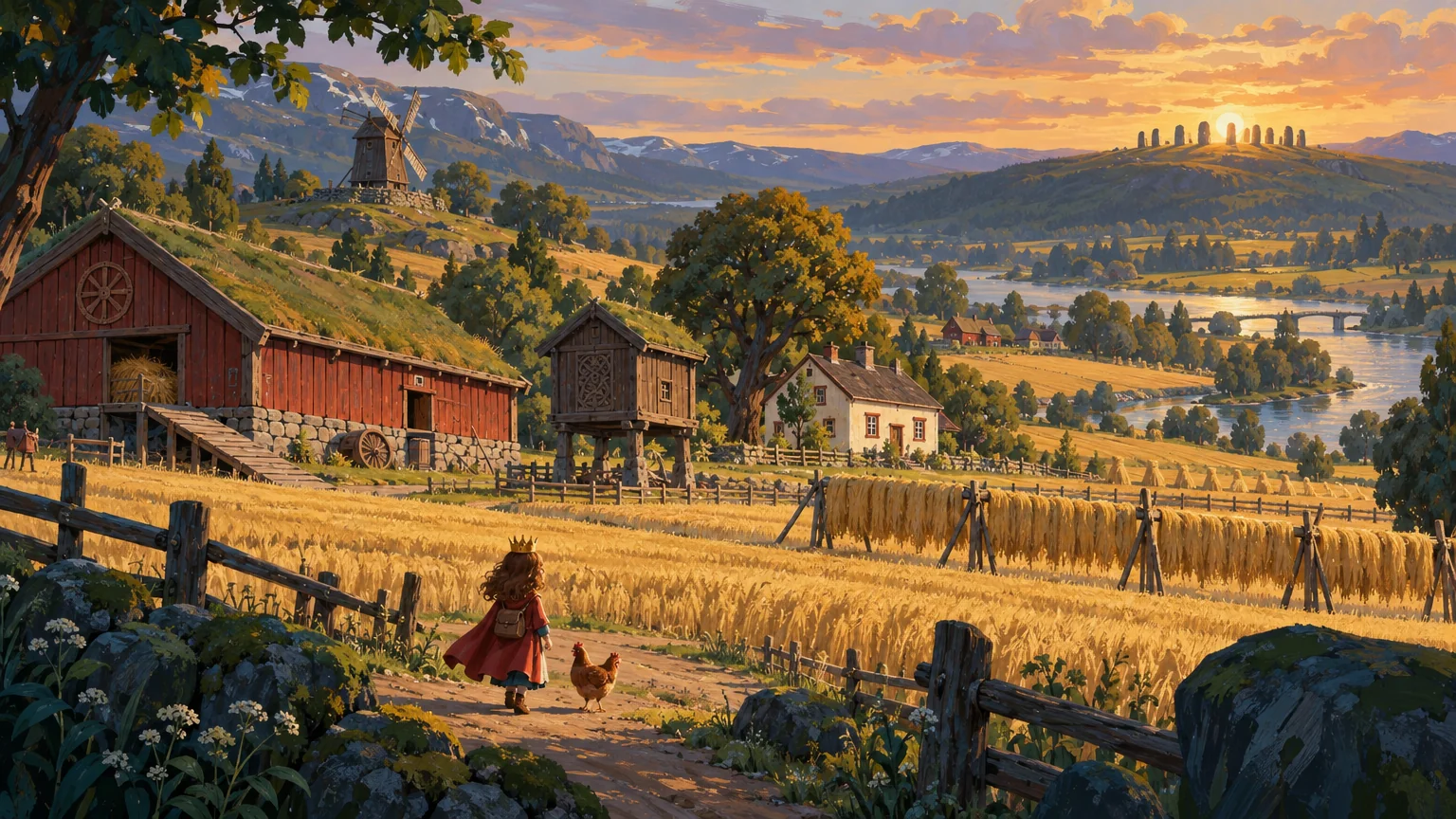
- Feeling: the last warm hour of a working day on the farm.
- Key reference: Østlandet farmland and national-romantic harvest painting; Frozen's "horizontal amongst the vertical".
- Palette:
#D9A441barley and hay ·#B8873Cstubble ·#9E3B2Fbarn red ·#55703Aoak crowns and pasture ·#5A4636dug earth and tarred fences ·#EADDC0farmhouse cream ·#5C8C99the river. Accent: gold, on the sun stones and in the barn's lamp. - Motif: the long low line and the row (the barn's ridge, fences, hay racks, furrows, field strips).
- Light and weather: late-afternoon gold, long shadows, dust in the air; showers over the bog. Value key 0.30–0.46.
- Plant and ground: barley and poppies at the field's edge; stubble, dug soil in rows, packed earth in the yard.
- Architecture: red barn on a stone foot with a ramp, stabbur on pillars, cream farmhouse, rail and picket fences, hay racks.
- Creatures: cows, sheep, hens, the farm dog and cat; hares and a fox at the field's edge.
- Never: a tall thin building (the windmill on its hill is the one upright).
7. Fjellfoten (outside)
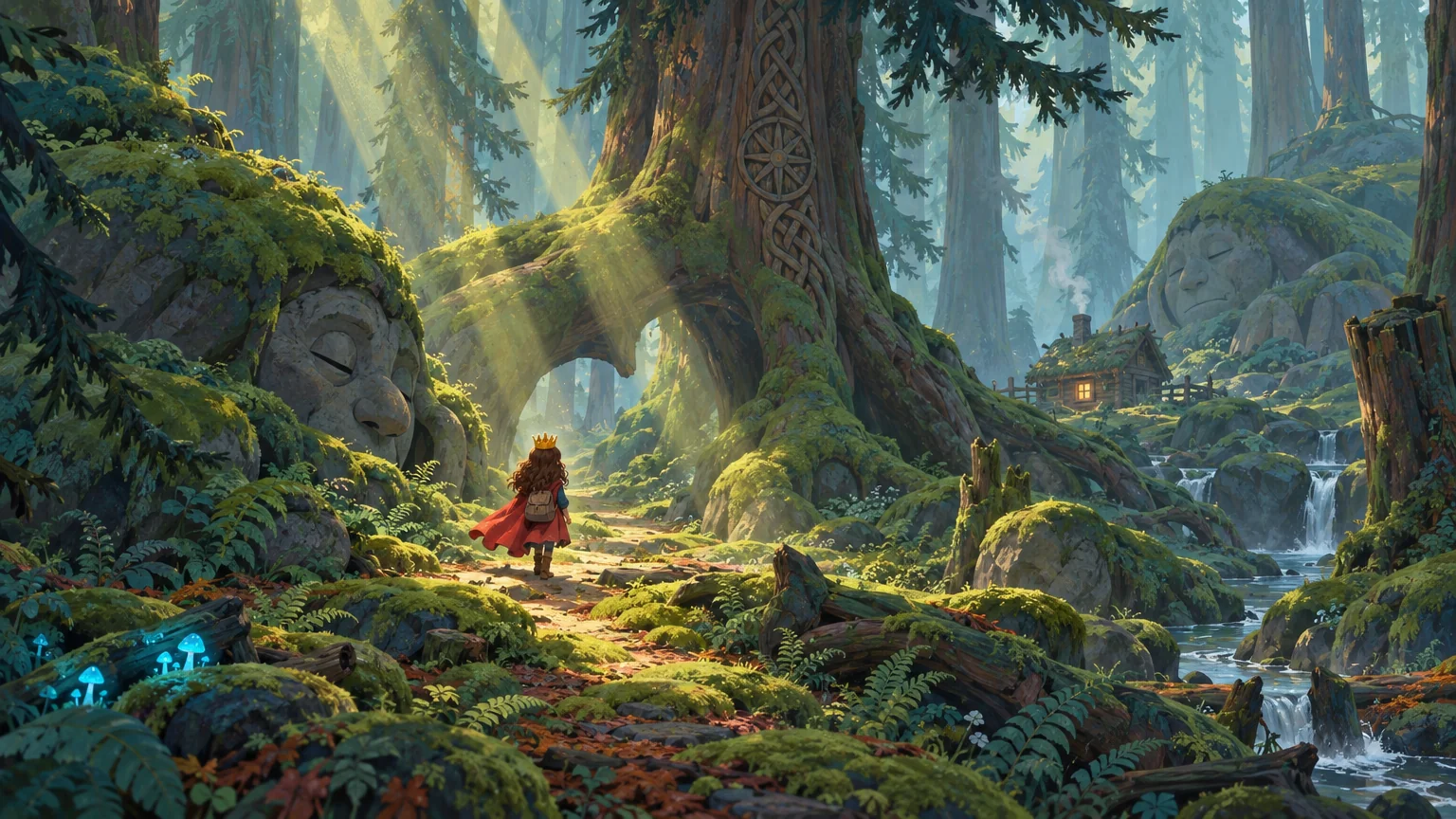
- Feeling: a forest so old it has started to snore.
- Key reference: Kittelsen's forest trolls made kind; old-growth spruce.
- Palette:
#4F7A3Amoss ·#86A84Amoss in the light ·#234A4Ateal shade (the darkest) ·#8A4B2Fbark and rust-red needles ·#A9C7B8mist and far trunks ·#6F7B74troll boulders ·#D8D48Ashafts of light. Accent: cyan, in the mushrooms and the trolls' tarn. - Motif: the huge trunk and the hunched round back (boulders that are sleeping trolls, root arches, turf roofs).
- Light and weather: closed canopy, pale mist in the depth, three or four shafts of green-gold light, a drizzle now and then. No sky. Value key 0.24–0.38: the lowest outside, and still a wood a child walks into.
- Plant and ground: ferns and glowing-cap mushrooms; deep moss with rust-red needle paths.
- Architecture: low heavy log huts with turf roofs, a watchtower, an old stone gate.
- Creatures: the wolf pack (red neckerchief on the old one), lynx, the mossy bear, the troll family; the combat skumlinger in their painted versions.
- Never: a median luma under 0.24, or a troll with its mouth open.
8. Nordalen (outside)
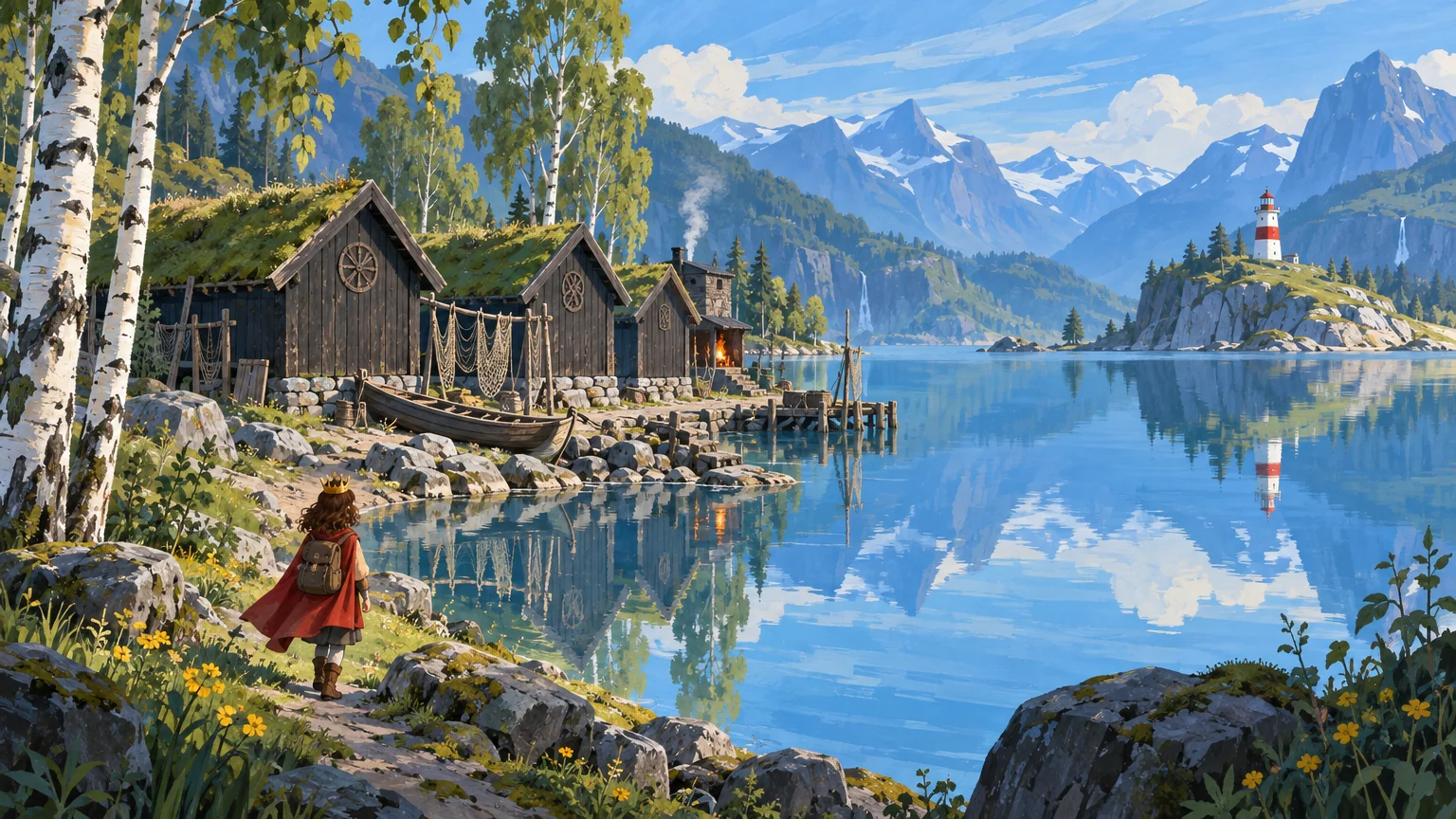
- Feeling: a clear cold morning by the lake, with smoke from one chimney.
- Key reference: a Vestland lake hamlet with naust; Nordlys's fire against the cold.
- Palette:
#5B93C4the lake ·#9CC3E6sky and its reflection ·#EDEAE0birch bark and the lighthouse ·#6F9A55cool summer green ·#3B5560tarred wood (slate teal, never black) ·#8A8F8Cshore stone ·#F2CF3Bbuttercups. Accent: ember, in the smokehouse, the kiln, the king's brazier and the lighthouse lamp. - Motif: the slender upright and its mirror image (birch trunks, naust gables, the lighthouse, masts, each doubled in the water).
- Light and weather: cool clear morning, still water, mist on the lake at dawn. Value key 0.40–0.58.
- Plant and ground: buttercups in drifts and birch; cool green meadow in level strokes, grey shingle at the water.
- Architecture: tall narrow naust of tarred planks on stone feet with turf roofs, a smokehouse, a white lighthouse with a red band, the stave church ruin.
- Creatures: gulls, the white water-horse (faint cyan), the cat at the gutting bench, ravens, Trollfar.
- Never: an orange sky by day.
9. Fjellet (outside)
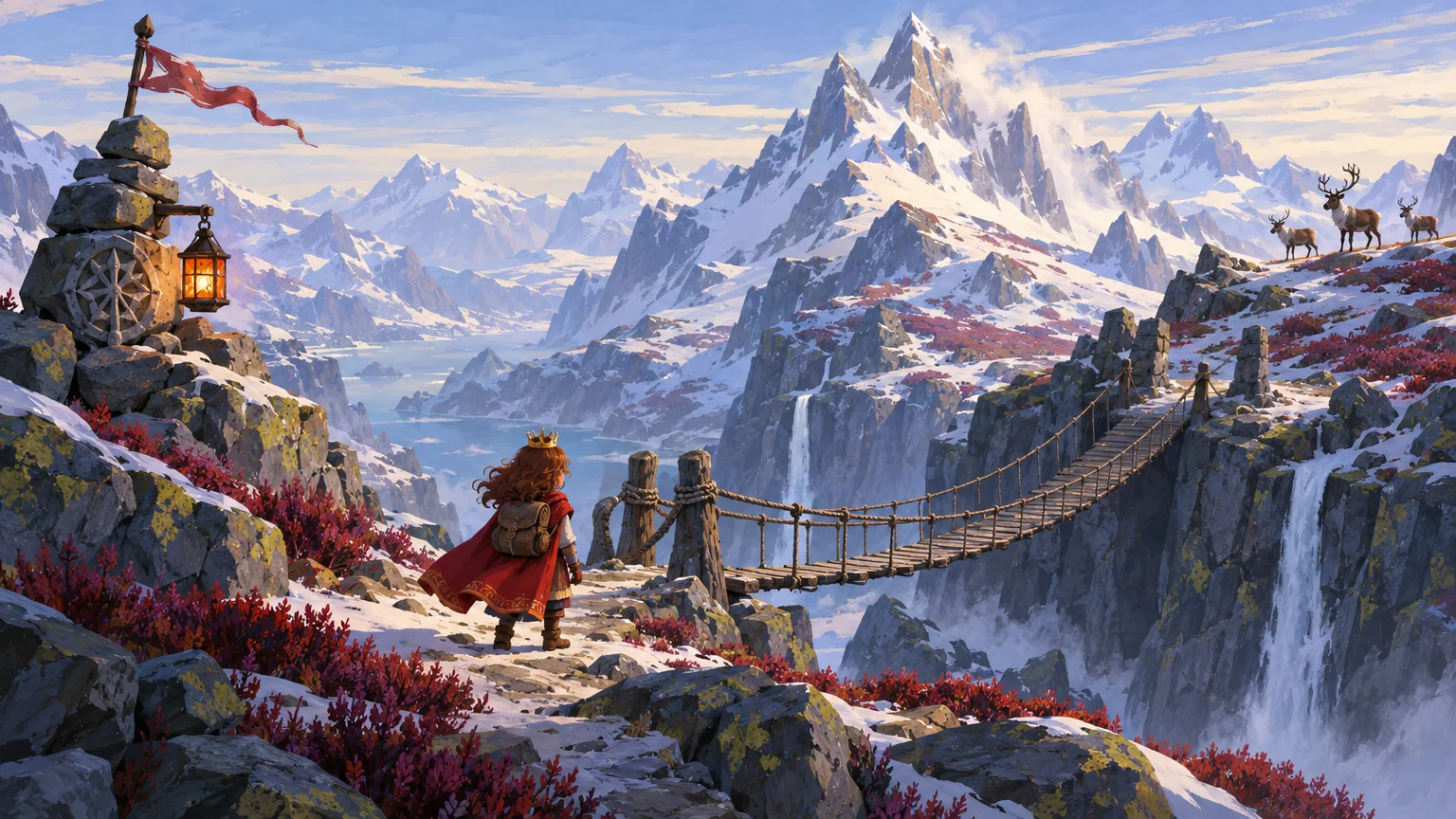
- Feeling: thin air, far views, and you feel small in a good way.
- Key reference: Jotunheimen above the tree line; Breath of the Wild's triangles.
- Palette:
#6C7896rock ·#F2F1F4snow in the light ·#A9B4DAsnow in the shade ·#8E2F45heather and dwarf birch in autumn red ·#B5B44Amap lichen ·#9FC6D6ice water and the far fjord ·#3F3D52rock in the shade (the darkest). Accent: ember by day (a lantern, a campfire); the northern lights at night. - Motif: the triangle and the diagonal (peaks, the path's hairpins, the rope bridge, wind streamers).
- Light and weather: cold clear afternoon, snow blowing off the tops, sudden flurries. Value key 0.40–0.58.
- Plant and ground: wine-red heather and dwarf birch; lichen-spotted rock, scree, snow patches.
- Architecture: stone cairns with a flag and a lantern, the rope bridge, the old mine's timbering, a stone hut.
- Creatures: reindeer, mountain goats, the eagle, the stone giant.
- Never: a round tree.
10. Alvheim (outside, look 0.6; ../alvheim/ goes deep)
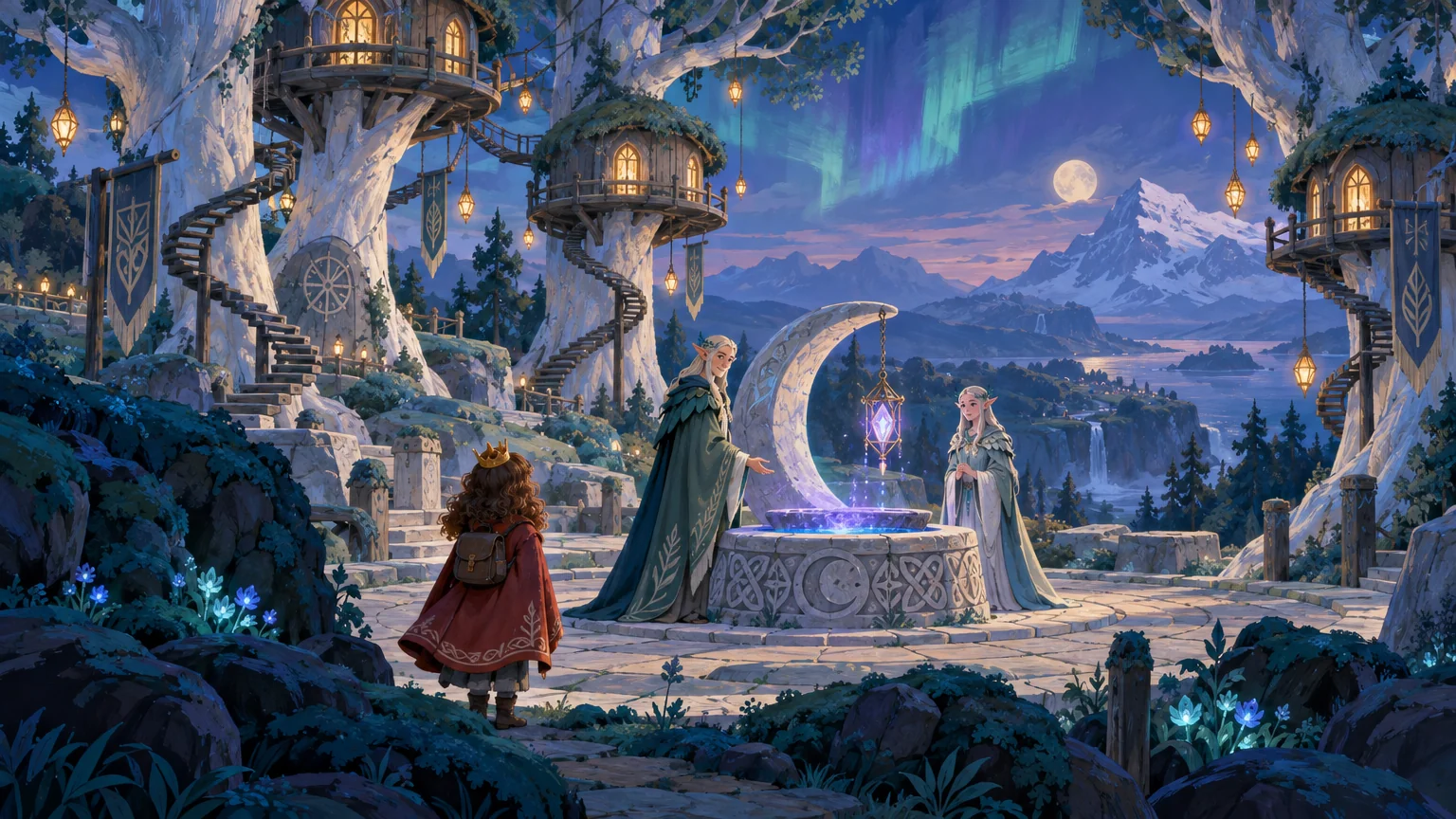
- Feeling: somewhere the moon is always just rising.
- Key reference:
docs/mountains.md(Månebrønnen, the tree houses, the lanterns in the trees); Amulet's glow as a light source. - Palette:
#C9CFE0silver bark ·#E4E9F5moonstone ·#3E5486dusk blue ·#1F4A50deep teal moss ·#C77DFFelf violet (accent) ·#4FF3E0magic cyan (accent) ·#FFD166lanterns in the trees. - Motif: the crescent and the pointed leaf (the moon horn, arches, cloak collars, lantern shapes).
- Light and weather: a dusk feeling at any hour: the grade leans blue, the glow carries the light; drifting motes; the northern lights on clear nights. Value key 0.26–0.42.
- Plant and ground: small glowing bellflowers; deep teal moss in broad shapes, pale flagstones.
- Architecture: round tree houses on huge pale trees, moonstone carved with runes. Ornament is carved and glows; no rosemaling, no sun wheel.
- Creatures: elves at five heads tall, the tallest folk in the game, slender, eyes still large; moths, an owl.
- Never: a city. Five trees, one court, much open ground. The first try (not kept) drew a Rivendell.
What the Alvheim portfolio must fit: the palette roles above, violet and cyan as its only glows besides the warm lanterns, the 3 % and 8 % dark limits (our own frame is at 6.8 %, so lift the foreground), elves on the outside proportion chart with their own head count, and the threshold rule at Alveporten (section 6.4).
6.4 Transitions
Three kinds of border:
| Kind | Where | Depth | What it feels like |
|---|---|---|---|
| The hard seam | the town wall's gates | 40 m | a step through a picture frame (section 5) |
| The soft border | between two zones | 80 m (60–120 m) | a walk of about 20 s in which the land changes its mind |
| The threshold | into a place inside a zone (Alvheim at Alveporten, Gammelskogen's heart, Skumleskogen) | 15–30 m | a doorway: an arch, two great trees, a stone gate |
A soft border, in the order things change as she walks through its 80 m:
- Ground hue shifts across the whole depth, in ragged bays (the build's 23 m and 110 m bays), never a line.
- The signature plant hands over in the middle 40 m: the leaving zone's flower thins to nothing, the entering zone's starts as single plants and thickens. For 20 m both grow together. Nowhere else may they mix.
- Tree silhouettes hand over in the same 40 m: the leaving kind grows sparse and odd (mossy birches), young ones of the entering kind stand between them.
- Light and haze ease across the depth (the region grade's own easing), about 20 s at a walk.
- Buildings never mix. No building of either zone within 100 m of the border, except the threshold marker.
- A threshold marker where a way crosses: one built thing made of both zones' stone or wood, with the carved ornament of the land ahead and a lantern in the entering zone's accent colour, facing the walker.
What stays the same across every border: the path's colour, the sky and the sun's direction, the lantern-post and waystone family, the princess, the UI.
Never: two zones' buildings in one view within 60 m of each other; a change of ground along a straight line; a border with no marker on a way.
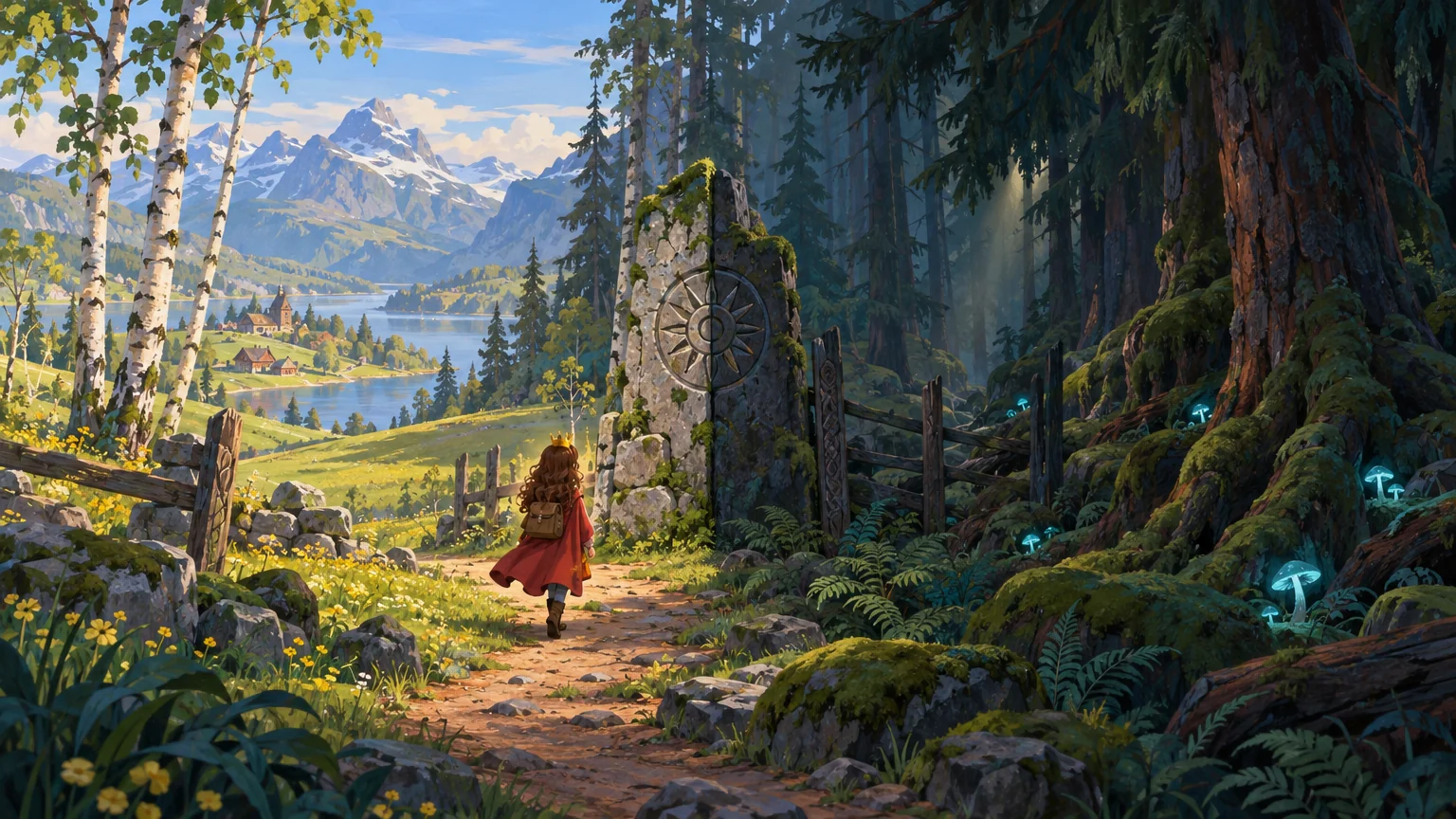
art/rule-border.webp shows the marker (pale lake stone on the Nordalen side, dark forest stone on the Fjellfoten
side) and one path through. It squeezes the 80 m into about 15 m; the game must not.
6.5 Ground and grass, the frame the flora work must fit
../flora/ owns technique. The frame it works inside:
| Inside the wall | Outside | |
|---|---|---|
| Grass as paint | soft masses in two or three close tones; blades only as a fringe at the near edge and on crests | long level strokes in three tones leaning with the zone's wind; blades only within about 8 m |
| Flowers | in tubs, boxes and beds near houses; in meadows, drifts of one kind 2–3 m across | one signature flower per zone as its only big drift; other flowers as single dabs |
| Hue | yellow-green #6DB33F–#8CC84B | the zone's own green (olive #5E7A43 by default; Nordalen #6F9A55, Fjellfoten moss #4F7A3A, Sørvika marram #9AA66A, Sørmarka pasture #55703A) |
| Ground share | no single-coloured ground wider than 20 m in view (the rulebook) | the same, and the ground is the zone's key colour or its second |
| Zone | Signature plant | Ground |
|---|---|---|
| Solengen | daisies in turf and tubs | lawn with rounded tan cobbles |
| Møllebakken | geraniums in window boxes, vines | worn cobbles |
| Skumleskogen | glowing mushrooms, curled ferns | mauve leaf floor |
| Kysten | sea rocket, beach pea | rippled sand, a wet line |
| Sørvika | sea thrift | pale sand, combed marram |
| Sørmarka | barley, poppies at the edge | stubble, dug rows, packed earth |
| Fjellfoten | ferns, glowing-cap mushrooms | deep moss, rust-red needles |
| Nordalen | buttercups, birch | cool meadow, grey shingle |
| Fjellet | heather, dwarf birch | lichen rock, scree, snow |
| Alvheim | glowing bellflowers | teal moss, pale flagstones |
7. Characters, creatures, buildings and props as a system
7.1 Folk
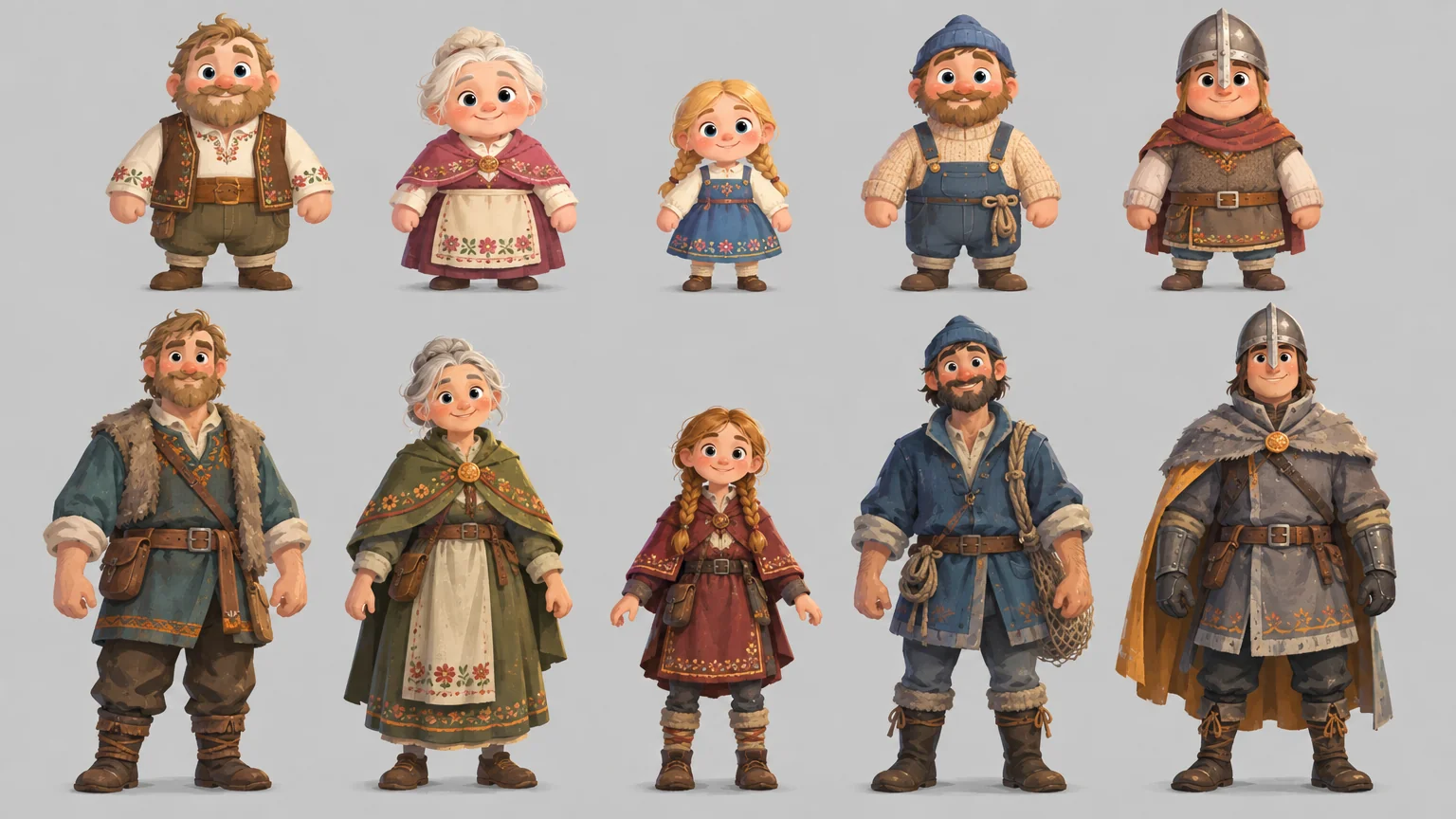
| Inside | Outside | |
|---|---|---|
| Grown-up | 3 heads tall (head 1/3 of the height) | 4.5 heads (4–5); elves 5 |
| Child | 2 heads | 3.5 heads |
| Height in the game | 1.0–1.55 m (the rulebook) | 1.45–1.8 m; elves to 2.0 m |
| Build | round, short limbs, mitten hands, feet half a head long | stocky, long body, short strong legs, tapered silhouette, hands with fingers |
| Each eye | at least 1/4 of the face's width, set low | at least 1/5 of the face's width |
| Face | small nose, a smile | eyebrows that act, a nose with a shape, still a smile |
| Colour | light and warm: cream, rose, butter, sky blue, warm brown | one colour of their own per figure (sea blue, olive, wine red, slate teal) and one small glowing accent (a lantern, a buckle) |
| Clothes | folk dress with one painted or embroidered flower band | layered, worn, practical; one woven geometric band |
| Paint | soft, blended, no line, no hard shadow shapes | three tones with hard edges, brush planes visible, thin coloured line; painted light from above and in front |
| The princess | one model on both sides; the paint pass carries her outside (the rulebook) |
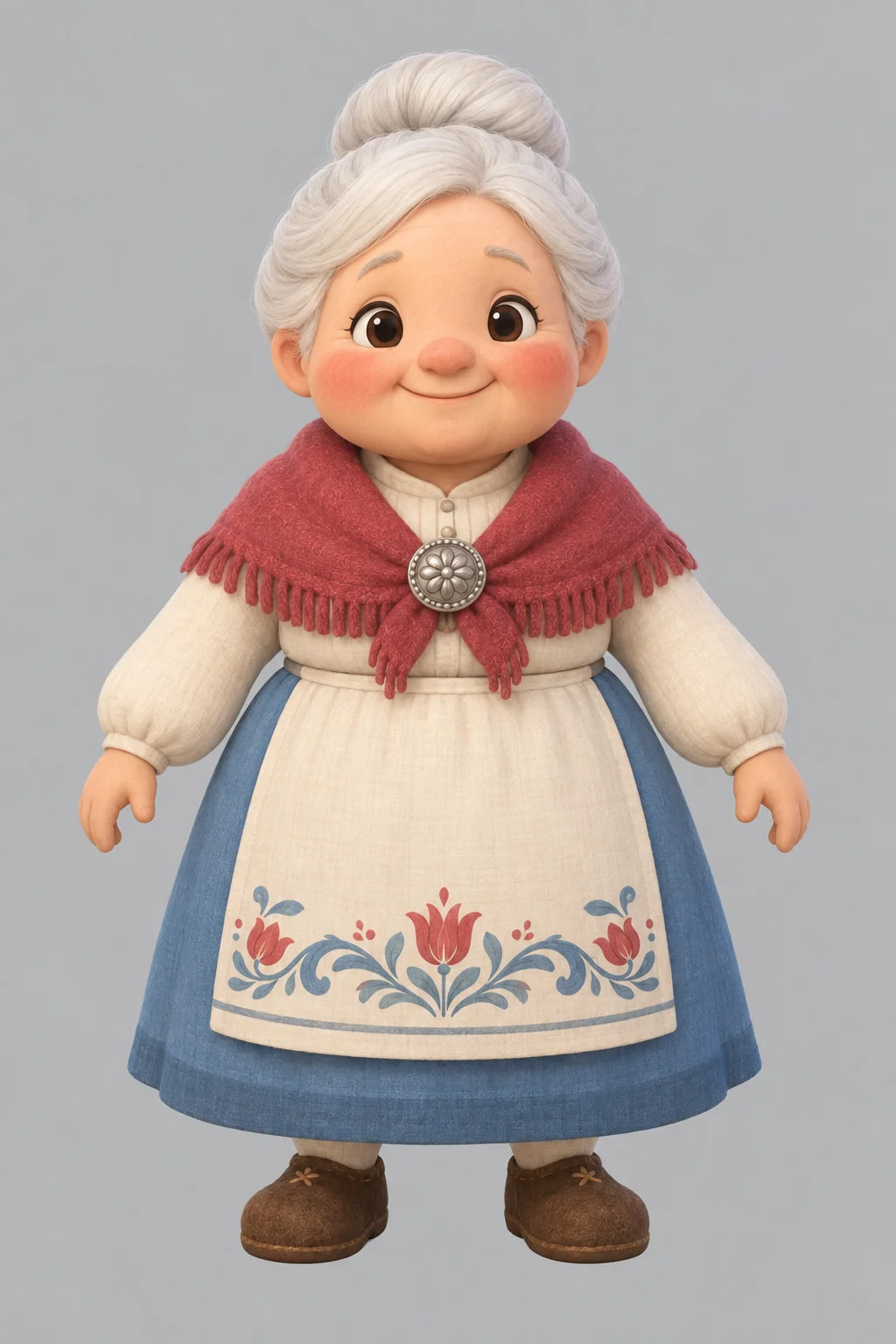
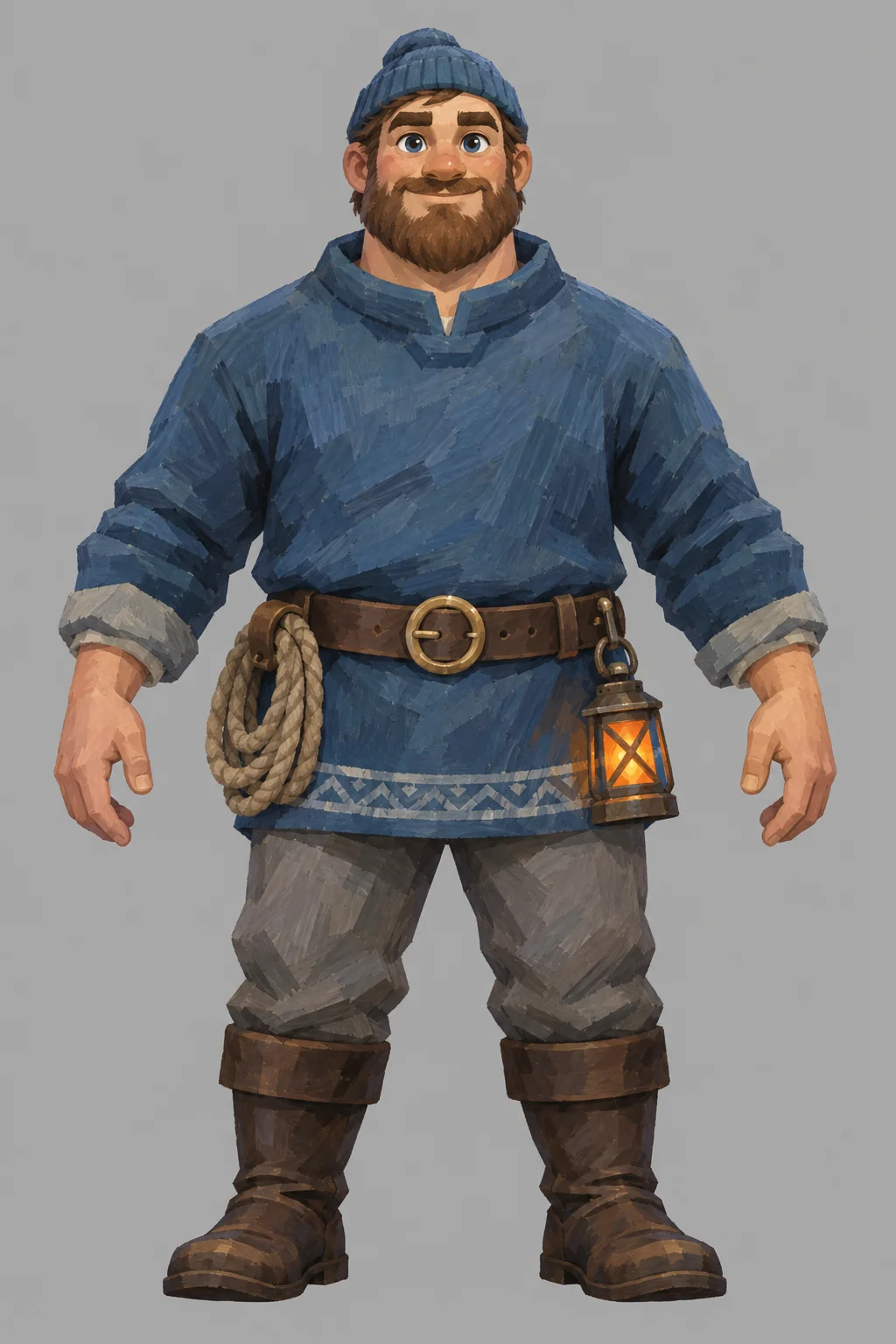
art/lineup-folk.webp shows the proportions (the lower row stands taller on the same scale). The surface difference
shows better in the two mesh references:
7.2 Creatures
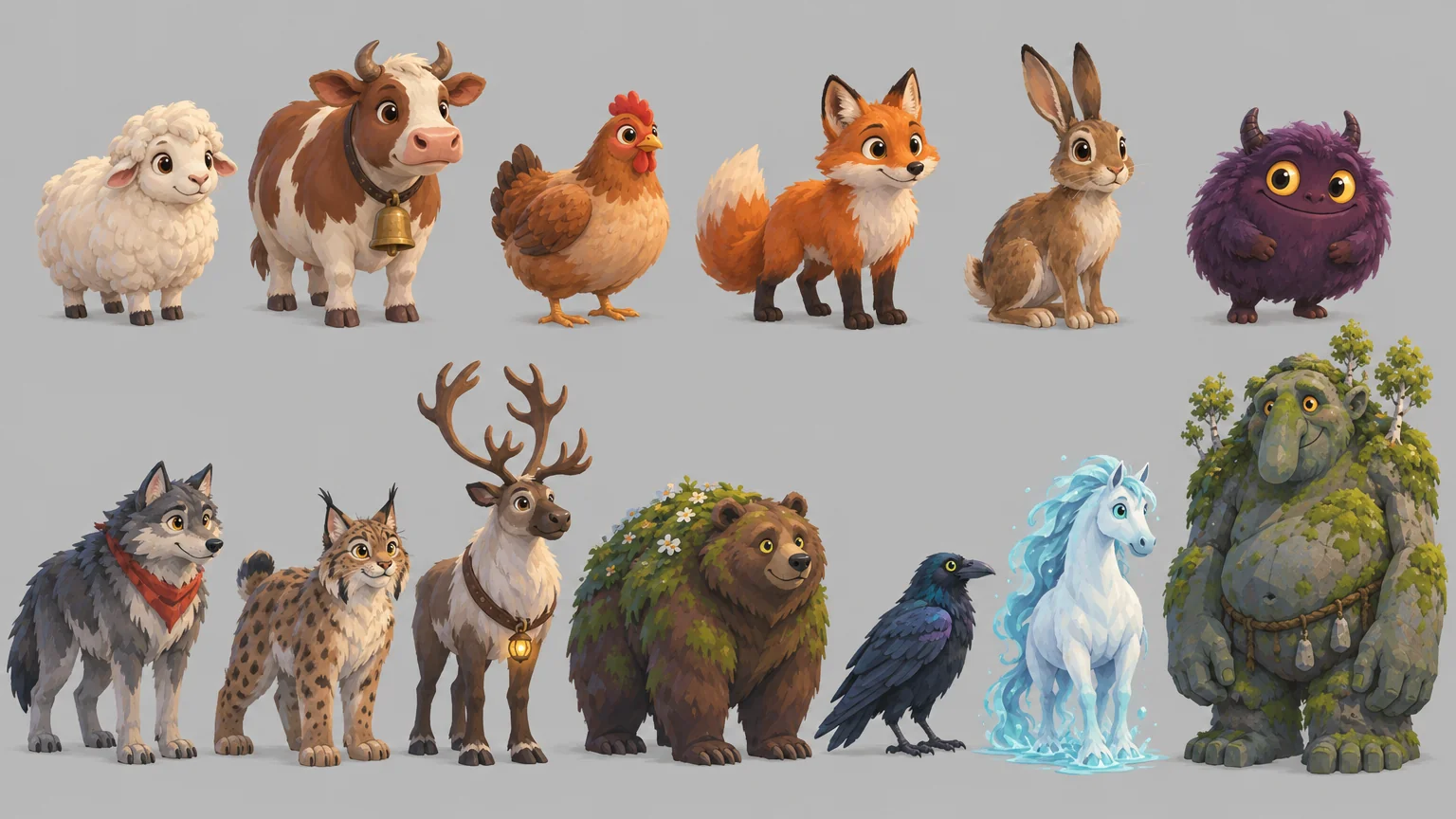
| Inside | Outside | |
|---|---|---|
| Head | half the body's size | a third |
| Legs | short; at most 1/4 of the height | longer, real joints, still thick |
| Silhouette | round rump, no neck | tapered, one asymmetry (a bent ear, a neckerchief, moss on one shoulder) |
| Eyes | big, round, dark with a highlight | big, coloured, bright; a magic creature's eyes glow in its zone's accent |
| Surface | soft masses, no strands | three tones, fur and feathers as brush planes |
| Something worn or grown | a bell, a bow | a neckerchief, flowers or moss growing on it, a lantern |
Rules for all: the bigger, the kinder (anything over 3 m has a round back, half-closed warm eyes and a closed
mouth); a dangerous thing differs from a friendly one by silhouette and accent before it is close (the rulebook);
skumlinger are plum #3B2A4F, never black; a creature belongs to one zone and wears something of it (Fjellfoten's
bear grows moss and anemones, Nordalen's water-horse has a cyan sheen, Fjellet's reindeer carries a lantern).
7.3 Buildings
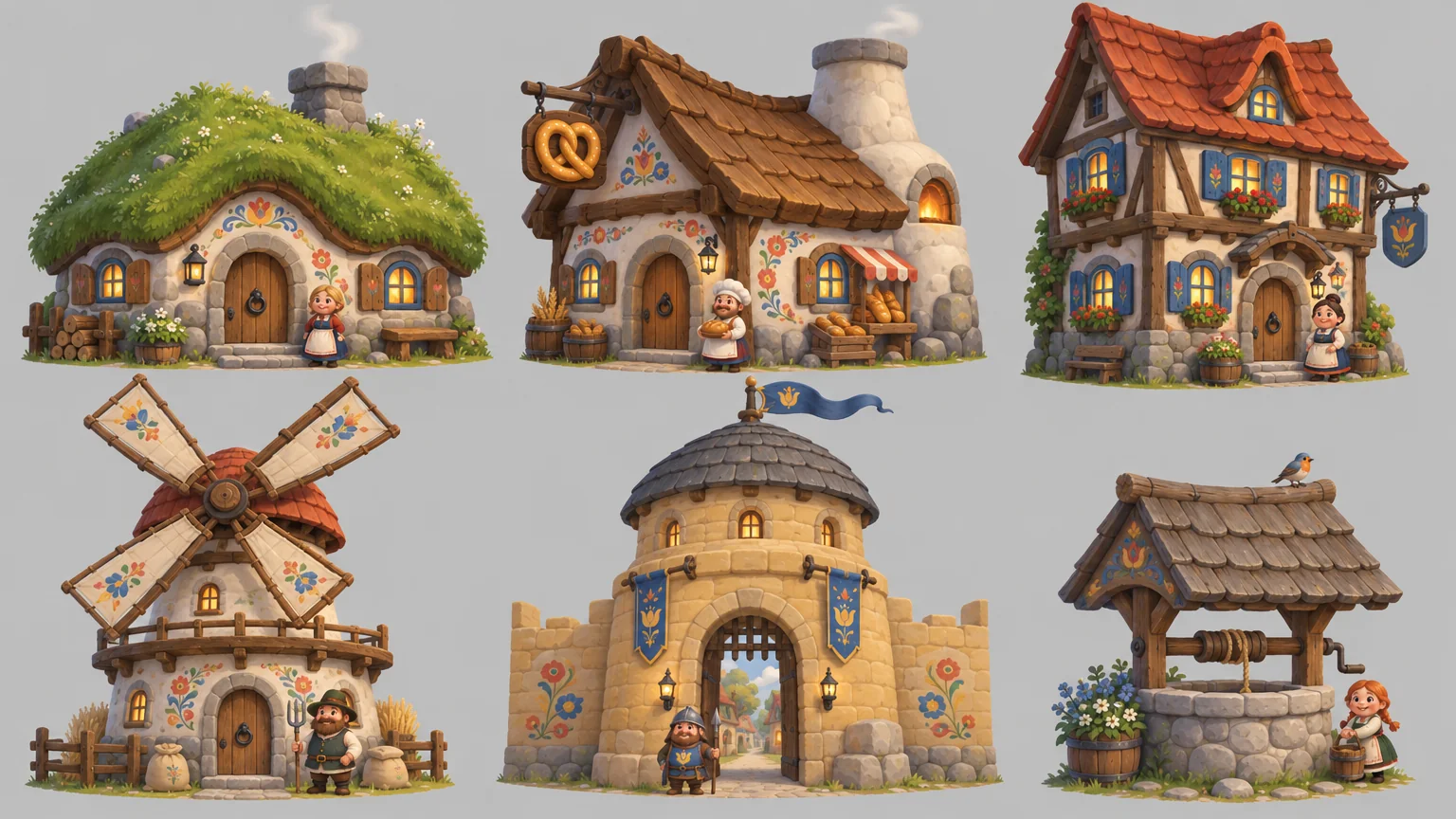
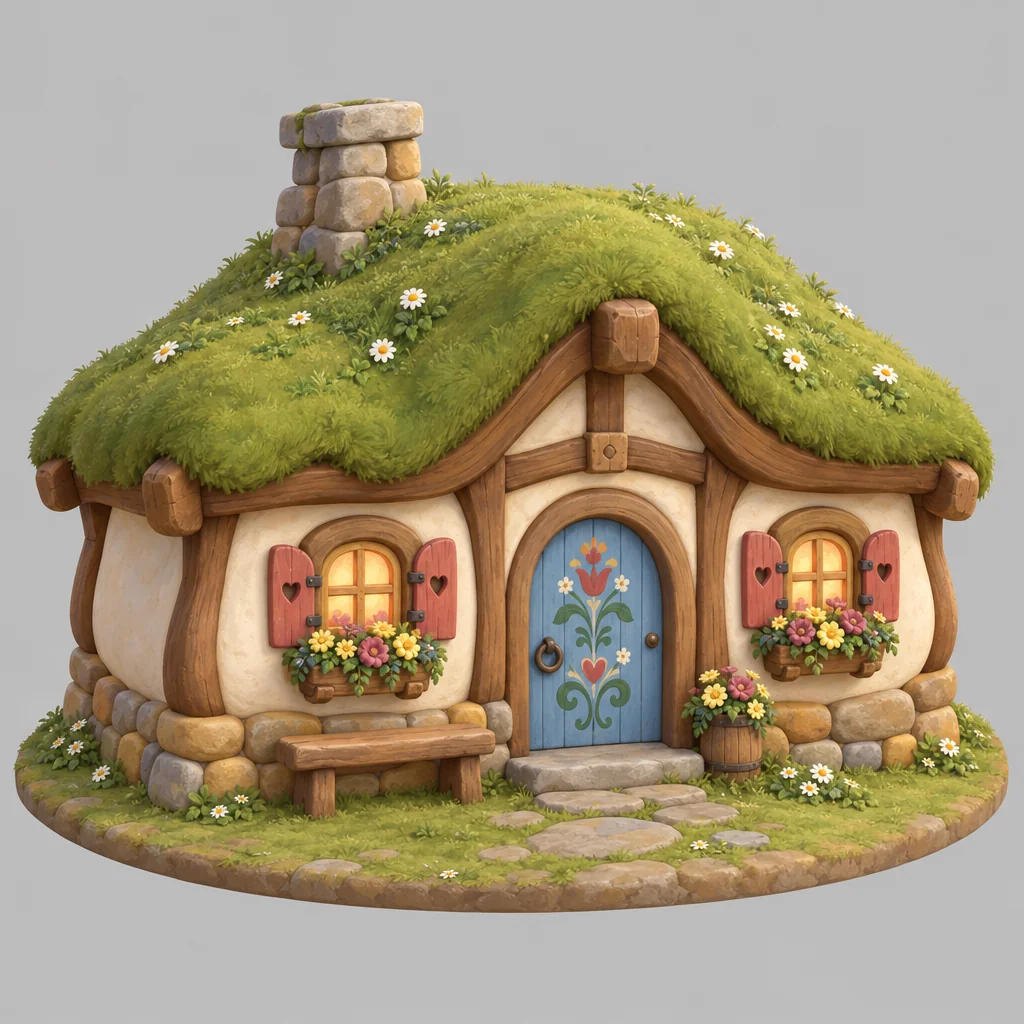
Inside:
- A cottage is as wide as it is tall (width to height 1 : 0.9–1.1); the roof is 45–55 % of the height.
- The ridge sags, the walls bulge, nothing leans (0°).
- Doors are round-topped and 1.3 × the princess's height; every window is lit.
- A foot of round honey stones up to 1/6 of the wall.
- One roof material per street (the rulebook): turf in Solengen, tile on Møllebakken.
- One door colour per building from the accents; one rosemaling ornament, on the door or the sign.
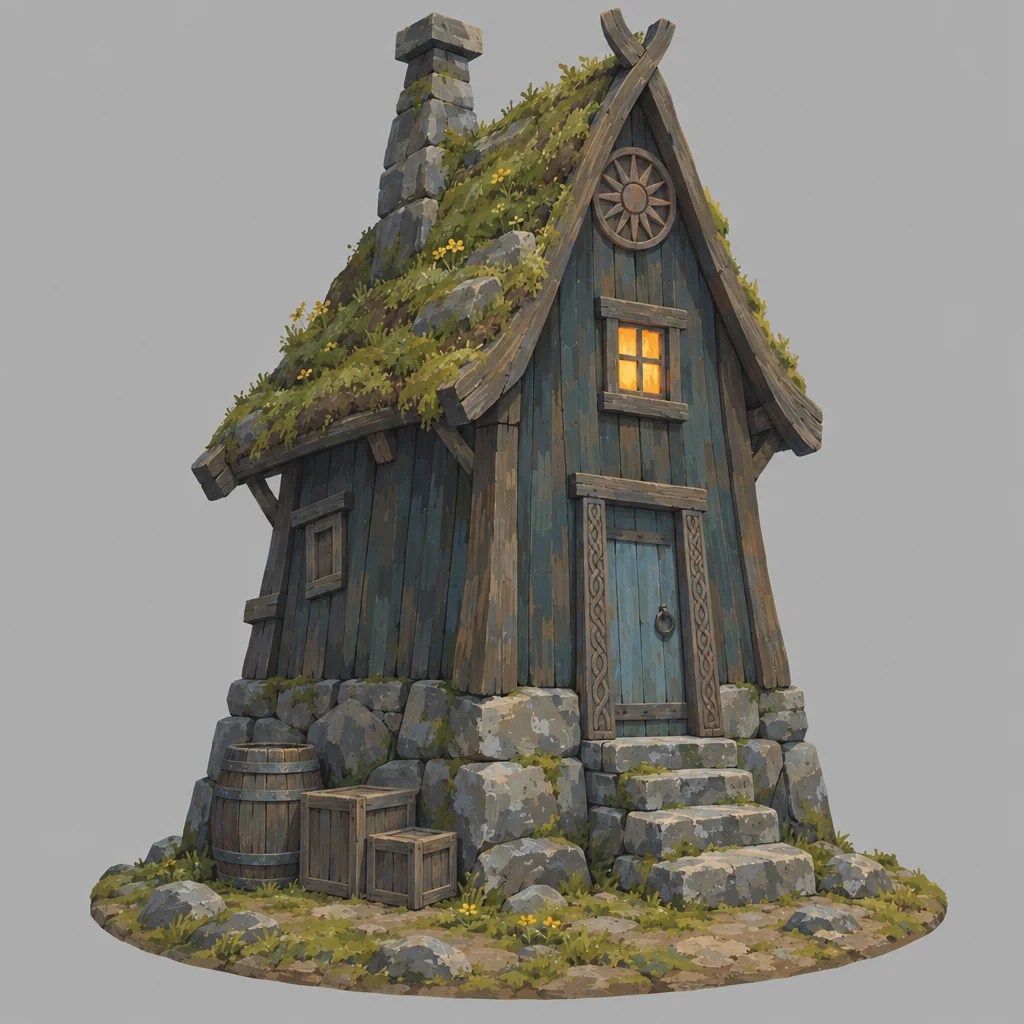
Outside:
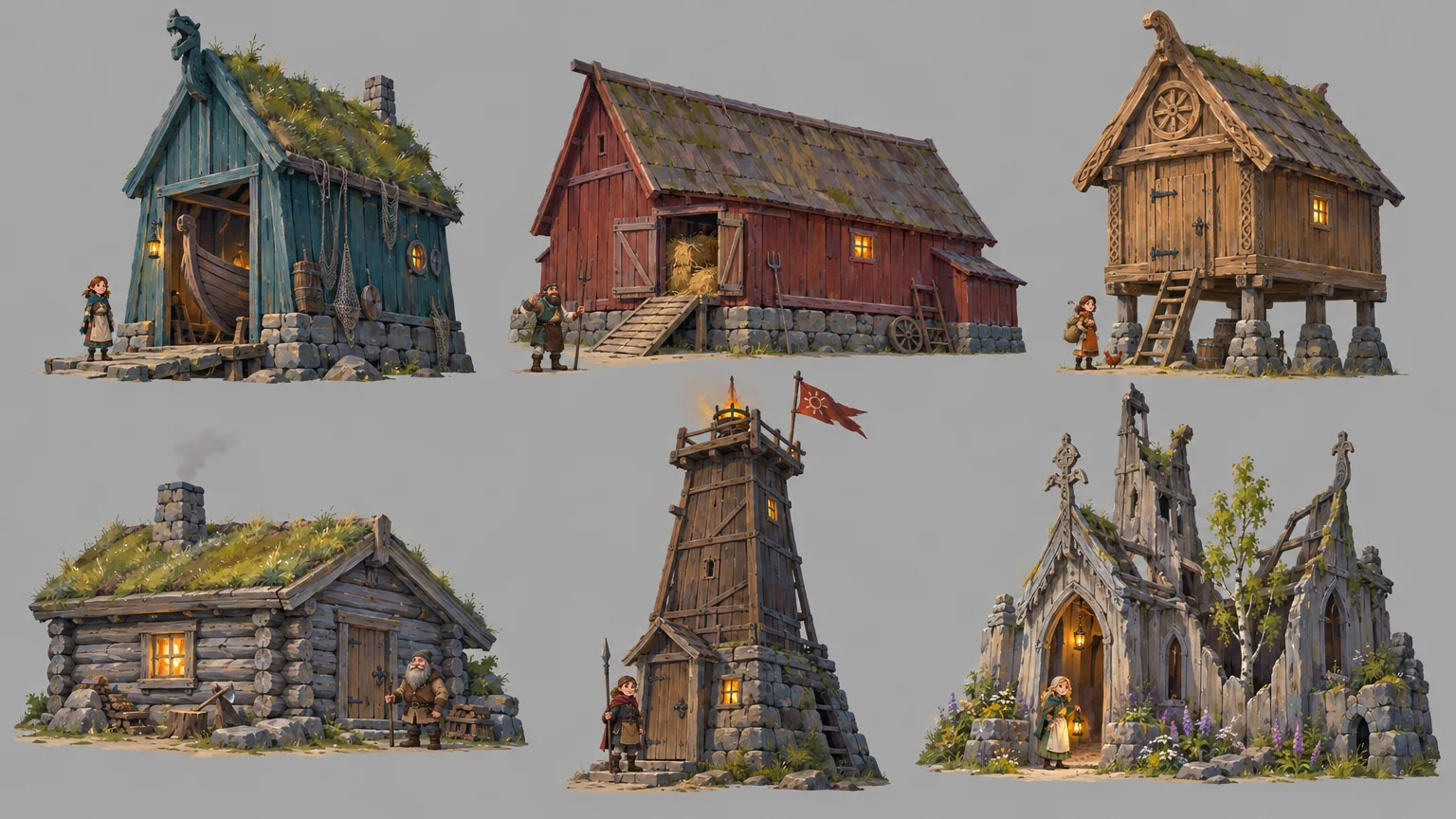
- Tall and narrow (height at least 1.4 × width) or long and low (length at least 2.5 × height). Never square.
- A foot of cold grey stone at least 1/5 of the wall's height; a roof pitch of 50° or more.
- A lean of 2–6°, away from the zone's wind.
- One colour per building from its zone's palette; mid values only (no wall under luma 0.15).
- Exactly one warm window toward the nearest way, visible from 60 m at night.
- One carved ornament, in the gable. Wear is moss, silvered wood and a mended board.
- Never: graves, spikes, broken glass, black tar, a door hanging open on darkness.
One rule per village, as docs/aaa-art.md round 5 asks:
| Village | Shape | Roof | Wall | Colour | Detail |
|---|---|---|---|---|---|
| Solengen | low dome | turf | cream plaster, timber frame | sky-blue doors | flower tubs, bunting |
| Møllebakken | tall gable | red tile | half-timber | blue frames | awnings, signs |
| Vassenden (Nordalen) | tall narrow | turf on tarred planks | upright planks on stone | slate teal | nets, creels, a boat |
| Sørgården (Sørmarka) | long low | turf or shingle | red boards on stone | barn red, cream house | hay racks, fences |
| Fjellfoten's huts | low heavy | turf | silver-grey logs | grey | woodpile, hides, an axe in a stump |
| Fjellet | stacked | stone slab | dry stone | rock grey | flag, lantern |
| Alvheim | round, in a tree | living wood | bark, moonstone | silver | rune light, hanging lanterns |
7.4 Props
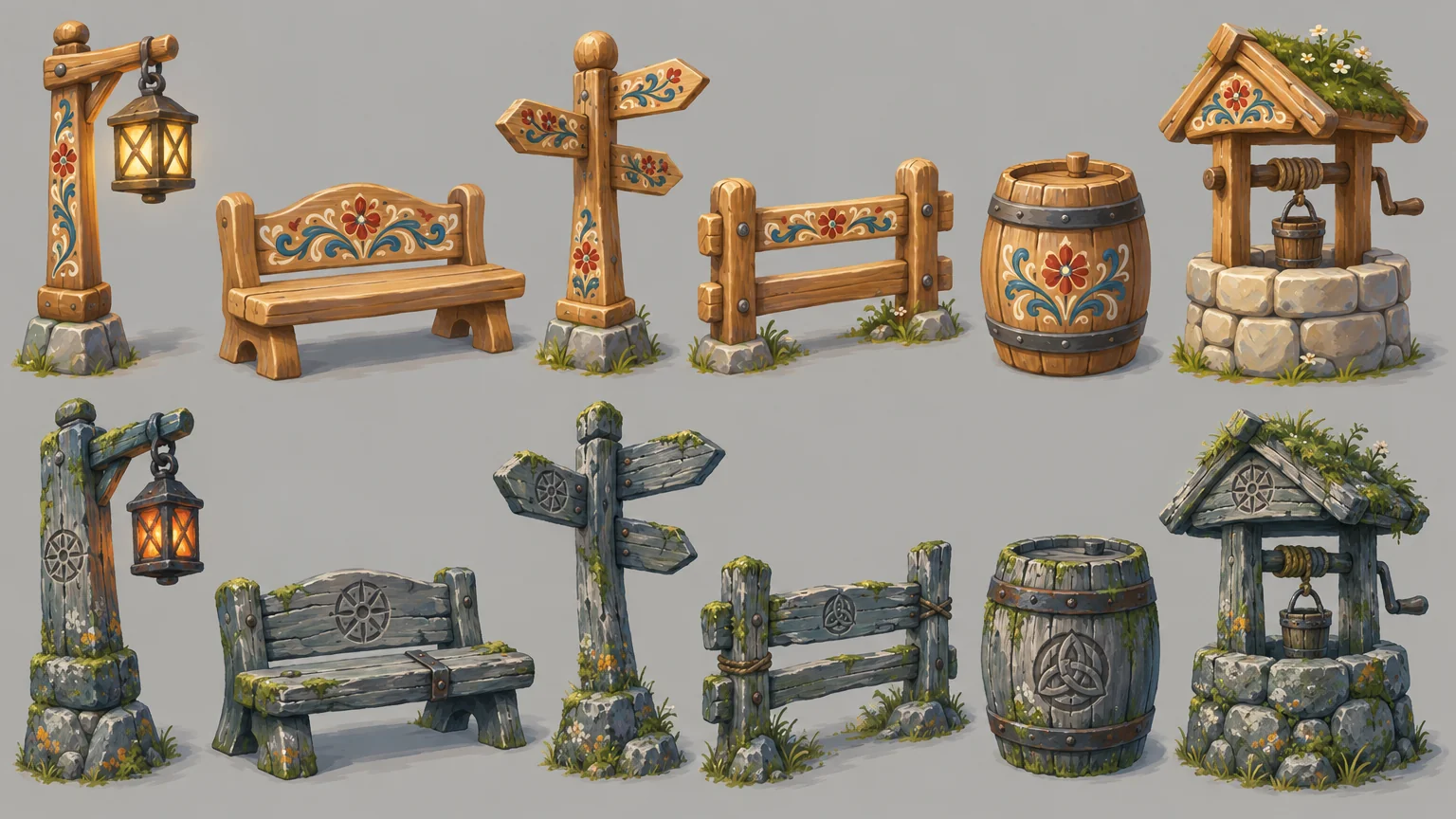
The same six props on each side. Inside: honey wood, oversized, bevelled, a painted scroll, butter light. Outside: silvered wood on a stone foot, taller, leaning a little, a carved wheel or knot, ember light. A prop outside is weathered and still in use; the sheet's lower row has more moss than a thing in daily use would.
8. Meshes
Four references were sent to zap-mesh (Pixal3D on zap); none had come back by the end of this work. Job ids,
source images and what to look for are in models/README.md. Nothing is in the 3D archive yet.
9. Checking a frame
python3 tools/frame-stats.py still.png --zone nordalenprints luma percentiles, saturation, the share under luma 0.08, the dominant colours, whether the median luma is inside the zone's value key, and how much of the frame lies within 40 RGB units of the zone's palette. The numbers in this document were measured with it on the generated frames; no still from the game has been run through it yet.
The value key separates the zones well. The palette share is a rough guide only: each frame run against all ten palettes scores highest on its own in six cases of ten. It tells warm zones from cool ones; it cannot tell Solengen from Møllebakken (the Møllebakken frame scores 51 % on Solengen's palette and 42 % on its own), Kysten from Sørvika, or Alvheim from Fjellet. For Solengen and Møllebakken that is also a finding about the art: see the neighbour rule.