The moon
Ice, black sky, Jupiter, the domes of magnetic blue, moss and its glow, and how to prompt a landscape.
Ganymede is the largest moon in the solar system: a world of blue-white grooved ice and dark old ground under a black sky, with Jupiter huge on the horizon. The game is the story of fourteen genres turning it green and loud, so the picture of the moon is always the same few things.
The ice and the sky
- Ice is blue-white and grooved, dug into terraced steps by the camps. Lit faces
#AAB6D0, calm plains#4A6CA8, shadow#32578E: one lit tone, one flat shadow tone, no gradient. - The sky is black with a few stars. Never an Earth-blue sky: it came up behind the robot in every direction of the sweep and must be asked away.
- Craters and the dark regio (the old dark ground between the ice) are not yet specified by the game's art direction and no picture has been made to test them. When one is needed, draw it in the same ink and flat colour, with a dark flat tone against the ice, and record the prompt that worked here.
- A calm, open stretch of smooth ice in soft blue shadow with very little detail is how a picture leaves room for a title.
Jupiter
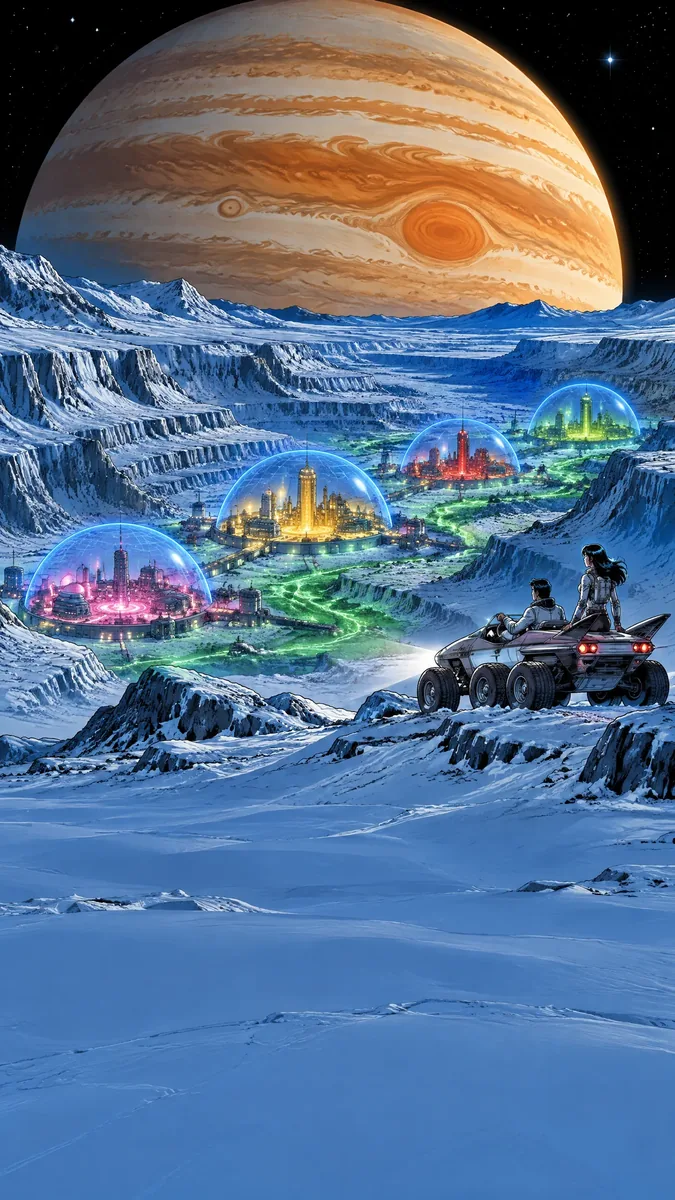
Jupiter is enormous, rising over the far ridges with its lower part hidden. It is drawn in ink: flat honey and cream bands with the ink line. It is never a photograph or a photo texture; every direction in the sweep drew it as a photo until the prompt said otherwise. The STYLE block carries the instruction ("Jupiter drawn in the same ink with flat honey and amber bands"); in the title art the bands are still richly textured, closer to a painting than to flat colour. Flatter is the target; judge a new Jupiter against the flat-band rule, not against the title art.
The domes
Each camp sits under a translucent dome of magnetic blue. The rim glows blue; the inside is lit in the camp's genre colour (pink, gold, crimson, lime in the title art). Inside: a coil tower at the centre, round habitat pods and a greenhouse. The dome is the biggest light in a camp and the thing that makes four colours sit together in one valley: the same blue rim around every one.
A camp, as the prompts word it:
a small settlement under a translucent blue magnetic dome, set in a terraced valley dug in steps into the ice, a coil tower at its centre, a social square inside it (a stage, a cafe, a bathhouse, a garden of glowing moss, people about their evening), the working buildings (power, water, solar panels, a workshop) on the ice around it, glowing moss spreading out along the low groundMoss
Bioluminescent moss #78C562 spreads from each dome in bright green threads along the valley floor and over the ice. It is the one green that glows. It marks how far a camp has terraformed, so it is drawn as threads and tufts spreading out, not as a field.
A landscape prompt
STYLE, a paragraph that names the sky, Jupiter, the ice, the domes and the moss, a composition line that says where the calm space is, TAIL. Say what is absent. The title art, whose exact prompt is in the game's art/prompts/title-wide.txt:
Title key art for the game, a wide cinematic landscape. Jupiter rises enormous over the horizon of Ganymede, its lower part still hidden behind the far ice ridges, its honey and amber bands drawn in ink, in a black starry sky. Below it runs a long valley dug in terraced steps into the blue-white grooved ice, and in the valley four camps sit under glowing translucent blue magnetic domes, each lit inside with a different hot colour (pink, gold, crimson, lime green), with threads of bright green bioluminescent moss spreading out between them along the valley floor. On a ridge in the middle distance, tiny against the scene, a chrome-finned convertible rover on six balloon tyres has its headlights on. Composition: everything of interest sits in the upper two thirds; the lower third of the picture is calm, open, smooth ice in soft blue shadow with very little detail, kept clear for the game's title.What went wrong with the title candidates, so it is asked away: the a and c candidates put large foreground figures into the scene though the prompt did not ask for them. The b candidates, with tiny figures at most, were picked. Text-to-image, 16:9 or 9:16, 2k, medium, three candidates; scaled to 1920 px on the long side as WebP under 600 KB.